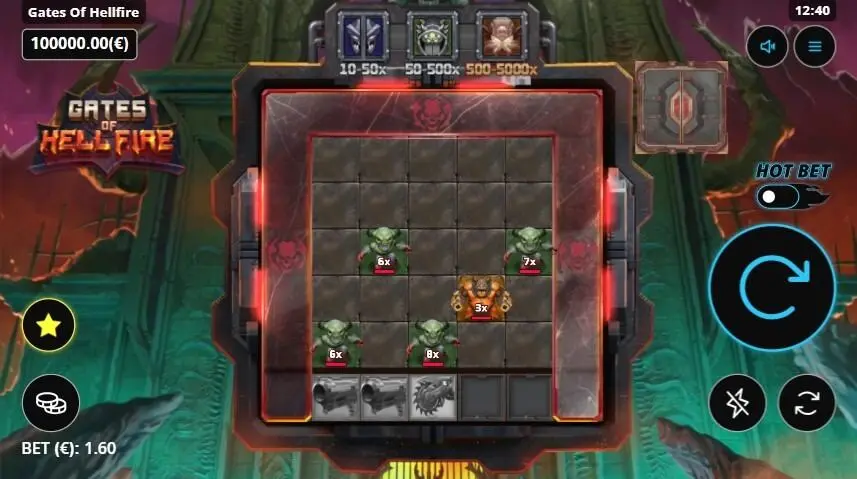
Gates of Hellfire is a Horror and scary-themed slot from Gaming Corps with a 96.02% RTP and a 5,000x ceiling. If you want a five-reel game that runs a touch above average on paper but does not publish its volatility or stake range, the gates of hellfire slot gives you a clear trade-off to weigh before you commit.
On this page you can try the free demo, check the hard numbers, and see what they imply for session length and bankroll. Nothing here predicts real-money results — every spin is independent.
Gates of Hellfire at a glance
Gates of Hellfire is listed as a Slot Machine with 5 reels and a primary theme of Horror and scary, with a secondary tag of 5-Reels. Gaming Corps has 38 titles in this data set, and this game sits at rank 1362 with a popularity percentile of 93.2, which puts it in the more-played part of the corpus but well outside the very top tier.
The headline figures are straightforward: 96.02% RTP and a 5,000x max win. No hit frequency, no volatility label and no stake limits were supplied in the facts for this title, so treat any such numbers you see elsewhere as unverified. Missing data matters — it means you cannot model swing size or bet coverage precisely before you play.
Who might it suit on paper? Players who filter first by return will note it is marginally above the averages shown below, and the 5,000x ceiling is a finite, mid-range top payout compared with ultra-high-potential games. If you prefer to know variance before you load a game, the absence of a volatility disclosure is a reason to start with the demo and keep stakes conservative until you see how the base game feels.
| Item | Detail |
|---|---|
| Game | Gates of Hellfire |
| Provider | Gaming Corps |
| RTP | 96.02% |
| Reels | 5 |
| Max win | 5,000x stake |
| Themes | Horror and scary, 5-Reels |
| Corpus average RTP | 95.71% |
| Provider average RTP | 95.76% |
| Popularity rank | 1362 (93.2nd percentile) |
| Free demo | Available |
For context, Horror and scary is a large category with 479 games in the set, so you have many alternatives if you want the same mood with different maths. If you like Gaming Corps slots generally, you can compare this to Bass Rewards Bonanza at 95.8% RTP to see how a slightly lower return changes the long-run expectation, or look at a Horror-adjacent option like Hand of Anubis at 96.24% RTP, which is a touch higher than Gates of Hellfire.
What a 96.02% RTP actually returns
RTP is a long-run statistical average, not a promise for any session. A 96.02% RTP means that for every £100 wagered, the game is designed to return £96.02 across a very large sample of spins — millions, not hundreds — with the remaining £3.98 as the theoretical house edge. Short-term results can be far above or below that line.
To make it concrete, take 1,000 spins at £1 per spin. You would have wagered £1,000 in total. At the stated RTP, the expected return across that sample is £960.20, for an expected net of -£39.80. That does not mean you will see -£39.80 on your 1,000 spins; you might be ahead or down several hundred pounds. It simply quantifies the average cost of that volume at that stake.
Because the facts do not list a minimum or maximum stake for Gates of Hellfire, the maths scales linearly with whatever stake you choose. At £0.20 per spin, 1,000 spins is £200 wagered with an expected return of £192.04. At £2 per spin, it is £2,000 wagered with an expected return of £1,920.40. The percentage stays the same; the absolute swing grows with stake and sample size.
Compared with the broader market, 96.02% sits 0.31 percentage points above the corpus average of 95.71% and 0.26 points above Gaming Corps’ own average of 95.76%. Over the same £1,000 wagered, the corpus average would return £957.10 versus £960.20 here — a £3.10 difference in expectation. That is small, but it is directionally better for the player on paper and it compounds over volume. A related title from the same provider, Delicious at 95.26%, sits below both averages, which helps illustrate how a few tenths of a point move expected return.
Remember that RTP says nothing about how returns are distributed. Two games can share 96.02% and feel completely different if one pays little and often and the other saves most of its return for rare larger hits. Without a volatility label or hit frequency for this title, use the demo to see whether returns, when they come, arrive steadily or in gaps.
Unlisted volatility and what your session will feel like
Gaming Corps has not published a volatility rating for Gates of Hellfire in the facts supplied, so there is no official low, medium or high label to anchor expectations. That absence is useful information in itself — it means you should not assume a risk profile based on theme, max win or RTP alone.
It helps to know what volatility describes in general. Low volatility typically means smaller, more frequent wins and a smoother bankroll line, which can stretch session time but rarely produces large spikes. High volatility typically means longer dry stretches with larger swings when wins land, which demands a bigger bankroll buffer and more tolerance for losing runs. Medium volatility sits between the two. These are tendencies across many slots, not features of this specific game, because this game has no disclosure to apply.
Without a published rating you can still plan sensibly. First, keep initial stakes modest while you observe how often winning combinations occur and how flat or spiky the balance feels over a few hundred demo spins. Second, set a stop point measured in spins or absolute loss rather than chasing to a target. Third, remember that every spin is independent — the game has no memory, and a losing run does not make a win more likely next spin.
The 5,000x max win tells you there is a defined ceiling, but it does not imply high or low volatility by itself. Some 5,000x games distribute much of their RTP in the base game, others concentrate it in rarer events. If you need a comparison with a known alternative at a lower return, Trickstar Spins at 94.0% RTP trades a lower percentage for whatever volatility and hit pattern it offers — the lower RTP raises the long-run cost per £100 wagered even if the session feels different.
Until Gaming Corps publishes more detail for this title, treat volatility as unknown and size your play accordingly. That is less exciting than a label, but it is more honest and it leads to better bankroll decisions.
The 5-reel layout and how wins are counted
Gates of Hellfire uses 5 reels, which is the most common layout in modern video slots. Five reels simply means five vertical columns of symbols that spin independently. The number of reels tells you the grid width, but not how wins are evaluated — that depends on the payline or ways system.
In general, slots count wins in one of two ways. Payline games evaluate wins along defined lines that run left to right across the reels, and you are usually paid for matching symbols on an active line. Ways games, often described as 243 ways or similar, pay for matching symbols on consecutive reels regardless of their exact row position. Both systems still require symbols to land on adjacent reels in most cases, but the number of possible winning positions differs substantially.
For this title the facts list reels as 5 but do not list a payline count or ways count. That means you cannot confirm from this data whether it uses fixed lines, selectable lines or a ways mechanic. Rather than guess, check the in-game paytable when you load the demo — it will state the number of lines or ways, which symbols are highest paying, and how wilds or scatters function as concepts if they are present.
What you can take from the 5-reel figure alone is mostly about session planning. Five reels with a clearly stated RTP gives you the same long-run percentage as any other five-reel game at 96.02%, but the distribution and hit rate will still vary. If you prefer a known 5-reel reference with a similar return, Book of Pirates at 96.11% is close on RTP and offers a different theme while keeping the same reel count family, so the comparison is mostly about feel rather than maths.
Stake range and sizing a bankroll
No minimum stake, maximum stake or default coin values were included in the facts for Gates of Hellfire, so a concrete bankroll table based on its limits cannot be built here. That is common with aggregator data — the limits exist in the game client but were not supplied to this review — and the right response is to be explicit about the gap.
You can still size a bankroll from first principles. Decide how many spins you want your budget to cover and work backwards. If you want 500 spins at £0.40 per spin, you need £200 of total wagering capacity, and at 96.02% RTP the long-run expected return on that volume is £192.04. If you want 300 spins at £1, the wagering volume is £300 with an expected return around £288.06 over a very large sample. These are averages — any single session will diverge.
Because volatility is also undisclosed, build in a buffer. If your preferred stake gives you only 50–100 spins of runway before your session budget is gone, a single cold stretch can end the session early regardless of RTP. Aim for a spin count that lets you sample the game’s distribution without pressuring you to chase. No betting system, progression or timing changes the RTP or the independence of each spin.
When you load the Gates of Hellfire free demo you will see the actual selectable stakes inside the game. Use that view to confirm the lowest and highest bets the implementation exposes, test the feel at the lowest setting first, and only then consider whether your real-money budget supports the stake you enjoy playing. If the demo shows a narrow range, keep expectations conservative; if it shows a wide range, size to the lower half until you have enough observations.
Playing the gates of hellfire slot demo before you commit
The facts confirm a free demo is available for Gates of Hellfire, and that is the sensible place to start given the missing volatility and stake-range data. The Gates of Hellfire free demo lets you open the paytable, verify how wins are counted on the 5 reels, and get a feel for cadence without spending. It needs no download in most implementations and runs the same 96.02% maths as the real-money version, but demo play does not predict real-money results — short-term outcomes remain random and high-variance sessions in demo do not mean the game is primed to pay.
Use the demo with intent. Run a block of spins at a single stake and note how often you see any return, how large the largest win in that block is relative to stake, and how many spins you can cover before a set loss limit would be reached. That exercise replaces guesswork about volatility with direct observation, even though it still cannot reveal the long-run distribution.
Keep play as entertainment with a clear budget. You must be 18+ to gamble in the UK. Set a deposit or loss limit before you start, never chase losses, and treat any money wagered as the cost of entertainment, not an investment. If you need support or want tools to manage play, GamCare and GambleAware offer free, confidential help and practical limit-setting options. Ending a session on time is a normal part of a healthy approach, whether you are ahead or behind.
Verdict: who should play Gates of Hellfire
Gates of Hellfire makes sense if you want a Horror and scary 5-reel game with a return that is modestly above both the provider and corpus averages and a capped 5,000x top payout. The 96.02% RTP is a small but genuine plus on paper versus the 95.71% corpus baseline, and the theme enjoys deep choice with 479 alternatives if you later want a different volatility or feature mix.
It is less suitable if you need a fully disclosed risk profile before you play, because volatility, hit frequency and stake limits were not supplied here. In that case use the free demo first, compare a known alternative such as Hand of Anubis at 96.24% or Bass Rewards Bonanza at 95.8% to feel how a slightly higher or lower RTP interacts with different distributions, and only commit a bankroll that comfortably supports several hundred spins at your chosen stake.
Frequently Asked Questions
Can I play Gates of Hellfire for free without risking real money?
Yes, the facts confirm a free demo is available for Gates of Hellfire. You can load it with no download in most browsers, check the paytable and try the 5-reel layout at 96.02% RTP. Demo credits have no cash value and demo results do not predict real-money outcomes.
What is the RTP of Gates of Hellfire and what does it mean for my session?
Gates of Hellfire has a 96.02% RTP, meaning it is designed to return £96.02 per £100 wagered across a very large sample. For 1,000 spins at £1, that is £960.20 back on £1,000 staked on average. Short-term results vary widely because every spin is independent.
What volatility is Gates of Hellfire and how risky is it?
No volatility rating was supplied for Gates of Hellfire, so its risk profile is officially unlisted. Volatility shapes how often and how large wins tend to be, with high volatility bringing bigger swings. Until a rating is published, keep stakes modest and use the demo to observe the game’s cadence.
Who makes Gates of Hellfire and what else do they offer?
Gates of Hellfire is made by Gaming Corps, which has 38 games in this data set and an average RTP of 95.76%. Other titles from the studio include Bass Rewards Bonanza at 95.8%, Book of Pirates at 96.11% and Delicious at 95.26%, giving you nearby points of comparison on return.
What stake range and max win does Gates of Hellfire have, and how should I size a bankroll?
The max win is 5,000x your stake, so a £1 stake could return up to £5,000 on a capped win. No minimum or maximum stake was supplied, so size a bankroll by spins: 500 spins at £0.40 needs £200 wagered. Build a buffer because volatility is unknown and each spin is independent.