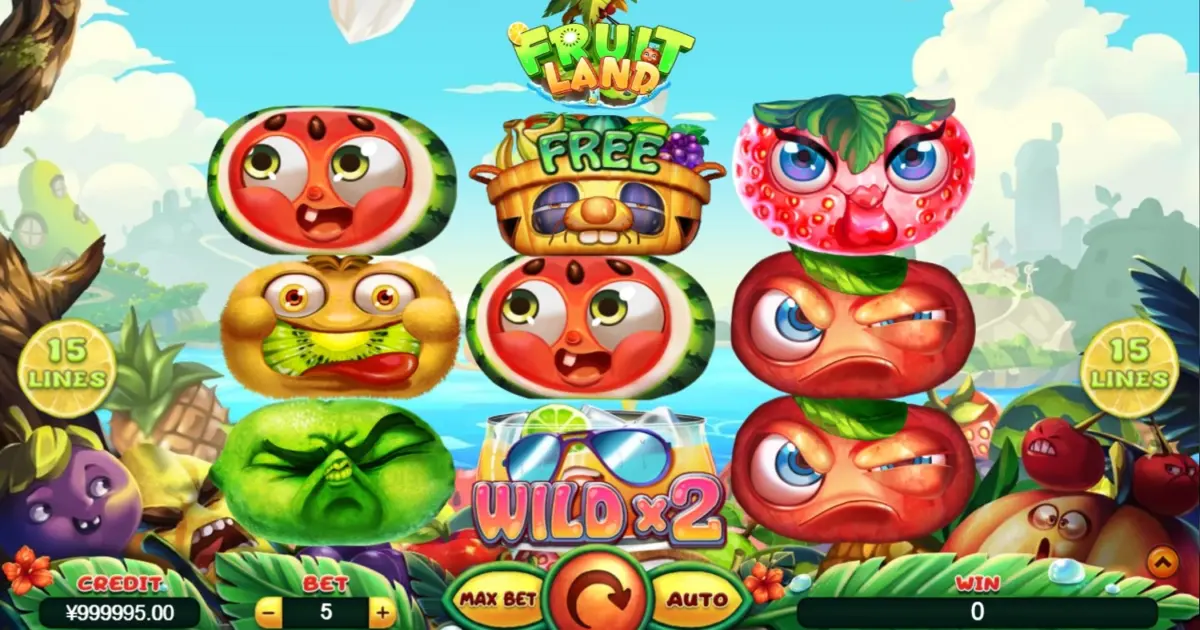
Fruit Land slot by FunTa Gaming presents a genuine problem for anyone comparing games before they spin: no return-to-player percentage has been published. That single missing number undercuts most of what you would normally use to judge a slot, so this review works with what is available and states clearly where the gaps are.
What we can confirm is the structure — 3 reels, a fruits theme, and a slot-machine subcategory — along with a popularity rank that places it in the 95th percentile across the review corpus. Those facts narrow the field somewhat, but they do not substitute for the math that matters most to your session. If you are searching for a fruit land slot with transparent numbers, you need to understand what you are working with and what you are not.
Fruit Land versus the average slot
Without an individual RTP figure for Fruit Land, the only reliable comparison comes from FunTa Gaming’s portfolio average. That studio’s games carry an average RTP of 96.33%, which sits 0.62 percentage points above the broader corpus average of 95.71%. If Fruit Land tracks that portfolio mean, you would expect a roughly 96.3% return across a very large sample of spins — meaning approximately £96.30 returned for every £100 wagered over hundreds of thousands of rounds.
The gap between those two averages sounds small. In practice it is not. A 0.62-point difference compounds across a session of several thousand spins, shifting the theoretical house edge from about 4.29% down to roughly 3.67%. That is a meaningful improvement for a player’s long-run expectancy, and it is exactly the kind of margin that makes provider averages worth checking before you commit time to a new title.
Fruit Land’s popularity percentile of 95.3 tells you the game is played more often than about 95% of titles in the corpus, which is unusual for a slot with no published RTP. Either the game is popular despite its opacity, or data exists that has not reached this particular review database.
| Provider | FunTa Gaming |
|---|---|
| Reels | 3 |
| Theme | Fruits |
| Free demo | Yes |
RTP breakdown: no published figure in context
No RTP has been published for Fruit Land by FunTa Gaming. This is the single most important fact in this review, and it should change how you treat the game relative to others where the number is available. RTP is not a cosmetic stat — it is the primary input in every long-run calculation a player can make about expected return.
Without it, you cannot determine how Fruit Land compares to other games on a like-for-like basis, you cannot model your expected loss per hour at a given stake, and you cannot verify whether the provider’s portfolio average actually applies to this specific title. Many operators publish RTP per game because regulators or internal policy require it; the absence here could reflect the studio’s disclosure practices, a missing data feed, or a game that predates current reporting standards.
General RTP maths still holds regardless. A 96% RTP does not mean you lose exactly 4% of your session budget — it means that across tens of thousands of spins, the average return converges toward 96. Individual sessions can swing far above or below that line. With no figure for this game, even that framework cannot be applied concretely, which is why the gap matters.
Volatility profile
Volatility is not specified for Fruit Land in any available data source. This is a second significant gap, and together with the missing RTP it means you are effectively going in blind on both the size and the frequency of potential returns.
In general terms, 3-reel slots often lean toward lower volatility because fewer reels and simpler mechanics tend to produce smaller wins more frequently. That is a pattern observed across the genre, not a confirmed characteristic of this specific game. Some 3-reel titles carry high volatility by paying rarely but heavily, and without a published variance label for Fruit Land you cannot rule that out.
The practical consequence for your bankroll planning is clear: if you cannot estimate volatility, you cannot set a stake that matches your risk tolerance. High-volatility games require larger session budgets to survive dry spells; low-volatility games return more often in smaller amounts. Playing a game with unknown volatility means you are betting partly on the maths and partly on chance, and the chance side carries no informational advantage for you.
FunTa Gaming as a studio
FunTa Gaming operates a catalogue of 67 titles with a portfolio average RTP of 96.33%. That places the studio modestly above the market-wide mean, though a 0.62-point margin is not dramatic. What the number does tell you is that when FunTa does publish RTP, it generally sits in a competitive band. Two of its other titles with available data reinforce this: DJ Rabbit carries a 96.54% RTP, which is slightly above the studio’s own average and comfortably above the corpus baseline of 95.71%. If you are drawn to FunTa’s catalogue but want confirmed numbers, that title gives you a concrete figure to work with.
Another studio title, Laughing Maitreya, also lacks a published RTP — which suggests the disclosure gap may be a pattern rather than an anomaly specific to Fruit Land. For a reader evaluating FunTa’s output, the lesson is straightforward: check for published numbers on each title individually, because the studio’s average does not guarantee that any particular game’s figure is available.
Three Fruits alternatives worth comparing
The Fruits theme spans 2,560 games in the corpus, giving you a wide field to search. Three titles stand out as direct comparisons to Fruit Land on a structural basis, each offering something the review of Fruit Land cannot.
Hot Hot Fruit carries a 96.84% RTP — well above both the corpus average and FunTa’s portfolio mean. If transparent numbers are your priority and you want the fruits format, that figure gives you a concrete edge to plan around. The gap between 96.84% and the unknown value for Fruit Land could range from negligible to significant, and you cannot know which without the data.
Trickstar Spins sits at 94.0% RTP, which is 1.71 points below the corpus average. That is a genuinely poor return for the player, and it illustrates why the missing number on Fruit Land matters: without one, you do not know which side of that spectrum this game falls.
Sevens High is another fruits-genre title, though its RTP is also unpublished, so it shares Fruit Land’s core limitation.
Getting the most out of the free demo
A Fruit Land free demo is available, and that is genuinely useful here. Since no RTP or volatility figure has been published, the demo is your only tool for forming any impression of how the game behaves. You can play Fruit Land free of cost to observe win frequency, the size of payouts relative to your stake, and the rhythm between dry stretches and smaller hits. None of that produces a statistically valid measurement — a few hundred spins tell you almost nothing about long-run returns — but it does let you rule the game out if the feel does not match your preferences.
If you move from demo to real-money play, set a fixed budget before you start and treat any losses as the cost of entertainment rather than an investment to recover. The demo does not predict real-money results, and independent spins carry no memory of what came before. Players must be 18 or older to gamble, and if you find yourself chasing losses or extending a session beyond what you planned, that is a clear signal to stop.
Should you play Fruit Land?
Fruit Land slot is a difficult recommendation to make with confidence. Its 95th-percentile popularity suggests many players enjoy it, and the 3-reel fruits format has a long, proven appeal. But the complete absence of both RTP and volatility data means you cannot assess whether this game offers a competitive return or a reasonable risk profile. You are effectively choosing a slot on vibes and reel count alone.
If transparency matters to you — and it should, since those two numbers carry most of the decision weight — start with a game that publishes both. The fruits theme offers thousands of alternatives where the data exists. Use the demo to evaluate the experience, but let the math guide which demos you spend your time on.
Frequently Asked Questions
What is the RTP of Fruit Land slot?
FunTa Gaming has not published an individual RTP figure for Fruit Land. The studio's portfolio average across its 67 games sits at 96.33%, which is above the 95.71% corpus-wide average, but no game-specific number has been confirmed for this title. Treat any RTP you see quoted elsewhere with caution until a verified source is available.
Can you play Fruit Land for free without downloading anything?
Yes, a free demo of Fruit Land is available. The demo runs directly in your browser with no download required, letting you observe the 3-reel mechanics and win rhythm before deciding whether to play for real money. However, demo results do not predict real-money outcomes, as each spin is an independent event regardless of mode.
What volatility does Fruit Land have?
No volatility rating has been published for Fruit Land. In general, 3-reel slot formats often trend toward lower volatility, producing smaller wins more frequently, but some 3-reel titles carry high variance by paying rarely and heavily. Without a confirmed label, you cannot plan your stake or bankroll around a known risk profile.
How does Fruit Land compare to Hot Hot Fruit?
Hot Hot Fruit carries a published RTP of 96.84%, while Fruit Land has no individual RTP available. That 1.13-point gap above the corpus average of 95.71% gives Hot Hot Fruit a measurable long-run advantage over an unknown target. If comparable numbers matter to your choice, Hot Hot Fruit is the more transparent option.
Who makes Fruit Land and what else do they produce?
Fruit Land is developed by FunTa Gaming, a studio with 67 titles in its catalogue. Related games from the same provider include DJ Rabbit, which publishes a 96.54% RTP, and Laughing Maitreya, which also lacks a confirmed figure. FunTa's portfolio averages 96.33% RTP across its output, placing it modestly above the market baseline.