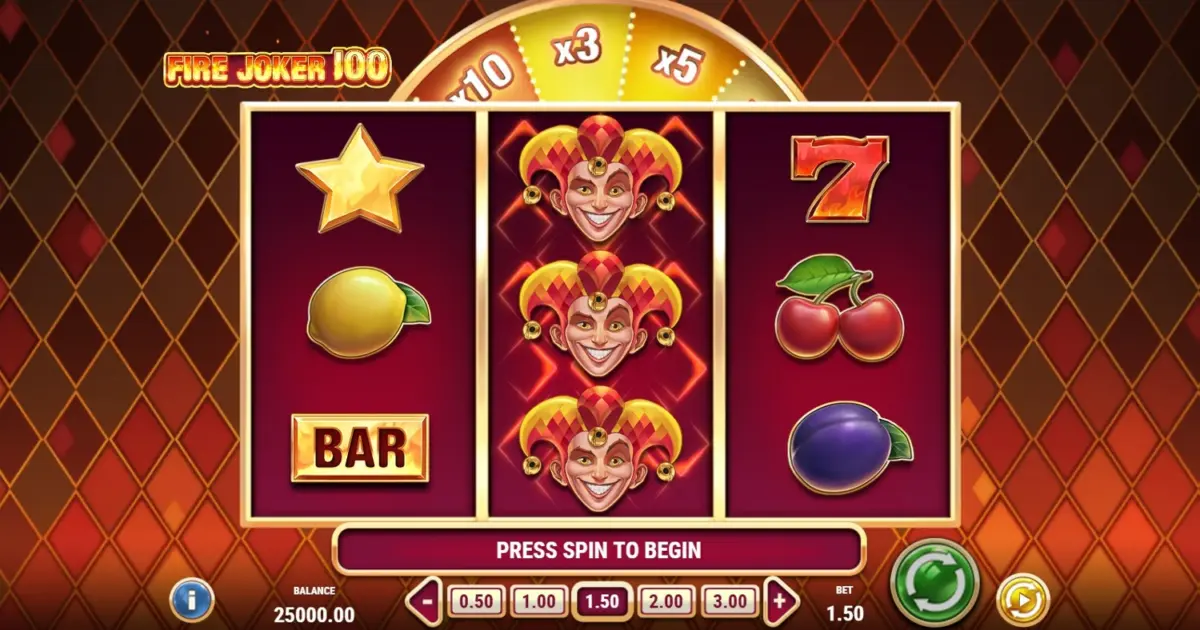
The headline number on this game is 94.21%, and it is the number worth pausing on. That sits about 1.5 percentage points below the 95.71% average across the slots catalogued here, and below Play’n GO’s own 95.8% average across 434 titles. If you care about published return figures, that gap matters more than anything else on this page.
First look at the Fire Joker 100 slot
This is a three-reel machine from Play’n GO, filed under the Fruits and 3-Reels themes and classed as a slot machine. It sits at rank 2029 in the popularity data, which places it in the 89.8th percentile — busier than roughly nine in ten of the games tracked here, so plenty of people are loading it.
What is not published is just as relevant. There is no official volatility rating, no stake range, no max win figure, no payline or ways count, and no hit frequency in the available data. That means any specific claim you read elsewhere about a maximum multiplier or a bonus round on this title is not traceable to a published source. A free demo is available, which is the cheapest way to see the reels turn for yourself.
| Figure | Detail |
|---|---|
| Game | Fire Joker 100 |
| Provider | Play’n GO |
| RTP | 94.21% |
| Reels | 3 |
| Themes | Fruits, 3-Reels |
| Type | Slot machine |
| Popularity rank | 2029 (89.8th percentile) |
| Provider average RTP | 95.8% across 434 games |
| Catalogue average RTP | 95.71% |
| Free demo | Available |
How a round plays out
Three reels is the defining structural fact here. With a three-reel grid there is far less real estate than on a five-reel game, so outcomes tend to resolve quickly and the result of a spin is usually obvious at a glance. That is a general property of the format, not a claim about this particular title’s paytable.
Beyond the reel count, the mechanics are not documented in the data available. Many fruit-themed three-reel games in this category lean on wilds, respins or a small set of high-value symbols, and many modern releases add free-spin rounds or a buy-feature option — but none of that is confirmed for this game, so treat those as genre patterns rather than features you should expect. The demo will answer the question in about thirty seconds.
One thing is certain regardless of mechanics: each spin is generated independently. Nothing carries over from the last round, and no sequence of results makes the next one more or less likely.
Reading the 94.21% return figure
RTP is a long-run average, not a session forecast. 94.21% RTP means the game is modelled to return £94.21 for every £100 wagered across an enormous number of spins — millions, not hundreds. Over 1,000 spins at £1 a spin, £1,000 staked carries a modelled house edge of £57.90, but actual results at that sample size scatter widely around it in both directions.
The comparison is where it gets useful. At 94.21% the modelled cost per £100 staked is £5.79. At the catalogue average of 95.71% it is £4.29. At Play’n GO’s own portfolio average of 95.8% it is £4.20. So this title is priced roughly a third more expensive per unit staked than a typical game in its own maker’s range.
If that matters to you, Play’n GO publishes higher figures elsewhere — Legacy of Dead is listed at 96.58%, which cuts the modelled cost per £100 to £3.42. Same studio, different maths.
Why unpublished volatility changes your bankroll maths
No volatility rating is published for this game, and that absence has practical consequences. Volatility describes how results are distributed around the RTP: low-volatility games pay small amounts often and produce long, steady sessions; high-volatility games pay rarely and larger, which means longer dry stretches and much wider swings from the same stake.
Two games can share an identical RTP and feel completely different. A low-volatility 94.21% title would grind your balance down fairly smoothly. A high-volatility 94.21% title could take your balance to zero quickly, or occasionally deliver a result well above your stake, with the same long-run average underneath.
Without a rating, you cannot size a bankroll to the game’s swing profile in advance. The workable approach is to assume wider swings than you would like, and to size stakes so that a run of dead spins does not end the session immediately. The demo is genuinely useful here: it shows you the shape of the variance without costing anything, even though demo results tell you nothing about what real-money sessions will do.
Bet sizing when the stake range is unpublished
No minimum or maximum stake is listed in the data for this title, so the numbers below are a method rather than a set of limits. Check the actual range in the game itself before you commit.
Work backwards from a budget and a session length instead of from the stake. Decide what you are willing to spend — say £40 — and how long you want it to last. At £0.20 a spin that is 200 spins before the budget is theoretically exhausted at full loss, and at 94.21% RTP the modelled cost of those 200 spins is £2.32. At £2 a spin, the same £40 covers 20 spins and carries a modelled cost of £23.20 per 200 spins. Stake size does not change the percentage; it changes how fast the percentage is applied.
No staking pattern alters expected value. Raising stakes after losses, lowering them after wins, or waiting for a “quiet” period changes nothing about the underlying probabilities. The only variables you actually control are stake size and how long you play.
Where Fire Joker 100 sits among Fruits slots
Fruits is a crowded category — 2,560 games carry the theme in this catalogue — so the return figure is one of the few clean ways to separate them. On that measure this game is toward the back of the field.
Hot Hot Fruit is listed at 96.84%, which is 2.63 points higher: £3.16 modelled cost per £100 staked against £5.79 here. If you want the same fruit furniture at a lower modelled cost, that is the straightforward swap. Trickstar Spins sits at 94.0%, slightly below this game, so it is a comparison rather than an upgrade. Sevens High has no published RTP at all in the data, which is worth knowing before you play it — an unknown return is a weaker position than a known low one.
Popularity does not track return here. This title’s 89.8th-percentile ranking tells you it gets played a lot, not that it pays back more than its neighbours.
The honest verdict
The case for playing this one is the format and the familiarity: three reels, fruit symbols, quick resolution, and a studio with 434 titles behind it. The case against is arithmetic. 94.21% is 1.5 points below the catalogue average and 1.59 below Play’n GO’s own average, and with no published volatility rating, stake range or max win you are also buying it partly blind.
If you specifically want this game, the free demo costs nothing and shows you the mechanics the data does not document. If you are choosing between fruit machines on the numbers, higher-RTP options in the same theme are easy to find and listed above.
Play only if you are 18 or over. Set a budget before you start, treat the money as the price of entertainment rather than an investment, and stop when the budget is gone. Demo play is free and carries no risk, but it also cannot pay real money and does not predict what a real-money session will do.
Frequently Asked Questions
Can you play Fire Joker 100 for free?
A free demo is available for this title, so you can spin it with virtual credits and no deposit. The demo shows the three-reel layout and how rounds resolve, which is useful because the volatility rating and stake range are not published. Demo results are not convertible to cash and do not forecast real-money outcomes.
What is the RTP of Fire Joker 100 and is it good?
The published RTP is 94.21%, which is below average. That models a return of £94.21 per £100 wagered across a very large sample, a house edge of £5.79 per £100. The catalogue average is 95.71% and Play'n GO's own portfolio average is 95.8%, so this title costs roughly a third more per unit staked than typical.
How volatile is Fire Joker 100?
No volatility rating is published for this game, so treat any figure you see quoted elsewhere with caution. Without it you cannot match bankroll to swing size in advance. The safer assumption is wider swings than you expect, with stakes sized so a run of dead spins does not end the session immediately.
Who makes Fire Joker 100 and what else do they produce?
Play'n GO developed it, and the studio has 434 titles in this catalogue with an average published RTP of 95.8%. Their range includes Book of Dead at 94.25%, Legacy of Dead at 96.58% and Divine Divas at 96.25%, so return figures across their Play'n GO slots vary by well over two percentage points.
How does Fire Joker 100 compare with Hot Hot Fruit?
Hot Hot Fruit publishes 96.84% against 94.21% here, a gap of 2.63 points. In cash terms that is a modelled £3.16 cost per £100 staked versus £5.79. Both sit in the Fruits category, which covers 2,560 games in this catalogue, so on published return alone Hot Hot Fruit is the cheaper option to play.