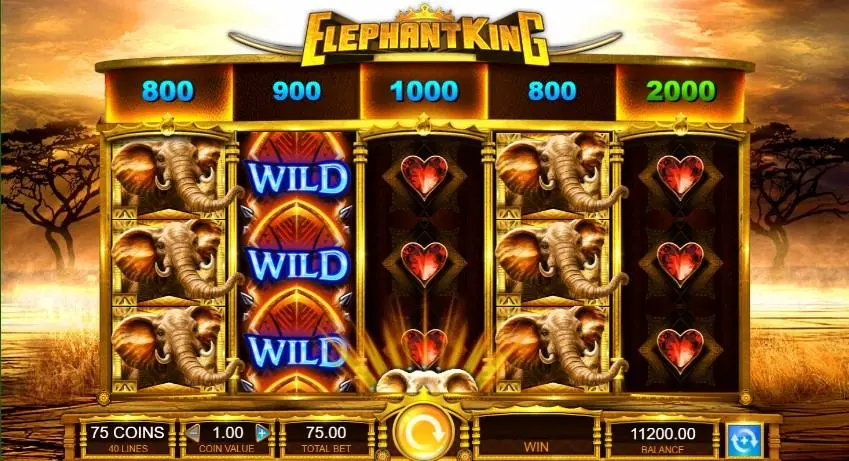
Should you bother with the elephant king slot? If you are hunting for a game whose theoretical return beats the market average and you value IGT’s long history of producing stable, well-tested software, Elephant King clears that bar comfortably. The game’s 96.02% RTP places it above both IGT’s own catalogue average and the broader corpus average, though the absence of published volatility and stake data means you are walking in with less information than you might like.
Elephant King at a glance
Elephant King is an IGT slot that runs across 5 reels and carries an animal theme. IGT has produced 114 slots in total, and this title sits at popularity rank 1572 with a 92.1st percentile ranking — solid, not spectacular, but comfortably in the upper tier of the corpus by that metric.
| Attribute | Value |
|---|---|
| Provider | IGT |
| RTP | 96.02% |
| Reels | 5 |
| Theme | Animals |
| Free demo | Available |
| Popularity percentile | 92.1 |
| Volatility | Not published |
| Paylines / Ways | Not published |
| Stake range | Not published |
Two important data gaps: IGT has not published a volatility classification or a stake range for this title. That means you cannot plan a session around a known risk profile or confirm minimum and maximum bets without checking a specific operator’s configuration. If you want the same provider’s catalogue context, Cleopatra is IGT’s most recognised slot and runs at 95.02% RTP, a full percentage point below Elephant King.
What a 96.02% RTP actually returns
RTP stands for return to player, and it is a long-run statistical average calculated across millions — often hundreds of millions — of simulated spins. It does not predict what happens in any single session. A 96.02% RTP means that, across an astronomically large sample, the game returns 96.02 units for every 100 wagered. The house edge is 3.98%.
Work it through a concrete example. Suppose you spin 1,000 times at a £0.20 stake per spin. You wager £200 total. The theoretical return is 96.02% of £200, which is £192.04. You would expect to finish with £7.96 lost across those 1,000 spins, though the actual outcome of any specific 1,000-spin block can vary enormously around that mean.
IGT’s provider average across 114 titles is 95.64%, so Elephant King outperforms its own house catalogue by 0.38 percentage points. The corpus-wide average for all reviewed slots is 95.71%, making Elephant King 0.31 points above market median. Neither gap is large — over a single evening of play, a 0.3-point RTP difference is imperceptible. Over a year of casual play, it translates to roughly £6 saved per £2,000 wagered compared to the average game.
Elephant King’s volatility and what your session will feel like
IGT has not published a volatility classification for Elephant King. This is a genuine gap because volatility determines the shape of your session far more than RTP does. RTP tells you how much comes back; volatility tells you when and in what sizes.
Without a stated volatility, you must infer risk from the provider’s typical design patterns or accept uncertainty. IGT produces games across the full spectrum. Da Vinci Diamonds, another IGT 5-reel title, is widely regarded as medium volatility; Elephant King could share that profile or sit elsewhere.
If the game turns out to be low volatility, expect frequent small wins, a relatively stable balance over time, and limited swing. Your bankroll stretches further, but you rarely see a single spin transform your session. Medium volatility balances hit frequency against win size — modest swings, occasional spikes. High volatility produces long dry stretches punctuated by rare large outcomes, demanding a bigger bankroll and a willingness to absorb variance without chasing it.
Because you cannot classify Elephant King’s volatility in advance, treat your first real-money session as information gathering. Start small, observe how often you hit versus how large those hits are, and let the pattern tell you which of the three profiles above the game actually fits.
The 5-reel layout and how wins are counted
Elephant King uses a 5-reel configuration, which is the dominant format in modern video slots. Five reels offer more symbol positions than the classic three, increasing the number of possible outcomes per spin and giving designers more room for features and scatter logic.
The payline or ways structure for Elephant King is not published in the data available here. That matters because how wins are counted directly affects both hit frequency and the theoretical combinations available. A fixed-payline game might evaluate 20 or 25 lines; a ways game counts adjacent matching symbols regardless of line position, often yielding hundreds of winning paths. Without knowing Elephant King’s mechanic, you cannot estimate how often a spin will produce a qualifying pattern.
What you can say: the game carries an animal theme, and IGT’s 5-reel output tends to favour either fixed-payline or cluster approaches over Megaways-style expanding reels. If you specifically prefer the expanding-ways mechanic, compare Elephant King with Apex Strike Megaways, which uses that system and sits at 96.13% RTP.
Stake range and sizing a bankroll
No minimum or maximum stake for Elephant King appears in the available data. Stake limits are typically set by the operator rather than the provider, so ranges can differ between casinos even for the same game.
The general principle for sizing a bankroll around an unknown-volatility game: set your per-spin stake so that your total session budget covers at least 200–300 spins. At 300 spins, even a medium-volatility slot is likely to produce a few meaningful wins, giving you a fair impression of the game’s rhythm before you commit more. If you later discover the game is high volatility, extend that minimum to 500 spins.
The math is simple. Budget divided by planned spins equals maximum per-spin stake. A £60 budget across 300 spins allows £0.20 per spin. A £100 budget across 200 spins allows £0.50 per spin. Choose the configuration that matches how much of your entertainment budget you are willing to allocate to a single session, and stop when that budget is spent regardless of where the balance sits.
Playing the Elephant King demo before you commit
A free demo version of Elephant King is available, and you should use it. Demo play lets you observe the spin cadence, the frequency of qualifying patterns, and the general feel of the game without any financial exposure. It also lets you test whether the animal theme and 5-reel presentation hold your attention — an underrated factor when you are evaluating a slot you might play across multiple sessions.
What demo play cannot do: predict your real-money results. The RTP applies to the underlying math model regardless of whether you are playing credits or cash, but 100 demo spins are far too small a sample to draw any conclusion about return. You are observing the game’s personality, not auditing its maths.
If you eventually move to real money, treat Elephant King as paid entertainment with a fixed cost. Set a budget before your first spin, keep it separate from money you need for anything else, and stop the session when the budget is gone. The 96.02% RTP is not a promise — it is the house’s long-run calculation, and individual sessions will diverge from it in both directions. Players should be 18 or older; if gambling stops feeling like entertainment, that is the signal to stop.
Verdict: who should play the Elephant King slot
Elephant King suits players who prioritise a slightly-above-average RTP and a familiar 5-reel structure from an established provider, and who do not need their volatility profile spelled out before they spin. The 96.02% figure is a genuine edge over IGT’s own 95.64% average and the corpus median of 95.71%, though the practical difference over a typical session is marginal.
If you need certainty before you commit — a published max win figure, a confirmed volatility tier, a known stake range — the missing data makes this a harder recommendation than it should be. The animal theme is broad enough to appeal widely, but without details on features, bonus mechanics, or payline structure, Elephant King remains a game you judge by its maths and then evaluate by feel in demo mode.
For players who want a higher-RTP alternative in a similar 5-reel bracket, Hercules Power Wild delivers 96.2% RTP. Elephant King’s strength is provider reliability plus that 0.31-point edge over the corpus average — enough to matter over thousands of spins, not enough to justify excitement on its own.
More from IGT
- Da Vinci Diamonds — 94.94% RTP
- Scarab — 96.0% RTP
- Wolf Run — 94.98% RTP
- Siberian Storm — 96.0% RTP
Frequently Asked Questions
What is the RTP of the Elephant King slot?
Elephant King has an RTP of 96.02%, meaning the game theoretically returns 96.02 units for every 100 wagered over a very large number of spins. This places it 0.31 percentage points above the corpus average of 95.71% and 0.38 points above IGT's own catalogue average of 95.64%.
Can I play Elephant King for free without downloading anything?
Yes, a free demo version of Elephant King is available with no download required. Demo play lets you observe the 5-reel layout, spin cadence, and general feel of the game without any financial commitment, though it cannot predict real-money results because any short sample is statistically meaningless.
What volatility does Elephant King use?
IGT has not published a volatility classification for Elephant King. Without this figure, you cannot predict session length or swing size in advance. The responsible approach is to start small, observe hit frequency and win sizes over a few hundred spins, and let the pattern inform your real-money stake level.
How does Elephant King compare to other IGT slots?
At 96.02% RTP, Elephant King outperforms Cleopatra (95.02%) and Da Vinci Diamonds (94.94%) by roughly one full percentage point. It also exceeds the provider average of 95.64% across IGT's 114-title catalogue, making it one of the stronger-return games from this developer.
Does Elephant King's 96.02% RTP mean I will lose only 4% of my money?
No. RTP is a long-run statistical average calculated across millions of simulated spins, not a per-session guarantee. A 1,000-spin block might return 80% or 120% of your wager depending on volatility and luck. The 3.98% house edge only becomes visible across extremely large samples.