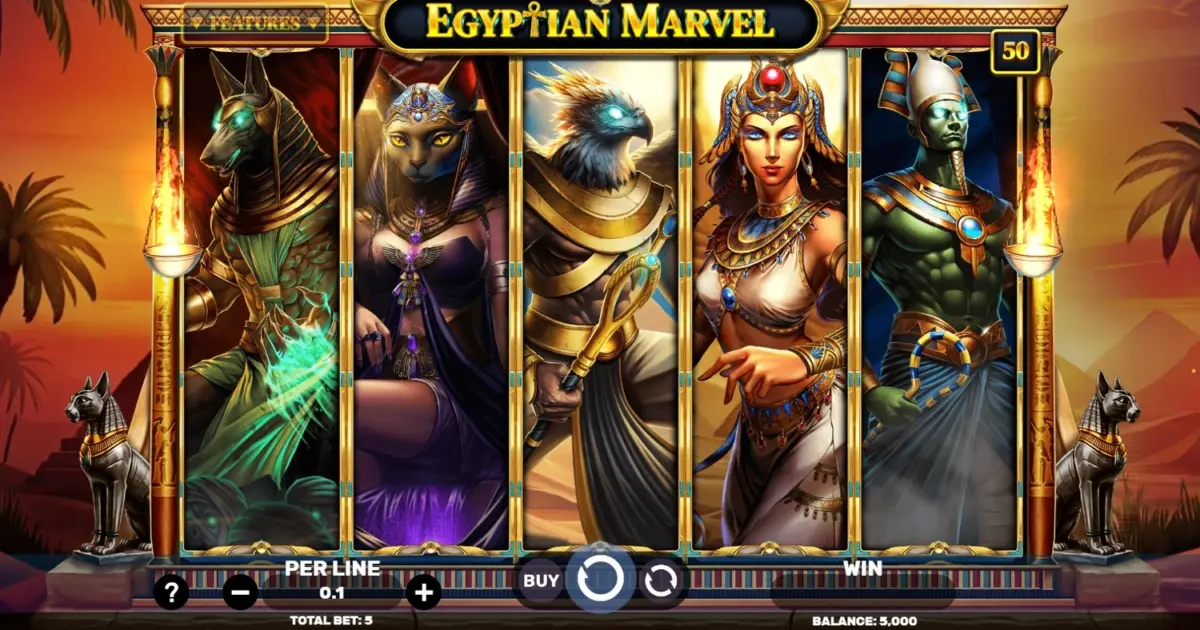
The short answer: this is a five-reel Mythology title from Spinomenal, it is playable in demo form, and almost every number a careful player would want before committing a bankroll is missing. No return-to-player figure, no volatility rating, no stated stake range, no max win. That absence is the single most important thing to know about it.
First look at the Egyptian Marvel slot
What can be stated with confidence is narrow. The game comes from Spinomenal, a studio with 548 titles catalogued here. It runs on five reels. Its theme labels place it in Mythology, with Egypt and Gods alongside, so the subject matter draws on ancient Egyptian mythology rather than anything more specific that could be described without guessing. It sits at rank 2215 for popularity, which puts it in roughly the 88.9th percentile of the games tracked here. That is respectable traffic, not a headline act.
Beyond that, the data thins out fast. Spinomenal has not published a return-to-player percentage for this title, has not assigned it a volatility band, and has not disclosed minimum or maximum stakes. There is no official max win multiplier either. If a site quotes you a precise RTP, a hit frequency or a “up to 10,000x” figure for this game, ask where it came from, because it did not come from the provider. Unverified numbers are worse than no numbers, because they feel like grounds for a decision.
| Provider | Spinomenal |
|---|---|
| Reels | 5 |
| Theme | Mythology |
| Free demo | Yes |
| Site-wide average RTP | 95.71% |
How a round plays out
Five reels is the standard modern layout, and it tells you the shape of a spin rather than its content: symbols land across five vertical columns, and wins are assessed against whatever line or ways structure the game uses. The payline or ways count is not recorded in the available data, so the number of ways a combination can form here is unknown. That matters more than it sounds. A 10-line game and a 243-ways game can share an identical RTP while producing completely different session rhythms, one paying small amounts often, the other paying rarely and larger.
Most five-reel slots released in the past decade include some combination of wild substitutions, scatter-triggered free spins and multipliers, and many now offer a paid bonus entry. None of that is confirmed for this game, so treat the feature set as unknown until you open it. The demo answers these questions in about two minutes: watch how often the reels pay anything at all, note whether a bonus round exists and roughly how often the trigger appears, and check what the paytable says about the top-paying symbol. Every spin result is independent of the last, whatever the feature set turns out to be.
Reading the return figure Spinomenal has not published
With no RTP disclosed, the most useful reference points are the averages around it. Spinomenal’s catalogue averages 95.11% across its 548 titles. The wider set of games tracked here averages 95.71%. Neither figure is a prediction for this game, but they frame the neighbourhood: studios tend to cluster their releases within a couple of percentage points of their house norm.
What a return figure actually means is worth restating, because it is routinely misread. An RTP of 95.11% means that across an enormous sample of spins, the game returns about £95.11 for every £100 staked, leaving £4.89 as the theoretical house margin. It is a long-run average measured over millions of spins, not a promise about your next hundred. On a £1 stake over 500 spins you have wagered £500 in total; at 95.11% the expected return on that turnover is around £475, but real outcomes scatter widely either side of it, and the scatter is wider on higher-variance games.
The practical takeaway: a missing RTP means you cannot compare this title on cost of play against anything. If that comparison matters to you, favour games that publish the figure.
Why an unstated volatility rating changes your bankroll maths
Volatility describes how a game’s returns are distributed over time, and it is the number that determines how a session feels. Low-volatility games pay small amounts frequently; a modest bankroll lasts a long time and the swings stay shallow. High-volatility games pay rarely and larger, which means long stretches with nothing back, punctuated by occasional bigger returns. Two games with the same RTP can require bankrolls that differ by a factor of five to survive the same number of spins.
Because no rating is recorded here, you cannot size a bankroll from the spec sheet. You can, however, estimate it from demo play. Run 200 or 300 demo spins at a fixed stake and count how many of them return anything at all. Roughly one in three or better suggests a low-to-medium profile. Fewer than one in five, with the balance draining in long dry runs, suggests something on the higher side. Then work backwards: if you want 300 spins of entertainment from a £30 budget, your stake is 10p, and a high-variance game will still test that.
Bet sizing when no stake range is published
No minimum or maximum bet is listed, so the only reliable place to find the range is the game’s own bet panel, which the demo exposes for free. Until then, plan from your budget rather than from the game. The arithmetic is simple and it is the same for every slot ever built: budget divided by stake equals the number of spins you get if nothing comes back at all. £20 at 20p is 100 spins. £20 at 2p is 1,000. Neither is better; they are different products bought with the same money.
One thing worth being explicit about: no stake pattern changes the maths. Raising your bet after losses, lowering it after wins, alternating, or waiting for a “cold” stretch to end all leave the theoretical return exactly where it was, because each spin is an independent event with the same odds as the one before it. Stake size controls how fast your budget moves and how large the swings feel. It does not control the edge.
Where Egyptian Marvel sits among Mythology slots
Mythology is a crowded category here, with 801 titles carrying the label, so this game competes against plenty of alternatives that do publish their numbers. Within Spinomenal’s own Mythology output, 1 Reel – Demi Gods 7 lists 95.42%, slightly above the studio average and a useful like-for-like if you want a Spinomenal game with a disclosed return. 9 Arrows of Odysseus sits lower at 94.0%, which on £100 of turnover implies roughly £6 of theoretical house margin rather than £4.58.
The clearest contrast comes from Gates of Olympus at 96.5%, the highest published figure among the related Mythology titles listed here and 1.39 points above Spinomenal’s catalogue average. Over a very large sample, 96.5% returns about £96.50 per £100 wagered against £95.11 at the studio norm — a real difference in cost of play, though one that only emerges over volumes far beyond a single session. If published numbers drive your choices, that is where to start.
The honest verdict
This is a hard game to recommend on the data, simply because there is so little of it. Five reels, a Mythology theme, a large and established developer behind it, solid-but-not-remarkable popularity, and a free demo available. Everything that would let you judge cost of play or session risk is unpublished. If you like Spinomenal slots and the subject matter appeals, the demo costs nothing and answers most of the open questions in a few minutes. If you are shortlisting on RTP, this one cannot be shortlisted.
Play is for adults aged 18 or over. Set a budget before you open the game, treat the money as the price of entertainment rather than an investment, and stop when the budget is spent. Demo results tell you how a game behaves; they tell you nothing about what real-money play will return.
Frequently Asked Questions
Can you play Egyptian Marvel for free?
A free demo version of this Spinomenal title is available, which means you can spin it in a browser with virtual credits and no deposit. That is currently the most useful way to assess it, because the provider has not published an RTP, volatility rating or stake range, so the demo is where you find the bet panel and paytable.
What is the RTP of Egyptian Marvel?
No return-to-player figure has been published for this game. For context, Spinomenal averages 95.11% across its 548 catalogued titles and the wider game set tracked here averages 95.71%. Neither is a prediction for this slot. Treat any precise RTP quoted elsewhere with caution, since it does not come from the provider.
Is Egyptian Marvel high or low volatility?
No volatility rating has been assigned to it, so the risk profile is unknown from the spec sheet. You can estimate it yourself in the Egyptian Marvel free demo: run 200 to 300 spins at a fixed stake and count how many return anything. Frequent small returns point low; long dry runs point high.
Who makes Egyptian Marvel and what else do they produce?
Spinomenal developed it. The studio has 548 titles catalogued here, averaging 95.11% RTP, and works heavily in mythology-led subject matter. Other examples include 1 Reel - Demi Gods 7 at 95.42%, Hades' Infernal Blaze and Story of The Little Mermaid, though the latter two have no published return figure either.
How does Egyptian Marvel compare to Gates of Olympus?
Gates of Olympus publishes a 96.5% RTP, which returns roughly £96.50 per £100 wagered across a very large sample, while this game publishes no figure at all. Both carry Mythology theming, one of 801 such titles tracked here. On disclosed numbers alone, Gates of Olympus is the easier game to evaluate.