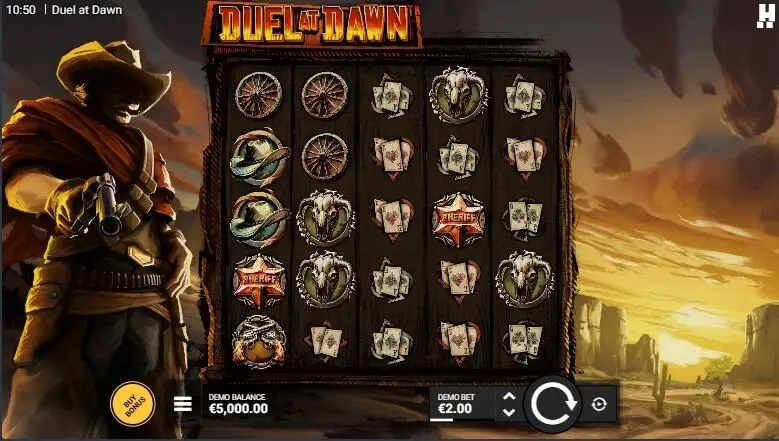
Duel at Dawn is Hacksaw Gaming’s entry into the Western genre, combining a 5-reel, 19-payline layout with a headline max win of 15,000x your stake. The duel at dawn slot sits 0.59 percentage points above the corpus average RTP of 95.71%, placing it among the more generous releases from a provider that averages 96.1% across 156 titles.
Duel at Dawn at a glance
The numbers that matter most:
| Attribute | Value |
|---|---|
| Provider | Hacksaw Gaming |
| RTP | 96.3% |
| Reels | 5 |
| Paylines | 19 |
| Max win | 15,000x stake |
| Theme | Western |
| Volatility | Not published |
| Popularity rank | 684 (96.6th percentile) |
| Free demo | Yes |
At rank 684 out of the full corpus yet in the 96.6th percentile, Duel at Dawn draws more players than roughly 97% of indexed titles. If you have followed Hacksaw Gaming slots for their high-variance, high-ceiling approach, this title fits that pattern numerically.
What a 96.3% RTP actually returns
RTP is a long-run theoretical average calculated across millions of spins, not a prediction for your session. At 96.3%, the game returns approximately 96.30 per every 100 wagered over a very large sample.
Concretely: 1,000 spins at 0.20 per spin means 200 total wagered. The expected return over that sample is 192.60, implying a theoretical loss of 7.40. The spread between your actual result and that expectation shrinks as sample size grows, but at 1,000 spins the variance remains wide enough that individual outcomes differ enormously from the average.
Against the corpus average of 95.71%, Duel at Dawn returns 0.59 percentage points more over the same theoretical horizon. Compared to Hacksaw’s own 96.1% provider average, it sits 0.2 points higher. That places it slightly above its provider’s typical output without reaching the top of their range—Wanted Dead or a Wild, another Western from the same studio, publishes 96.38%.
Volatility and what your session will feel like
Hacksaw Gaming has not published a volatility rating for Duel at Dawn in the data available to this review. Treat that gap as a practical warning: without a stated volatility tier, you cannot predict whether your session will produce frequent small wins or long dry spells punctuated by large hits.
What the 15,000x max win ceiling does suggest, in general terms, is a design capable of extreme outcomes. Across the slot industry, max wins of 10,000x and above correlate more often with high-volatility mathematics—meaning rare triggers, larger swings, and a bankroll that needs more room to absorb losing stretches. Many Hacksaw Gaming titles carry high volatility, so if you have played Wanted Dead or a Wild and found its rhythm punishing, expect a similar feel from this game.
If Hacksaw later publishes a volatility figure for this title, that information will narrow the uncertainty. Until then, size your stake conservatively and judge the distribution for yourself in demo mode.
The 5-reel layout and how wins are counted
Duel at Dawn uses a standard 5-reel configuration with 19 fixed paylines. A fixed-payline design means every spin activates all 19 lines regardless of your stake; you cannot choose to play fewer lines to reduce cost. The effective cost per spin is therefore your line bet multiplied by 19.
Five-reel, 19-line layouts are common in Western slots because they offer moderate hit frequency without the complexity of cluster pays or Megaways. You will see winning combinations when matching symbols land on consecutive reels along one of the defined lines. This is a straightforward structure—no cascading grids or adjacent-symbol mechanics—so the base game math should be relatively easy to read while you spin.
19 paylines on 5 reels places this game in the lower end of line counts for the genre; many competitors use 20, 25, or 50. Fewer lines typically means fewer simultaneous win opportunities per spin, which concentrates value in fewer, potentially larger events.
Stake range and sizing a bankroll
The specific minimum and maximum stake limits for Duel at Dawn are not included in the available data. Without those figures, you cannot calculate exact session lengths from a fixed bankroll. The general principle remains: divide your total budget by the number of spins you want to fund, then choose a per-spin cost at or below that division.
For a game with a 15,000x ceiling and no published volatility rating, a prudent starting framework is to budget for at least 300 to 500 spins. If the minimum stake is 0.10 per spin, that means a working session bankroll of 30 to 50. If the maximum is 100 per spin and you are chasing the 15,000x cap, the same 500-spin budget requires 50,000 in funds—a figure that exceeds most recreational bankrolls.
Check the actual stake limits on the game screen before committing money. A Fistful of Coins by another provider sits in the same Western theme with a published RTP of 96.0% and may offer different minimum stakes worth comparing.
Playing the Duel at Dawn demo before you commit
A free demo is available for this title. Demo play uses virtual credits and produces the same reel outcomes as real-money spins, but it cannot pay out any winnings. Use it to observe how frequently bonus events trigger, how quickly your virtual balance fluctuates, and whether the hit cadence matches your patience—then decide separately whether real play suits you.
Demo results are not evidence of what your real-money session will produce. The maths are identical, but sample sizes in a 20-minute demo are too small to reveal the distribution.
Set a hard budget before you play with money, treat any losses as the cost of entertainment, and stop when that budget is spent. You must be 18 or over to play for real money. If gambling stops being entertainment, resources such as GamCare and GamStop exist to help you take control.
Verdict: who should play Duel at Dawn
Duel at Dawn suits players who value a clear above-average RTP combined with a high win ceiling, and who are comfortable reading volatility as “unknown but probably aggressive” given Hacksaw’s design history. The 19-payline structure keeps the base game accessible; the 15,000x cap gives the session a clear theoretical target.
Skip it if you need frequent small wins to stay engaged or if you cannot absorb long losing stretches while waiting for the variance to resolve. Compare it against Le Bandit, another Hacksaw title at 96.34% RTP, if you want the same provider’s math at a different theme, or Strength of Hercules at 96.31% for similar RTP in a mythology setting.
The popularity percentile tells you other players have found this title worth spinning. The missing volatility data tells you they were willing to accept some uncertainty to find out why.
Frequently Asked Questions
Is Duel at Dawn available to play for free?
Yes. Hacksaw Gaming provides a free demo version of Duel at Dawn with virtual credits and no registration required. The demo mirrors the same reel mathematics as real-money play but cannot produce any cash payout, so treat it as an observation tool rather than a result predictor.
What is the RTP of Duel at Dawn and how does it compare?
Duel at Dawn has a published RTP of 96.3%, which places it 0.59 percentage points above the corpus average of 95.71% and 0.2 points above Hacksaw Gaming's own provider average of 96.1%. Over a very large sample this means slightly more theoretical return than most indexed slots.
What volatility does Duel at Dawn have?
Hacksaw Gaming has not published a volatility rating for Duel at Dawn in the available data. The 15,000x max win ceiling and the provider's design history suggest high volatility, but without a stated figure you should assume wide swings and size your bankroll accordingly.
How does Duel at Dawn compare to other Hacksaw Gaming slots?
Duel at Dawn sits at 96.3% RTP, slightly below Wanted Dead or a Wild (96.38%) and Le Bandit (96.34%) from the same provider. All three cluster near 96.3%, so the RTP difference is marginal; the distinction lies in theme, mechanic, and volatility profile rather than theoretical return.
How many reels and paylines does Duel at Dawn use?
The game runs on a 5-reel layout with 19 fixed paylines. Every spin activates all 19 lines simultaneously, meaning your per-spin cost equals the line bet times 19. This is a lower line count than many Western-themed competitors, concentrating potential wins into fewer simultaneous events.




