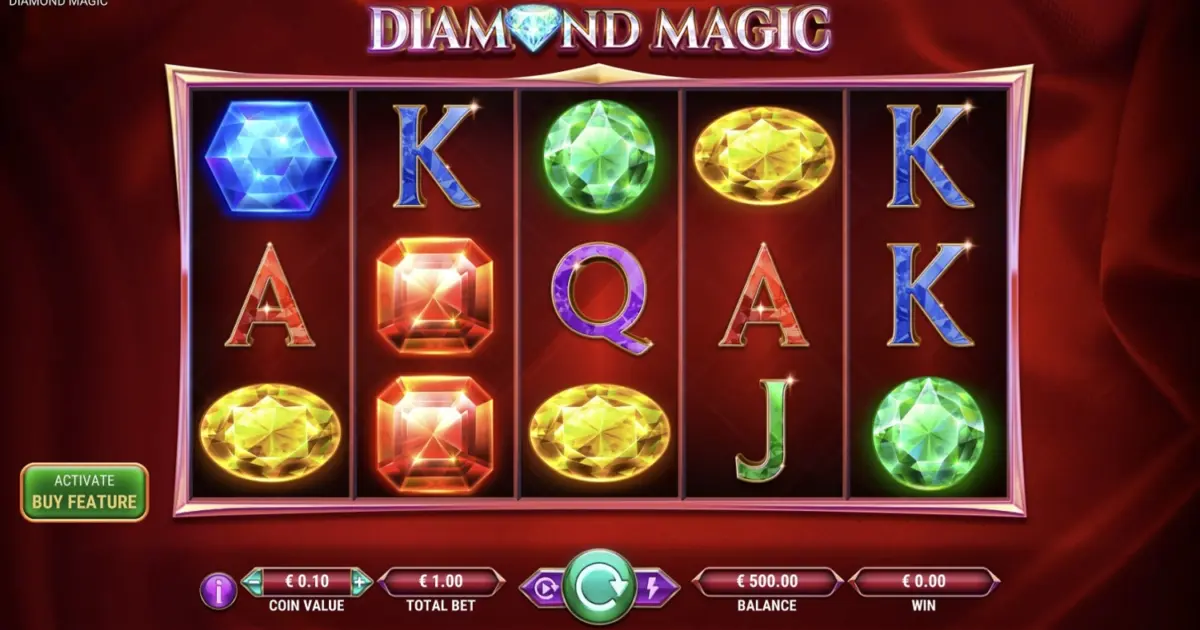
Diamond Magic is a five-reel GameArt release with a published return-to-player of 97.02%, which sits 1.31 percentage points above the average of every game tracked on this site. That figure is the main reason to load the diamond magic slot in demo mode rather than one of the hundreds of near-identical gem titles. What GameArt has not published — volatility rating, payline count, maximum win, stake range — matters just as much, and this review is straight about those gaps instead of filling them in.
Is Diamond Magic worth playing?
On the numbers available, yes — provided you are choosing on RTP rather than on features. A 97.02% return is high for a mainstream five-reel slot, and it beats the GameArt house average of 96.08% across their 178 tracked games by almost a full point. Over a long enough sample, that difference is real money: it is roughly 94p less theoretical cost per £100 wagered.
The caveats are about information, not quality. GameArt has not published a volatility rating, a hit frequency, a maximum win multiplier or a paylines figure for this title, and no bonus mechanics are documented in the data available here. So you cannot know in advance whether the swings will be gentle or brutal, or whether the ceiling is 500x or 5,000x your stake. Anyone quoting a specific max win for this game is working from something other than published information, and you should treat it accordingly.
It also carries genuine traffic: a popularity rank of 2,523 puts it in roughly the 87th percentile of games tracked, so enough people have found it to suggest it holds attention past the first spin. The Diamond Magic free demo is available, which means the cheapest way to answer the feature question is to play it yourself at zero stake.
What 97.02% RTP means over 1,000 spins
RTP is a long-run statistical average, not a promise about your session. A 97.02% figure means that across an enormous number of spins — millions, not thousands — the game is designed to return £97.02 for every £100 staked, with the remaining £2.98 retained as house edge.
Put 1,000 spins at £0.20 through it and you have wagered £200. The theoretical return on that £200 is £194.04, so the expected cost of the session is about £5.96. That is the number to plan around. What you will actually see is scattered widely around it, because 1,000 spins is a tiny sample in statistical terms. Finishing 40% down or 60% up over that stretch is entirely ordinary variance, and neither outcome tells you anything about the RTP being accurate.
Two things follow. First, RTP is a comparison tool between games, not a predictor of your afternoon. Second, the edge only compounds against you with volume, so the practical value of a higher RTP shows up if you play a lot, not if you play once.
| Detail | Value |
|---|---|
| Game | Diamond Magic |
| Provider | GameArt |
| RTP | 97.02% |
| Reels | 5 |
| Type | Slot Machine |
| Theme | Gems and diamonds |
| Popularity rank | 2,523 (87.4th percentile) |
| Free demo | Available |
| Provider average RTP | 96.08% across 178 games |
| Site average RTP | 95.71% |
How volatile is Diamond Magic?
There is no published volatility rating for this game, so the honest answer is that it is unknown. That absence is worth knowing rather than glossing over, because volatility affects your session more directly than RTP does.
In general terms, a low-volatility slot pays small amounts often. Your balance drifts down slowly, sessions last a long time on a given bankroll, and the biggest single result is modest. A high-volatility slot does the opposite: long stretches with nothing back, then occasional results large enough to reshape the session. Both can share the same 97.02% RTP — the maths of the long run is identical, the experience is not. Medium volatility sits between the two and is the most common design choice for five-reel releases.
Because you cannot look this up for Diamond Magic, the demo is doing real work. A hundred or so free spins will tell you plenty: count roughly how often anything comes back at all, and note how deep the dry runs go. One thing the demo cannot tell you is what happens next, because every spin is an independent event — no game is ever due, warm or overdue for a result.
What the Gems and diamonds theme brings to the game
The theme label tells you the symbol set is built around gemstones and diamonds rather than fruit, mythology or a licensed property. That is one of the largest categories in the catalogue — 484 tracked games share it — which tells you something useful about expectations.
Gem-themed slots are usually designed around clarity rather than narrative. Coloured stones read instantly at a glance, they scale cleanly on a phone screen, and they do not require the player to learn who anyone is before spinning. The trade-off is that the theme itself is not a differentiator. With hundreds of alternatives wearing the same clothes, nothing about the gems label alone should push you towards or away from this particular title.
What that leaves is the numbers, which is where Diamond Magic actually separates itself. In a crowded category, a 97.02% return is the thing worth choosing on. No specific visual details, animations or soundtrack elements are documented in the data here, so anything beyond “it is a gems slot on five reels” is something to confirm with your own eyes in the demo.
Stakes, session length and bankroll
GameArt has not published a minimum or maximum bet for this title in the data available, so check the stake range in the game itself before committing anything. Most five-reel slots from established studios run from around 10p to £100 a spin, but that is a category norm rather than a fact about this game, and the difference between a 10p floor and a £1 floor changes your session planning completely.
Work backwards from a budget instead. Decide the amount you are prepared to spend for the entertainment, divide it by the number of spins you want, and let that set your stake. If you have £30 and want a session of roughly 300 spins, you are playing at £0.10. At £1 a spin, £30 is gone in about thirty spins of average luck — and with an undocumented volatility profile, it could be considerably faster.
No staking pattern changes the arithmetic. Raising your bet after losses, lowering it after wins, or waiting for a “cold” stretch to end all leave the 2.98% house edge exactly where it was. Larger stakes simply move money through that edge faster.
Alternatives if Diamond Magic slot is not for you
If the missing volatility and max win figures bother you, or you simply want to compare returns inside the same theme, there are close neighbours worth a look.
- Love Gems Hold and Win publishes a marginally higher 97.1% RTP and, unlike this title, tells you up front that it uses a hold-and-win mechanic — useful if you want a documented feature set rather than a surprise.
- Joker’s Jewels returns 96.5%, half a point lower, but it is one of the most widely played gem slots anywhere, which means far more public information about how it behaves.
- Sweet FTN is the pick if you liked the studio more than the theme: 96.55% RTP, still above the site average of 95.71%, and a different visual register entirely.
Across GameArt slots generally, note that 97.02% is at the high end of what the studio publishes, so trading down on theme usually means trading down on return as well.
Final take
Diamond Magic earns its place on a shortlist on one clear merit: a 97.02% RTP that beats both its provider’s average and the wider field by a meaningful margin. Everything else about it — swing size, feature set, ceiling, stake floor — is undocumented, and the free demo is the only reliable way to fill those blanks. That is a fair deal, because the demo costs nothing and the RTP advantage is the part you cannot verify by playing anyway.
Slots are paid entertainment, not income. Play only if you are 18 or over, set the amount you are willing to lose before you start, and stop at that number regardless of how the session is going. Free-play results carry no predictive weight for real-money play, and they never have.
Frequently Asked Questions
Can you play Diamond Magic for free?
A free demo of Diamond Magic is available, so you can spin it at zero stake with no deposit. That is the practical way to check the things GameArt has not published for this title — the feature set, how often anything comes back, and the size of the dry stretches — before you decide whether to stake real money on it.
What is the RTP of Diamond Magic?
The published RTP is 97.02%, meaning the game is built to return £97.02 per £100 wagered across a very large sample. That is 1.31 points above the 95.71% average of games tracked here and nearly a point above GameArt's own 96.08% average. It describes long-run design, not the outcome of your session.
Is Diamond Magic high or low volatility?
GameArt has not published a volatility rating for Diamond Magic, so it cannot be stated honestly. Low volatility generally means frequent small returns and longer sessions; high volatility means long gaps and bigger occasional results. Both can share the same 97.02% RTP. A hundred demo spins will give you a rough feel for which side it falls on.
Who makes Diamond Magic and what else do they produce?
GameArt developed it, and 178 of their games are tracked here with an average RTP of 96.08%. Their catalogue spans several themes — Sweet FTN returns 96.55% and Kukulkan's Queen 96.06% — so this title's 97.02% sits at the upper end of what the studio publishes rather than in the middle.
How does Diamond Magic compare to Love Gems Hold and Win?
Love Gems Hold and Win edges it on return at 97.1% against 97.02%, a gap of 0.08 points that is negligible in practice. The real difference is documentation: that game names its hold-and-win mechanic, while no bonus features are documented for Diamond Magic. Both sit in the gems category alongside 484 other tracked titles.