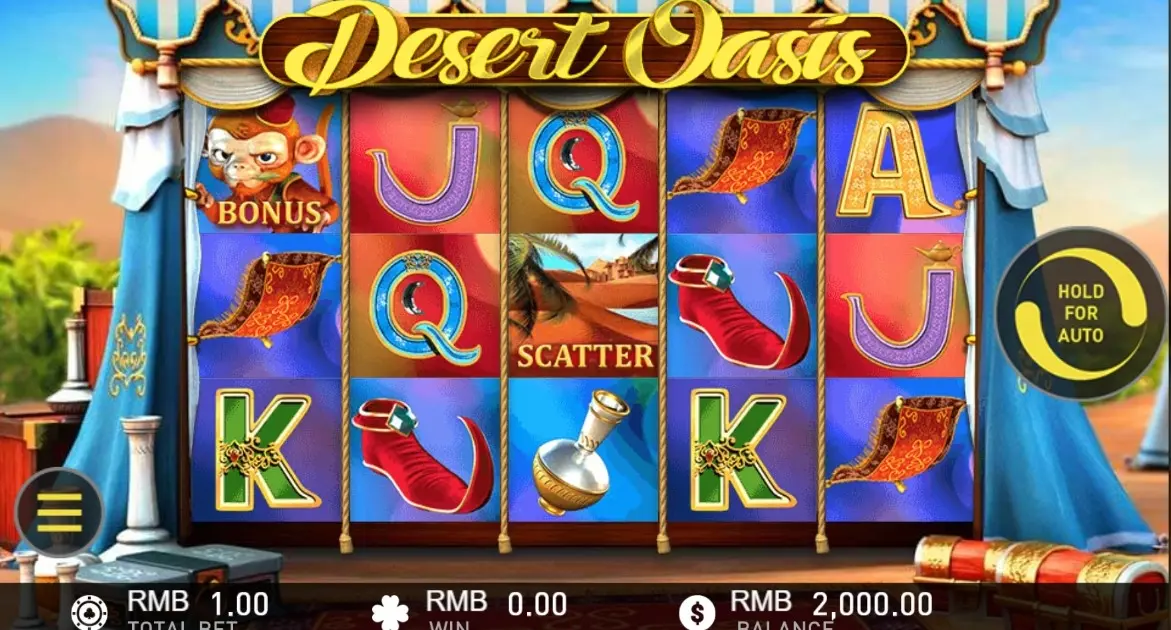
The short answer: this is a three-reel Gameplay Interactive machine you can try without spending anything, and the free demo is the sensible first step because the numbers that would normally guide a decision are not on the table. No RTP figure has been published for the desert oasis slot, and no volatility rating either. That absence is not a small footnote — it is the single most important thing to know before you decide how much of a bankroll to point at it.
Who makes Desert Oasis
Gameplay Interactive is the studio behind it, and they have 118 titles listed in this catalogue. That is a mid-sized library by supplier standards — large enough that the studio has a house style and a spread of formats, small enough that individual games do not get lost in the hundreds.
The more useful figure is the catalogue average. Across those 118 games, the average return-to-player works out at 96.69%, which sits just under a percentage point above the 95.71% average across every game in this database. Read that carefully, though: a studio average tells you about the studio, not about this particular machine. Some suppliers cluster tightly around their average; others ship a 97% flagship alongside a 94% budget title and land in the middle. Without a published figure for this game, you cannot tell which situation applies here.
What the average does give you is a benchmark. If Gameplay Interactive eventually publishes a number for this title and it comes in well under 96.69%, that is a game returning less than the studio’s own typical standard. If it lands above, the reverse. Until then, 96.69% is context, not a claim about this release.
Where Desert Oasis sits in the Gameplay Interactive catalogue
By traffic, it ranks 2,681st overall, which puts it in the 86.6th percentile for popularity. That means it draws more interest than roughly seven in eight games here — respectable, without being a headline act. Popularity is a measure of attention, not of generosity; a widely played game and a well-paying game are different things, and ranking tells you nothing about either RTP or hit frequency.
If you want a Gameplay Interactive title where the maths is actually on record, Fountain of Fortune is the obvious comparison: it carries a published 97.0% RTP, which is above the studio’s own 96.69% average and a full 1.29 points above the all-games average of 95.71%. Over a very large number of spins, 97.0% returns £97 per £100 staked, against £95.71 at the corpus average. That difference compounds across a long session history.
The studio’s other nearby titles are less transparent. Monsters Cash has no published RTP either, so it sits in the same information gap as this game. If a documented return figure matters to you — and for anyone tracking long-run cost, it should — start with the titles that publish one.
RTP: unpublished, against a 96.69% Gameplay Interactive average
There is no RTP figure for this game in the available data, so any number you see quoted for it elsewhere should be treated with real caution unless it traces back to the studio or the operator’s own game info screen.
Here is why the figure matters. RTP is a long-run statistical average, calculated across millions of simulated spins. A 96% game returns about £96 per £100 wagered across that enormous sample; a 94% game returns about £94. Over a few hundred spins, neither figure predicts your result — variance dominates completely at that scale, and you can finish well up or well down on either. Over thousands of spins, the gap between 96% and 94% becomes the dominant cost of playing. Two percentage points on £1,000 of total turnover is £20 of expected difference, and turnover accumulates faster than most people expect.
Every spin is independent, settled by a random number generator with no memory of what came before. Nothing that happened on the last spin changes the next one.
| Detail | Figure |
|---|---|
| Game | Desert Oasis Slot |
| Provider | Gameplay Interactive |
| Reels | 3 |
| Type | Slot Machine |
| RTP | Not published |
| Volatility | Not published |
| Popularity rank | 2,681 (86.6th percentile) |
| Provider catalogue size | 118 titles |
| Provider average RTP | 96.69% |
| All-games average RTP | 95.71% |
| Free demo | Available |
Volatility and who it suits
No volatility rating has been published, so the honest position is that the risk profile is unknown until you have spent time with the demo.
Volatility describes the shape of the ride rather than the destination. Low-volatility games pay small amounts often, which keeps a balance ticking over and makes a modest bankroll last through a long session. High-volatility games pay rarely and larger, which means longer stretches with nothing landing and much deeper swings in both directions. Two games can share an identical RTP and feel completely different to play, because the same long-run return can be delivered through frequent small wins or infrequent bigger ones.
Reel count is a weak signal, not a rating. Many three-reel machines use simpler paytables and fewer paying combinations than modern five-reel grids, and plenty lean toward frequent small returns — but that is a tendency across the format, not a fact about this title. Free spins, wilds, scatters and buy features are all common in the wider market; none of them are documented for this game, so assume nothing about what it does or does not include.
Practically: if you need a known risk profile before committing money, this one does not offer it, and titles with published figures are a better fit.
Playing the Desert Oasis slot for free
A free demo is available, which is the right place to start when the published data is thin. The demo runs on the same game engine and the same random number generator as the paid version, so it shows you the paytable, the reel behaviour and the pace of play without any money moving. Use it to answer the questions the data sheet cannot: how often something lands, how the wins are structured, whether the rhythm suits you. Play a few hundred spins rather than twenty, because short samples tell you almost nothing.
What the demo cannot do is predict real-money results. Demo credits are not a preview of outcomes, and a good or bad run in free play carries no information about what happens next with real stakes. Free play with no download is a research tool, not a forecast.
This is 18+ entertainment. Decide what the session is worth to you before you open the game, treat that amount as the price of the entertainment rather than an investment you expect back, and stop when it is gone. No stake pattern, bet progression or timing changes the expected value of a spin — the maths is fixed and indifferent to how you arrange your bets.
Similar picks
There are no other games sharing this title’s theme classification in the database, so theme-based alternatives are not something the data can offer. What it can offer is stablemates from the same studio, which at least share a development house and a broad approach.
Pharaoh (Gameplay Int.) is another Gameplay Interactive release, though it also lacks a published RTP — so it swaps one information gap for another rather than closing it. If your priority is knowing the return figure before you stake anything, the studio’s documented titles are the better route, and the 97.0% option mentioned earlier is the strongest of them on paper.
When you compare alternatives, compare the things that are actually written down: the RTP figure, the volatility rating, the stake range and the reel format. Screenshots and theme labels tell you whether you will enjoy looking at a game. Only the published numbers tell you what it costs to play over time.
Verdict
A three-reel Gameplay Interactive machine with decent traffic — 86.6th percentile — and two blanks where the most decision-relevant figures should be. No published RTP and no published volatility rating means you cannot price the long-run cost or anticipate the swings, and no amount of review writing can fill that in honestly.
That does not make it a bad game. It makes it an unquantified one. The free demo costs nothing and answers the feel questions, so if the format appeals, spend time there first. If you are choosing where real money goes, the studio’s titles with documented returns give you something to work with, and 97.0% versus the 95.71% all-games average is a measurable edge in transparency as much as in return.
Worth a demo session. Harder to recommend for a funded bankroll until the numbers are on record.
Frequently Asked Questions
Can I play Desert Oasis for free without downloading anything?
A free demo is available, and it runs in the browser with no download required. It uses the same engine and random number generator as the paid version, so the paytable and reel behaviour are identical. Play a few hundred spins rather than a handful, since short samples reveal very little about how a game actually behaves.
What is the RTP of Desert Oasis?
No RTP figure has been published for this title, so treat any number quoted elsewhere with caution unless it comes from the game info screen itself. For context, Gameplay Interactive's 118 games average 96.69%, against 95.71% across all games in this database. A studio average describes the catalogue, not this specific machine.
Is Desert Oasis high or low volatility?
The volatility rating is not published, so the risk profile is genuinely unknown before you play. Low volatility means frequent small returns and longer sessions from a given bankroll; high volatility means rarer wins and much deeper swings. Two games with identical RTP can feel entirely different, which is why the missing rating matters.
Who is Gameplay Interactive and what else do they make?
Gameplay Interactive is the studio behind this game, with 118 titles in this catalogue and an average RTP of 96.69% across them. Their range includes Fountain of Fortune at a published 97.0% RTP, plus Pharaoh (Gameplay Int.) and Monsters Cash, neither of which has a documented return figure available.
How does Desert Oasis compare to Fountain of Fortune?
Fountain of Fortune publishes a 97.0% RTP; this game publishes none, which is the decisive difference. At 97.0%, expect roughly £97 returned per £100 staked across a very large sample, against £95.71 at the all-games average. Both come from Gameplay Interactive, but only one lets you price the long-run cost.