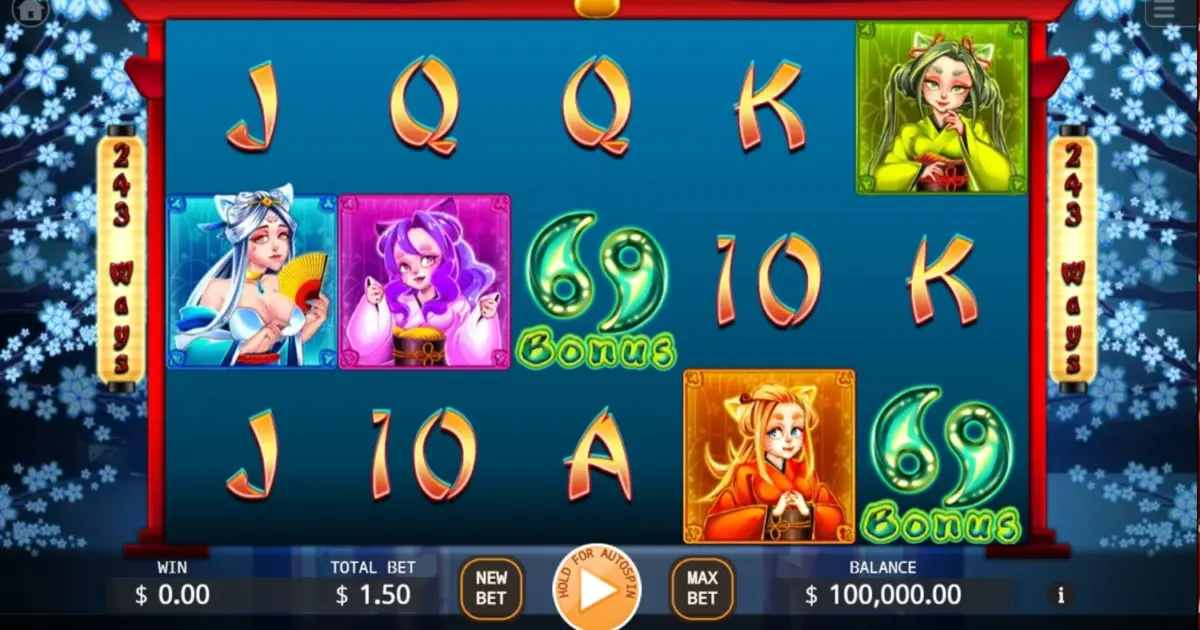
Demon Fox is a five-reel horror-themed release from Ka Gaming, and the most important thing to know before you spin is that no return-to-player figure has been published for it. A free demo exists, so you can watch the reels turn without staking money, but you cannot check the maths behind them. That gap should shape how you approach the demon fox slot.
Demon Fox slot versus the average slot
Across the games catalogued on this site, the average published RTP sits at 95.71%. That is the benchmark a new title gets measured against, and it is the comparison most readers want first. Demon Fox cannot be placed on that scale, because Ka Gaming has not released a figure for it.
What can be said is contextual rather than specific. Ka Gaming’s published games average 94.47% RTP, which is 1.24 percentage points below the corpus average. On a £100 turnover that difference is £1.24 in theoretical return over a very large sample of spins. It is not a prediction about any single session, and it is not a statement about Demon Fox itself, because this game is not part of the published set. Treat the studio average as background information about the house that built the game, nothing more.
The game does have visible reach. Its popularity rank of 2522 places it in the 87.4th percentile of titles here, meaning it draws more attention than roughly seven in eight games in the database. Popularity reflects traffic, not payout behaviour.
| Provider | Ka Gaming |
|---|---|
| Reels | 5 |
| Theme | Horror and scary |
| Free demo | Yes |
| Site-wide average RTP | 95.71% |
RTP breakdown: no published figure in context
RTP describes the share of total wagers a slot returns across an enormous sample, usually tens of millions of spins in simulation. A 96% game returns £96 per £100 staked over that horizon. It says nothing about your next hundred spins, where short-run variance dominates completely.
Because Ka Gaming has not published an RTP for this title, you have no way to calculate a theoretical loss rate before you play. If you see a specific percentage quoted for Demon Fox on another site, treat it with caution unless it cites the studio or the operator’s own game information panel. Numbers get copied between pages and harden into fact without any source behind them.
The practical step is to check the in-game information screen at whichever operator hosts it. Many studios disclose RTP there even when they do not publish it in marketing material, and some titles ship with multiple RTP configurations that operators select between. If the panel is blank too, then the figure genuinely is not available, and that is a legitimate reason to prefer a game that does disclose one.
Volatility profile
Volatility is not published for Demon Fox either, so anything said here is about the concept rather than this game. It matters because it determines how a bankroll behaves over a session, independent of RTP. Two games with identical 96% returns can feel completely different to play.
Low-volatility slots pay small amounts often. Balances drift downward slowly, sessions last longer on a given deposit, and the largest outcomes are modest. High-volatility slots do the opposite: long stretches return nothing, the balance drops faster, and the rare large results carry the whole return figure. Medium sits between the two. A high-variance game generally needs a larger bankroll relative to stake size to survive its dry spells, which is why stake sizing and volatility are really one decision rather than two.
Without a rating, the demo is your only instrument. Spin a few hundred times at a fixed stake and watch how frequently anything lands and how deep the gaps run. That gives you a rough feel for the swing pattern. It does not reveal the RTP, and it cannot, because variance swamps the average at that sample size.
Ka Gaming as a studio
Ka Gaming is a high-volume developer with 602 games catalogued here, which is a large library by any measure. Studios operating at that scale tend to build on shared engines and reuse mechanical templates across titles, which is why their games often feel familiar to each other. Their published average RTP of 94.47% sits below the 95.71% corpus figure, so their catalogue as a whole is a little tighter than the market baseline.
If you want to see how their output varies, Monkey Heist and Miss Tiger are two other Ka Gaming slots in the same library, though neither has a published RTP either, so the comparison is about feel rather than numbers. That pattern of missing disclosure across the studio’s titles is itself worth noting. It is common enough among high-output developers, and it means you are relying on operator-side information panels rather than the studio’s own documentation whenever you evaluate one of their games.
Three Horror and scary alternatives worth comparing
The horror category is well populated here, with 479 games carrying the theme, so there is no shortage of substitutes if the missing numbers bother you. Two are worth naming specifically because they publish figures.
Hand of Anubis is the strongest comparison on paper at 96.24% RTP, which is above the 95.71% corpus average and more than 1.7 points clear of Ka Gaming’s studio average. On a £100 turnover that gap is worth £1.77 in theoretical return across a very large sample. Trickstar Spins sits at 94.00%, below the corpus average, so it is the weaker of the two on that single metric. Halloween Crystals is a third option in the same theme, but like Demon Fox it has no published RTP, so it offers no more transparency than the game you came here to read about.
RTP is one input among several. Volatility, stake range and whether you enjoy the game all matter, and a published number does not make a game suitable for your bankroll.
Getting the most out of the free demo
A Demon Fox free demo lets you learn the layout, the paytable and the rhythm of the five reels at zero cost. Read the information panel first, since that is where the RTP and any volatility rating will appear if they exist anywhere. Then run a consistent stake for several hundred spins and pay attention to how long the quiet stretches last.
Demo results do not predict real-money results. The sample is far too small for the average to assert itself, and a lucky or dreadful demo run tells you nothing about what follows. Every spin is independent of every spin before it, so no pattern in the demo carries forward and no stake progression changes the expected return.
Slots are 18+ entertainment that costs money, not a way to make it. Decide what you are willing to spend before you deposit, treat that amount as the price of the evening, and stop when it is gone. If tracking that feels difficult, deposit limits and session reminders are available at most licensed operators.
Should you play Demon Fox?
Play it in demo form if the horror theme appeals and you want to see what a widely-played Ka Gaming title feels like. It sits in the 87.4th percentile for popularity, so plenty of people have found something in it, and the free version costs you nothing but time.
For real money the case is weaker, and the reason is disclosure rather than quality. No published RTP and no published volatility rating means you cannot assess the theoretical cost of playing or the bankroll it demands before you commit. That is a straightforward disadvantage next to a horror-themed game that tells you both. Hand of Anubis at 96.24% is the obvious point of contrast in the same category.
If you do play it for stakes, check the operator’s game information screen first, set a budget you are comfortable losing, and keep stakes small enough that an unknown variance profile cannot empty the balance in a few minutes. Missing data is not evidence of a bad game. It is simply a reason to be more careful.
More from Ka Gaming
Frequently Asked Questions
Can I play Demon Fox for free without downloading anything?
A free demo of Demon Fox is available and runs in the browser, so no download or account is needed to try it. The demo uses play-money credits and the same five-reel layout as the real-money version. It costs nothing, which makes it the sensible first step given no RTP figure has been published.
What is the RTP of Demon Fox?
Ka Gaming has not published an RTP for Demon Fox, so no reliable figure exists. For context, the studio's published games average 94.47% and the wider database averages 95.71%. If another site quotes a specific percentage, check it against the in-game information panel before trusting it, as unsourced numbers circulate easily.
Is Demon Fox high or low volatility?
No volatility rating has been published for Demon Fox, so the risk profile is unknown before you play. High-volatility games pay rarely but larger and need a bigger bankroll relative to stake; low-volatility games pay small amounts often. A few hundred demo spins will give you a rough feel for which pattern applies.
Who is Ka Gaming and what else do they make?
Ka Gaming is a high-volume slot developer with 602 titles catalogued here, averaging 94.47% RTP across the games where a figure is published. That sits 1.24 points below the 95.71% database average. Monkey Heist, Miss Tiger and The Primeval Rainforest are three other releases from the same studio.
How does Demon Fox compare to Hand of Anubis?
Hand of Anubis publishes a 96.24% RTP, which is above the 95.71% corpus average, while Demon Fox publishes nothing. On transparency and theoretical return, Hand of Anubis is the stronger pick within the 479-game horror category. Demon Fox is the more widely played of the two here, sitting in the 87.4th popularity percentile.