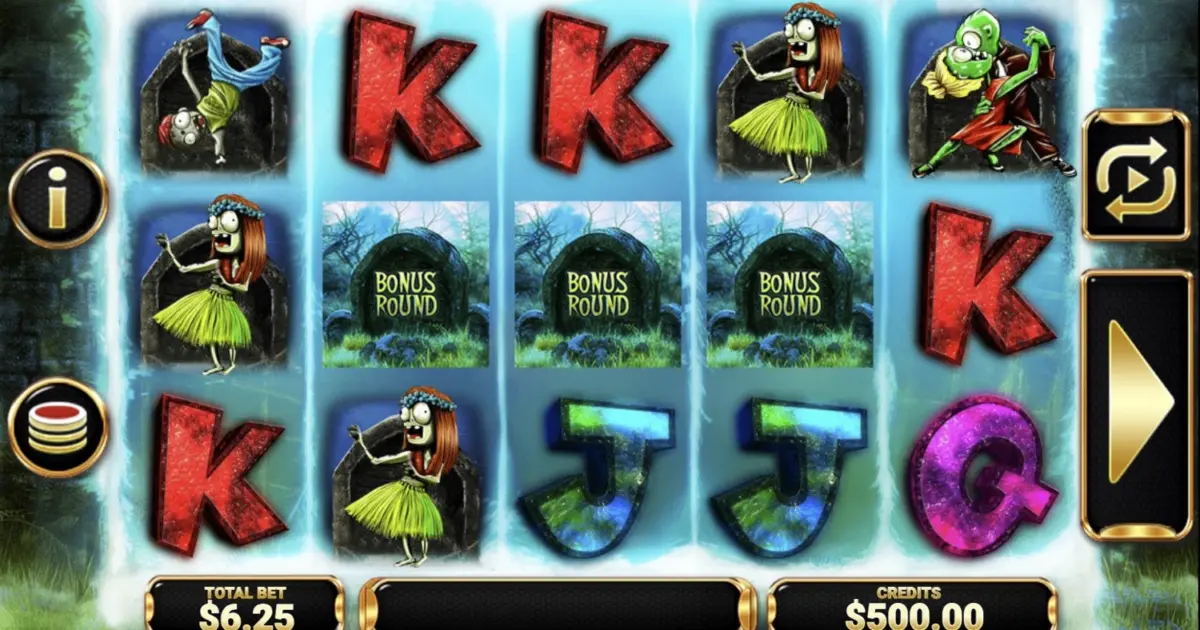
Before you commit time to the dancin’ zombies slot, here is the short answer: it sits just above the site-wide average return but below what MultiSlot typically publishes. Whether that distinction changes your session depends on volatility and bet sizing, both of which we address below with what is and is not available.
First look at Dancin’ Zombies
Dancin’ Zombies is a five-reel slot machine from MultiSlot, a provider that publishes 70 titles in this corpus. Its primary theme is tagged “Horror and scary,” and it ranks at position 901 with a popularity percentile of 95.5, meaning it draws more traffic than roughly 95% of indexed games. That combination tells you the title has visible player interest despite not sitting near the top of the RTP rankings.
What FACTS does not include: volatility classification, maximum win cap, hit frequency, bonus-round structure, scatter or wild behaviour, and stake range. That is a meaningful list of omissions. You can evaluate the maths of the return figure on its own, but you cannot build a full risk profile without knowing how swings distribute. Treat any bonus-feature description you find on third-party sites as unverified until MultiSlot or a licensed operator publishes it.
What you can confirm from the data: five reels, the horror-and-scary theme tag, and a 96.07% theoretical return to player. Those three facts anchor everything below.
| Provider | MultiSlot |
|---|---|
| RTP | 96.07% |
| Reels | 5 |
| Theme | Horror and scary |
| Free demo | Yes |
How a round plays out
With five reels, the game uses the format that dominates modern online slots. Five reels typically support anywhere from ten to thousands of paylines or ways, but MultiSlot has not published the line count for this title in the data available here. Without that figure, you cannot calculate the exact number of ways a spin can resolve, and that number directly affects how often you hit any combination at all.
General principle: more ways or lines lower the per-spin hit frequency but increase the number of simultaneous wins when you do land a combination. Fewer lines raise per-line hit probability but concentrate payouts. Because the line count is absent here, judge the game by its RTP figure and, once you know the volatility, by how often small wins cluster versus rare large hits.
The theme label “Horror and scary” tells you the game draws on zombie and horror imagery. The title adds a dancing or musical element. Beyond that, no specific symbol descriptions, animation details, or soundtrack information appear in the available data, so any visual review you encounter elsewhere is outside what can be verified here.
Reading the 96.07% return figure
RTP is a long-run statistical average calculated across tens or hundreds of millions of simulated spins. A figure of 96.07% means that across that enormous sample, the game retains 3.93% of all money wagered and returns the rest. On a per-£100-wagered basis, that is £96.07 returned to players in the aggregate.
The comparison that matters most: MultiSlot’s own provider average across its 70 titles is 96.76%, meaning Dancin’ Zombies sits 0.69 percentage points below its own provider’s mean. Against the full site corpus average of 95.71%, it runs 0.36 points above. So it is above generic market average but below the best MultiSlot typically offers.
A 0.69-point gap between a game and its provider average translates to roughly £6.90 per £1,000 wagered. Over a session of 500 spins at £1 per spin (total staked: £500), that difference amounts to about £3.45 in expected return. Short sessions are dominated by variance, not by this gap, so the practical impact of 96.07 versus 96.76 is invisible over most single sittings.
The corpus average of 95.71% is the number to benchmark against if you are comparing across providers rather than within one studio’s catalogue.
Volatility: what you need to know (and what you don’t)
Volatility classification is absent from the available data for this title. That gap is the single most consequential piece of missing information because it governs how the 96.07% return is actually distributed across your session.
In general terms: high-volatility slots deliver fewer wins that are larger when they hit, requiring a bankroll that can absorb 100 to 300 spin stretches without a meaningful return. Low-volatility slots pay small wins frequently, stretching bankroll duration but capping realistic single-session upside. Medium sits between the two.
Without knowing where Dancin’ Zombies falls, you cannot size your budget correctly for this game specifically. The safest assumption is that a horror-themed five-reel title from a provider at position 901 by rank likely uses medium-to-high volatility, but that is inference from category norms, not a published fact. Wait for a casino’s game-info panel to state the volatility before depositing, or test in the Dancin’ Zombies free demo to observe your own win-distribution pattern over 200 to 300 spins.
If you find no published volatility anywhere, set a loss limit based on the most conservative assumption (high volatility) rather than the optimistic one.
Bet sizing and bankroll maths
The stake range is not listed in the available data. Most five-reel online slots from mid-size providers support minimum bets in the £0.10 to £0.20 range and maximum bets between £50 and £200, but MultiSlot has not published the specific bounds for Dancin’ Zombies here.
What you can do: once you open the game on a licensed operator, the bet selector will display the exact minimum and maximum. Apply a simple bankroll rule — divide your total session budget by the minimum bet, and that quotient is your theoretical spin count at the lowest stake. If the result is under 200 spins and you have no volatility information, consider choosing a lower-stake slot or a higher-budget session, because 200 spins is roughly the minimum sample where you begin to see whether the game behaves as a variance machine or a steady drip-feed.
Where the Dancin’ Zombies slot sits among horror and scary slots
The “Horror and scary” category contains 479 titles in this corpus, so the comparison pool is large. Two useful reference points from the same theme: Hand of Anubis carries a 96.24% RTP — about 0.17 points above Dancin’ Zombies — while Trickstar Spins sits at 94.0%, roughly 2.07 points below. That spread of over 2 percentage points within the same theme tells you the genre label alone does not predict return quality; individual game design still dominates.
Within MultiSlot’s own catalogue, Vintage Toy Room publishes a lower 95.56% RTP, so if you are a MultiSlot regular looking for the better mathematical deal in their horror and scary slots, Dancin’ Zombies at 96.07% beats Vintage Toy Room by half a percentage point but still trails the provider average.
The popularity percentile of 95.5 combined with a below-provider-average RTP suggests player interest is driven by presentation or theme rather than by return quality. That is common in this genre; horror theming attracts engagement regardless of a few tenths of percentage point in either direction.
The honest verdict
Dancin’ Zombies is a five-reel horror slot with a 96.07% RTP that beats the site-wide average but underperforms its own provider’s mean by nearly 0.7 points. The data available here cannot tell you the volatility, stake range, bonus structure, or max win, which means a complete risk assessment is impossible from published figures alone.
If you are drawn to the zombie-and-dance theme and want a game with above-average return, the 96.07% figure is adequate — not exceptional, not bad. The missing volatility data is your main blocker. Play the demo first, track your own hit distribution over at least 200 spins, and set a real-money budget only after you know whether this game pays you in frequent small hits or rare large clusters.
This is a game of chance with a fixed mathematical edge favouring the house over the long run. Set a budget before you spin, treat it as the cost of entertainment you have already spent, and never chase losses expecting a return. If gambling stops being fun, support services are available in most jurisdictions.
Frequently Asked Questions
Can I play Dancin' Zombies free without downloading anything?
Yes. FACTS confirms that a free demo is available for Dancin' Zombies, and demo play on this review platform runs in-browser with no download required. The demo uses the same 96.07% RTP maths as the real-money version but does not pay out actual currency.
What does the 96.07% RTP mean for my session?
Over a very large sample of spins, the game returns approximately £96.07 for every £100 wagered in aggregate. In a single 200-spin session at £0.50 per spin (£100 total staked), your actual result will vary widely because short-term outcomes are governed by variance rather than by the average return.
What volatility does Dancin' Zombies have?
Volatility is not published in the available data for this MultiSlot title. Without it, you cannot accurately predict session length or swing size. The safest approach is to observe your own hit pattern over 200 to 300 demo spins and budget for the high-volatility scenario until a published figure emerges.
How does Dancin' Zombies compare to other MultiSlot games?
MultiSlot averages 96.76% RTP across its 70 titles in this corpus. Dancin' Zombies at 96.07% sits 0.69 points below that provider mean. By contrast, Vintage Toy Room from the same provider publishes 95.56%, making Dancin' Zombies the stronger return of the two by half a percentage point.
Will playing the demo predict my real-money results?
No. The demo uses the same underlying maths as the real-money game, but individual sessions are random regardless of which version you play. Twenty demo spins tell you nothing about your next twenty real-money spins. The demo's value is that it lets you observe win frequency and pacing without spending cash.




