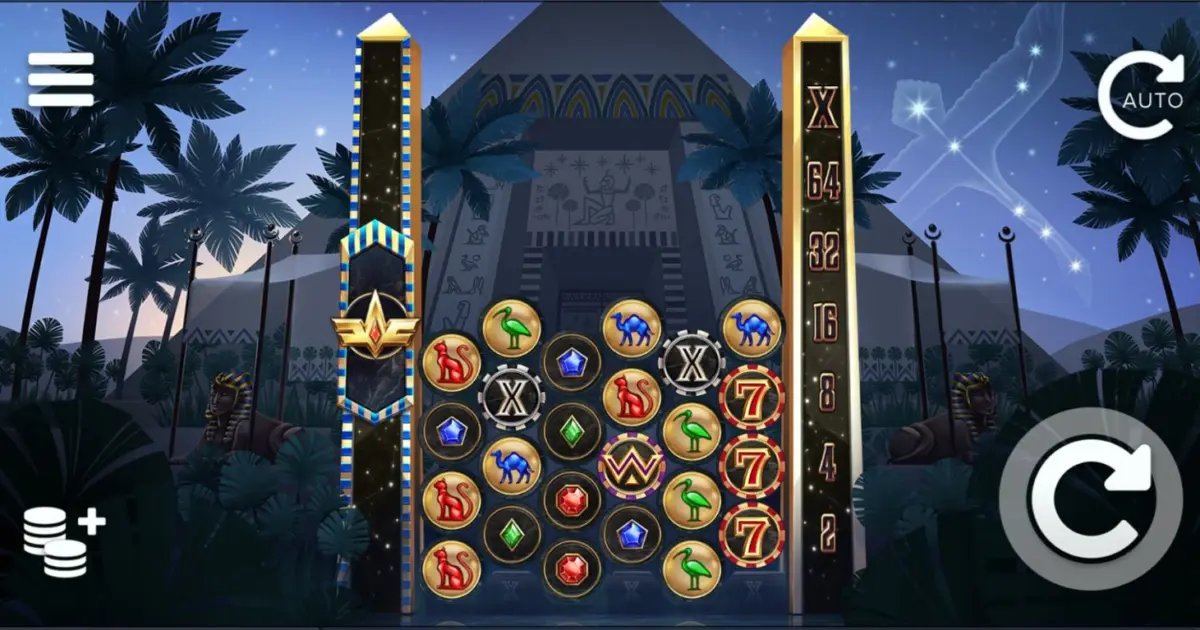
The single most useful number attached to the cygnus slot is its 96.1% RTP. That sits above the 95.71% average across the games catalogued here, and well above the 94.92% average of the 138 titles ELK Studios has released. If you judge a game first on its published return, this one clears the bar.
What follows works through that figure in cash terms, explains what the six-reel layout does and does not tell you, and flags the fields ELK Studios has not published — because gaps matter as much as numbers when you are deciding where to spend a session.
Cygnus at a glance
Here are the figures that exist for this title. Anything absent from the table is absent from the published data, not omitted for space.
| Field | Detail |
|---|---|
| Game | Cygnus |
| Provider | ELK Studios |
| RTP | 96.1% |
| Reels | 6 |
| Category | Slot Machine |
| Provider average RTP | 94.92% across 138 games |
| Site average RTP | 95.71% |
| Popularity rank | 2,754 (86.2nd percentile) |
| Free demo | Available |
That popularity rank puts it in the upper band of titles tracked here — more attention than roughly 86% of the catalogue, which usually means a game has been around long enough to build a following rather than that it plays any particular way.
Who does it suit? Readers who care about the published return figure and are comfortable going in without a volatility rating, a stake range or a max win number to plan around. If you need all of those before you commit, you will have to take the demo route to fill in the blanks yourself.
What a 96.1% RTP actually returns
RTP is a long-run statistical average, not a promise about your session. At 96.1%, the game is modelled to return £96.10 for every £100 wagered across a very large number of spins. The remaining £3.90 is the house edge.
Put that through a concrete example. Spin £1 a thousand times and you have staked £1,000; the modelled return is £961, with £39 as the theoretical cost. A thousand spins is nowhere near a large enough sample for that to hold, though. Over a session that size, real outcomes scatter widely either side of the average — some sessions end well up, plenty end at zero. The percentage only tightens towards 96.1% across hundreds of thousands of spins, pooled across everyone playing.
Against the benchmarks in this catalogue, 96.1% is 0.39 points above the site-wide 95.71% average and 1.18 points above the ELK Studios house average of 94.92%. In cash, that 1.18-point gap is about £11.80 less theoretical cost per £1,000 staked compared with a typical game from the same studio. The Pirots 3 release, for instance, is published at 94.0% — a 2.1-point difference, or roughly £21 more theoretical cost per £1,000 wagered.
Volatility and what your session will feel like
No volatility rating has been published for this game, so treat any figure quoted elsewhere with caution. That absence is worth stating plainly rather than guessing around, because volatility shapes a session more directly than RTP does.
In general terms: low-volatility games pay small amounts often, so a fixed bankroll lasts longer and the balance drifts rather than lurches. High-volatility games pay rarely but larger, which means long dry stretches and a real chance of losing a session bankroll quickly even when the published RTP is good. Medium sits between the two. Two games can share an identical 96.1% return and still feel nothing alike, because RTP describes the total paid back, not how it is parcelled out.
Without a rating, the practical move is to watch the demo and note how often anything pays at all, and how large the swings feel relative to your stake. That gives you a rough read on risk profile even though it is not a measured hit frequency.
The 6-reel layout and how wins are counted
Six reels is the one structural fact available. A sixth reel widens the grid compared with the traditional five-reel format, which generally means more symbol positions in play on each spin and more possible combinations for the maths to work with.
What ELK Studios has not published is how those positions resolve into wins. Six-reel games in general use one of several systems: fixed paylines, cluster pays that reward groups of touching symbols, or ways-style counting where any matching symbol on consecutive reels pays regardless of row. The payline or ways count is not in the data here, so there is no honest way to say which applies. Nor is there any information on wild or scatter behaviour, bonus rounds, free spins, multipliers or a feature-buy option — common enough across modern slots as concepts, but unconfirmed for this title and not something to assume.
The paytable inside the game itself is the reliable source on all of this, and it costs nothing to open before you stake anything.
Stake range and sizing a bankroll
Minimum and maximum stakes are not listed in the available data, so check the bet controls in the game before your first spin. Most slots offer a wide range, often from small change up to substantial per-spin amounts, but the specific figures here are unpublished.
The sizing principle does not depend on the game. Decide the total you are willing to lose for the session, then divide by the number of spins you want it to cover. A £50 budget stretched over 500 spins means £0.10 per spin. Halve the spin count and you double the stake, and you compress the same budget into half the playing time.
One thing to be clear about: every spin is independent, settled by its own random outcome. Raising or lowering your stake after a run of either kind does not change the expected return of the next spin, and no staking pattern, sequence or timing shifts the 3.9% house edge. Stake size controls how long your money lasts and how big each swing is — nothing more.
Playing the cygnus slot demo before you commit
A Cygnus free demo is available, and given how much is unpublished about this title, it is the sensible first stop. Free play runs the same reels with play-money credits, which lets you read the paytable, find the stake controls, see how the six-reel grid resolves wins and get a feel for how often it pays. Note that demo sessions cannot pay real money and do not predict real-money results — outcomes are independent every time, so a good demo run tells you nothing about what comes next.
Slots are paid entertainment, not income. Play only if you are 18 or over, decide your budget before you start, and treat anything you stake as money already spent. If tracking the spend stops being comfortable, stop.
Verdict: who should play Cygnus
The case for this game rests on one solid figure and a lot of blanks. 96.1% is the strongest number here — above the site average and comfortably above what ELK Studios averages across their own catalogue. Judged on return alone, it is a reasonable pick.
The case against is the missing detail. No volatility rating, no stake range, no payline or ways count, no max win. You can fill those gaps yourself in the demo, but you cannot plan around them in advance, and some readers reasonably prefer a game where the specification is fully documented.
If you want to see how the studio’s return figures vary before choosing, Pirots is published at 94.0%, more than two points lower, while Pirots 4 sits at the same 94.0% — useful context for how far above the house norm 96.1% actually is. Anyone browsing ELK Studios slots on return alone should start here rather than there.
More from ELK Studios
- Nitropolis 3 — 95.0% RTP
- Nitropolis 5 — 94.0% RTP
- Katmandu X — 95.0% RTP
- Coba — 95.0% RTP
- Nitropolis 4 — 94.0% RTP
- Pirots — 94.0% RTP
Frequently Asked Questions
Can I play Cygnus for free without downloading anything?
A free demo of Cygnus is available, so you can try the six-reel game with play-money credits. Demo mode runs in the browser, which means Cygnus no download access for most readers. It is the practical way to check the paytable and stake controls, since neither has been published in the available data.
What is the RTP of Cygnus and what does it mean for me?
Cygnus is published at 96.1% RTP, meaning the game is modelled to return £96.10 per £100 wagered across a very large sample. That leaves a 3.9% house edge. Over a short session of a few hundred spins, actual results scatter widely either side of that average in both directions.
Is Cygnus a high or low volatility slot?
ELK Studios has not published a volatility rating for Cygnus, so no reliable answer exists and any figure quoted elsewhere deserves scepticism. Volatility determines whether wins arrive small and often or rare and large, which affects how long a bankroll lasts. Watching the free demo gives you a rough sense of the swings.
Who makes Cygnus and what else do they release?
ELK Studios developed Cygnus, and they have 138 games catalogued here with an average published RTP of 94.92%. At 96.1%, Cygnus sits 1.18 points above that house average. Their Pirots series, including Pirots 3 and Pirots 4, is published at 94.0% by comparison.
How much should I stake per spin on Cygnus?
The minimum and maximum stakes are not listed in the available data, so check the bet controls in the game itself. Size your stake from your session budget instead: a £50 budget divided by 500 spins gives £0.10 per spin. Every spin is independent, so stake changes never alter expected return.