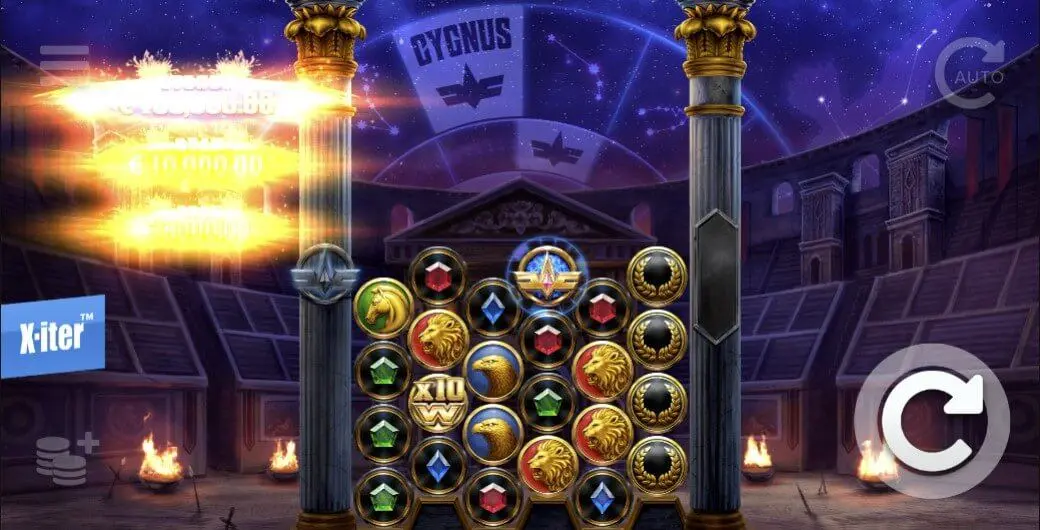
Cygnus 3 is a six-reel release from ELK Studios, and the headline figure is a 94% return to player. That sits 1.71 percentage points under the 95.71% average across the slots reviewed here, so the cygnus 3 slot asks you to accept a thinner long-run return than most of the catalogue. Play it because the six-reel format interests you, not because the maths is working in your favour.
First look at the Cygnus 3 slot
The facts on file are narrow, so it is worth being clear about what is known and what is not. ELK Studios is the developer, the grid runs across six reels, the game is catalogued as a slot machine, and a free demo is available. The published return is 94%.
ELK Studios has 138 titles listed here, with an average RTP of 94.92% across them. Cygnus 3 comes in slightly below even its own studio’s typical setting, which is unusual — most releases cluster around or above their provider’s average rather than under it.
On popularity, it ranks 2755, placing it in the 86.2nd percentile. That means it draws more attention than roughly six games in seven, which tells you there is an audience, though popularity and payout percentage are entirely separate things. A widely played game with a 94% return is still a 94% return.
Beyond the reel count and the studio name, no payline total, stake range, maximum win or volatility rating appears in the data available. Absent information is worth noting rather than filling in.
| Provider | ELK Studios |
|---|---|
| RTP | 94.0% |
| Reels | 6 |
| Free demo | Yes |
| Site-wide average RTP | 95.71% |
How a round plays out
What can be said with confidence is structural. Six reels is a wider grid than the traditional five, and wider grids generally mean more symbol positions per spin. Designers usually compensate for that extra space in one of two ways: either individual symbol combinations pay less, or winning combinations are made harder to land. Either route keeps the overall return where the studio wants it.
Many six-reel slots drop fixed paylines in favour of “ways” counting, cluster payouts or adjacent-reel matching, because drawing conventional lines across six columns produces awkward numbers. Whether Cygnus 3 uses any of those approaches is not recorded in the data here, so treat descriptions you find elsewhere as unverified until you check the game’s own information screen.
The same applies to features. Wilds, scatters, free-spin rounds and purchasable bonuses are common across the modern market, but none of them is documented for this title in the facts available, and inventing a feature list would not help you. The free demo is the practical answer: load it, open the paytable, and read the mechanics directly from the source.
One thing is universal. Each spin resolves independently, with no memory of the spin before it.
Reading the 94% return figure
A 94% RTP means that across an extremely large number of spins, the game is modelled to return £94 for every £100 staked. The other £6 is the house edge. That average only emerges over hundreds of thousands or millions of spins — far more than any individual session contains — so your own results will scatter widely around it in both directions.
Put a session-sized number on it. Stake £1 a spin for 500 spins and you have wagered £500; the modelled return on that turnover is £470, an expected cost of £30. Actual outcomes range from losing the lot to finishing well ahead, because variance dominates at that sample size. The percentage describes the long-run tendency, not your afternoon.
Context matters here. The site-wide average is 95.71% and the ELK Studios average is 94.92%, so this game is 1.71 percentage points below the corpus average. On £500 of turnover, that gap works out to roughly £8.55 in additional expected cost compared with an average-RTP game. Small per spin, meaningful over a few hundred hours.
Why volatility changes your bankroll maths
No volatility rating is published for this title in the data available, which is a genuine gap rather than a detail to skip past. Volatility describes how returns are distributed over time, and two games sharing an identical 94% RTP can feel completely different depending on it.
A low-volatility design pays small amounts often. Balances drift downward gently, sessions last longer on the same bankroll, and the biggest single results are modest. A high-volatility design does the opposite: long stretches return nothing, then occasional larger hits carry the payout percentage. The average is the same; the ride is not.
That distinction drives bankroll sizing. If a game is high variance, a rule of thumb many players use is a bankroll of several hundred times the base stake, simply so a dry run does not end the session prematurely. Low variance tolerates a shorter bankroll relative to stake.
With no rating available, the demo is the substitute. Spin a few hundred times at a fixed stake and watch how frequently and how heavily it pays. That gives you a rough feel, though it never predicts real-money outcomes — demo and cash play run the same independent maths, and neither tells you what comes next.
Bet sizing when the stake range is unpublished
No minimum or maximum bet appears in the facts for this game, so the numbers below are about method rather than specific limits. Check the actual range in the game itself before you commit anything.
The useful calculation is spins-per-budget. Decide what you are willing to spend for the session, then divide by the stake to see how many spins that buys. A £40 budget at £0.20 a spin gives you 200 spins; the same £40 at £2 a spin gives you 20. Those are two entirely different experiences of the same game, and the second one exposes you to variance far more sharply.
At a 94% return, higher stakes also mean a higher expected cost per hour. Four hundred spins an hour at £0.20 is £80 of turnover, carrying an expected cost near £4.80. The same hour at £1 a spin turns over £400 and carries roughly £24.
No stake pattern, progression or timing changes any of this. Raising bets after losses does not improve the return percentage; it only increases how fast money moves.
Where Cygnus 3 sits among 6-Reels slots
The 6-Reels label is a format category rather than a visual theme, and no other titles are catalogued under it here, so there is no direct like-for-like group to rank this against. What is available is the rest of the ELK Studios list, and that comparison is instructive because the studio holds the same return figure across several of its better-known releases.
Pirots 3 also runs at 94%, which suggests a deliberate house setting rather than a one-off decision for this title. The earlier Pirots matches it, as does the newer Pirots 4. If you want a sense of how this developer builds around that number, those are the natural places to look, and all three have larger followings.
The broader point for anyone browsing ELK Studios slots: the studio average of 94.92% means most of its catalogue returns marginally more than this game does. If return percentage is your primary filter, you can stay with the same developer and still find a slightly better figure.
The honest verdict
Cygnus 3 is a six-reel ELK Studios game with a 94% return, which is below its studio’s average and 1.71 points below the average across the games reviewed here. That is the clearest fact about it, and it is not a flattering one. Nothing else in the published data — no volatility rating, no stake range, no maximum win — gives you a counterweight to weigh against that figure.
It has an audience, sitting in the 86.2nd percentile for popularity, so plenty of people clearly enjoy the format. If the six-reel structure is what draws you, the Cygnus 3 free demo costs nothing and lets you read the paytable and mechanics for yourself instead of relying on second-hand descriptions.
What it does not deserve is a place on a shortlist chosen purely on return percentage. Several games from the same developer, and most of the wider catalogue here, pay back more over the long run.
Slots are paid entertainment, not income. Play only if you are 18 or over, decide your budget before you open the game, and treat that amount as the price of the session rather than money you expect to see again.
More from ELK Studios
- Pirots 4 — 94.0% RTP
- Tropicool 2 — 94.0% RTP
- Nitropolis 4 — 94.0% RTP
- Coba — 95.0% RTP
- Nitropolis 3 — 95.0% RTP
- Katmandu X — 95.0% RTP
- Hula Balua — 94.0% RTP
Frequently Asked Questions
Can I play Cygnus 3 for free without downloading anything?
A free demo of Cygnus 3 is available, so you can try the six-reel format with no money at stake and no download required. Demo mode runs the same mathematics as the paid version, including the 94% return, but demo balances hold no cash value and cannot be withdrawn.
What does the 94% RTP on Cygnus 3 actually mean for me?
It means the game is modelled to return £94 for every £100 wagered across an extremely large sample of spins, leaving a 6% house edge. Over 500 spins at £1, expected turnover is £500 and modelled return £470. Short sessions scatter widely around that average in both directions.
How volatile is Cygnus 3?
ELK Studios has not published a volatility rating for this title, so treat any figure quoted elsewhere with caution. Volatility determines whether returns arrive as frequent small payouts or rare larger ones, which directly affects how big a bankroll you need. The demo is the only reliable way to gauge it yourself.
Who are ELK Studios and what else do they make?
ELK Studios is the developer behind Cygnus 3 and has 138 titles listed here, averaging 94.92% RTP across them. Their better-known releases include Pirots, Pirots 3 and Pirots 4, all of which also carry a 94% return, suggesting a consistent house setting across the range.
Is Cygnus 3 better value than Pirots 3?
On return percentage the two are identical: both Cygnus 3 and Pirots 3 are set at 94%, so neither offers a long-run edge over the other. The choice comes down to mechanics and format preference rather than maths. Both sit below the 95.71% average across the games reviewed here.