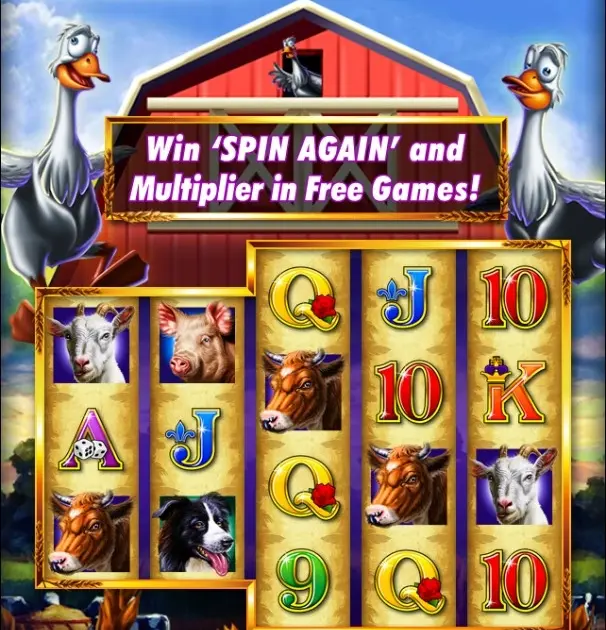
Crazy Goose is a single-reel slot from Ainsworth Game Technology that returns 94.11% RTP — noticeably below the 95.71% corpus average. If you prefer video slots with multiple paylines and elaborate bonus rounds, this game will not satisfy that itch, but the free demo is available for anyone curious about the format.
The 1-reel grid explained
Most online slots use a 5×3 grid or larger. Crazy Goose strips this down to a single reel. In practice, a one-reel format means every spin resolves on one column of symbols, removing the left-to-right line-reading that multi-reel games require. The mechanic itself is closer to a traditional mechanical slot than a modern video title.
With only one reel, the total number of possible symbol combinations is far smaller than on a 5-reel game. Fewer combinations can mean fewer simultaneous winning paths, though the actual outcome depends entirely on the weighting applied to each symbol position — a detail Ainsworth has not published for this title.
The format suits players who want simple, fast spins with minimal visual clutter. It does not suit anyone looking for expanding wilds, cascading symbols or tumbling reels, because those mechanics require multiple reels to interact with each other. If that simplicity appeals to you, the Crazy Goose free demo lets you evaluate the pace before risking any money.
Paylines, ways and how Crazy Goose pays
Ainsworth has not published a payline count or ways mechanic for Crazy Goose. On a single-reel machine, traditional paylines are largely a non-issue: a winning outcome typically depends on a set number of matching symbols appearing in the single visible row, multiplied by whatever line bet you placed.
Some one-reel formats use a simple multiplier table — three matching symbols pay 10×, four pay 50×, five pay 500×, for example. Without Ainsworth’s actual pay table, treat every number you see quoted on third-party review sites as unverified.
The practical consequence is clear: you cannot calculate expected payout per spin from public data alone. The RTP figure of 94.11% is the closest substitute, but it averages across thousands of sessions and tells you nothing about which specific combinations trigger which prizes. Compare this against a game like Fiesta De Toros from the same provider, which at 95.77% RTP sits well above the corpus average and is more likely to document its pay structure publicly.
94.11% RTP put in context
Crazy Goose returns 94.11% of wagered money over a very long statistical sample. Across 10,000 spins at £1 per spin (£10,000 total staked), the theoretical return is £9,411, leaving £589 as the house’s expected margin. That is a meaningful difference from a 96.5% game, which would return £9,650 from the same outlay.
The provider average for Ainsworth Game Technology slots sits at 94.7%, meaning Crazy Goose lands 0.59 percentage points below even its own studio’s norm. Compared with the full corpus average of 95.71%, it trails by 1.6 points. The game ranks 958th in popularity percentile among indexed titles.
Here is how it stacks against nearby Ainsworth titles:
| Game | RTP | Gap vs corpus |
|---|---|---|
| Fiesta De Toros | 95.77% | +0.06% |
| Enchanted Eyes | 94.31% | −1.40% |
| Crazy Goose | 94.11% | −1.60% |
| Pussy Cat | 94.16% | −1.55% |
| Corpus average | 95.71% | 0 |
Crazy Goose sits in the lower half of its provider’s catalogue, with Pussy Cat at 94.16% being the only comparable title closer to the floor. Every percentage point of RTP lost compounds over thousands of spins, so this gap is not trivial if you play long sessions.
Volatility and hit patterns
Ainsworth has not assigned a volatility rating to Crazy Goose in the available data. Without that classification, you cannot predict whether the game pays small wins frequently or reserves its action for rare, larger hits. Both profiles produce the same 94.11% long-run return; they just distribute it differently across individual sessions.
As a general principle, single-reel machines tend toward lower volatility because the reduced combination count limits extreme outcomes. But this is a heuristic, not a rule — weighting strategies can produce wild swings on any reel count. Ainsworth has not published hit frequency data for this title either.
What this means for your bankroll: if the game is genuinely low-volatility, expect modest wins spread fairly evenly and a slow erosion of balance due to the sub-average RTP. If it is higher-volatility than typical for the format, expect longer dry spells punctuated by larger payouts, with the same house edge operating underneath. Without a published volatility rating, you should treat session-length planning conservatively and not assume the simple format guarantees predictable outcomes.
Choosing a stake between unknown limits
The available FACTS do not include a minimum or maximum stake for Crazy Goose. This absence matters because stake range is one of the primary levers you control: it determines how long your bankroll lasts and how exposed each spin is to variance.
On a 94.11% RTP game, every £100 you wager carries an expected loss of £5.89 before variance is considered. At a higher stake — say £5 per spin — that expected loss compresses to roughly £5.89 every 20 spins rather than every 100 spins at £1 each. The percentage edge is identical; the speed at which it drains your balance is not.
If you find the stake range when playing the demo, note the maximum bet before committing real funds. On a game with below-average RTP, a high maximum stake amplifies losses faster than on a 96%+ title. There is no published data here to refine that advice further — that is the honest state of the information.
Demo play versus real money
Crazy Goose offers a free demo, which means you can spin the reel and observe payout patterns without depositing. The demo uses randomised outcomes identical to the real-money version, so it is useful for assessing pace, interface and whether you enjoy the single-reel format. It is not useful for predicting real-money results, because any individual session — whether demo or funded — is governed by variance, not a scheduled payout sequence.
No demo outcome carries over to real play, and no demo outcome changes what the next real spin will do. Every spin is independent. There is no “warming up” that the machine remembers.
If you decide to play for money, treat it as paid entertainment. Set a budget you can afford to lose before you open the game, stop when it is gone, and never chase a loss expecting the maths to reverse on your behalf. You must be 18 or older to gamble, and if playing stops feeling like entertainment, that is the point to stop — not to increase your stake.
Verdict on Crazy Goose
Crazy Goose is a functional single-reel machine that falls below both its provider’s average and the wider corpus in RTP. At 94.11%, the house edge is 0.59 percentage points higher than the typical Ainsworth game and 1.6 points higher than the overall market average. That gap compounds quietly across any extended session.
The format has a clear audience: players who prefer mechanical simplicity, fast spins, and no complex features to learn. If that describes you, the free demo costs nothing and lets you decide quickly. But if you are optimising for session value, Enchanted Eyes gives you a marginally better return from the same studio, and Fiesta De Toros sits above the corpus average entirely.
What is missing from public documentation — paylines, volatility, stake range, max win — means you are evaluating this game with incomplete information. That is not unique to Crazy Goose, but combined with a below-average RTP, it weakens the case for choosing it over titles where those numbers are at least available. Spin the demo if the format interests you, but do not expect value advantages from the maths.
Frequently Asked Questions
Is Crazy Goose available to play for free?
Yes, the free demo is available on this site. You can play Crazy Goose without downloading software or depositing money. The demo uses the same randomised outcomes as the real-money version, so it reflects actual game behaviour without financial risk.
What is the RTP of Crazy Goose?
Crazy Goose has an RTP of 94.11%, which is below the Ainsworth Game Technology provider average of 94.7% and 1.6 percentage points below the corpus average of 95.71%. This means the game retains more of each wager over very long samples than the market norm.
What volatility does Crazy Goose have?
Ainsworth has not published a volatility rating for Crazy Goose, and no hit frequency data is available either. Without this information, you cannot determine whether the game produces frequent small wins or infrequent larger ones — both patterns yield the same 94.11% long-run return.
Who makes Crazy Goose and what else do they publish?
Crazy Goose is made by Ainsworth Game Technology, which has 87 titles in the indexed catalogue with an average RTP of 94.7%. Their related slots include Fiesta De Toros at 95.77% RTP and Enchanted Eyes at 94.31%, both of which offer slightly better theoretical returns.
Can playing Crazy Goose demo win real money?
No. Demo play uses virtual credits and no outcome transfers to a real-money session. The 94.11% RTP applies identically in both modes, but demo results have no financial value whatsoever. To play for real stakes you must deposit at a licensed operator.




