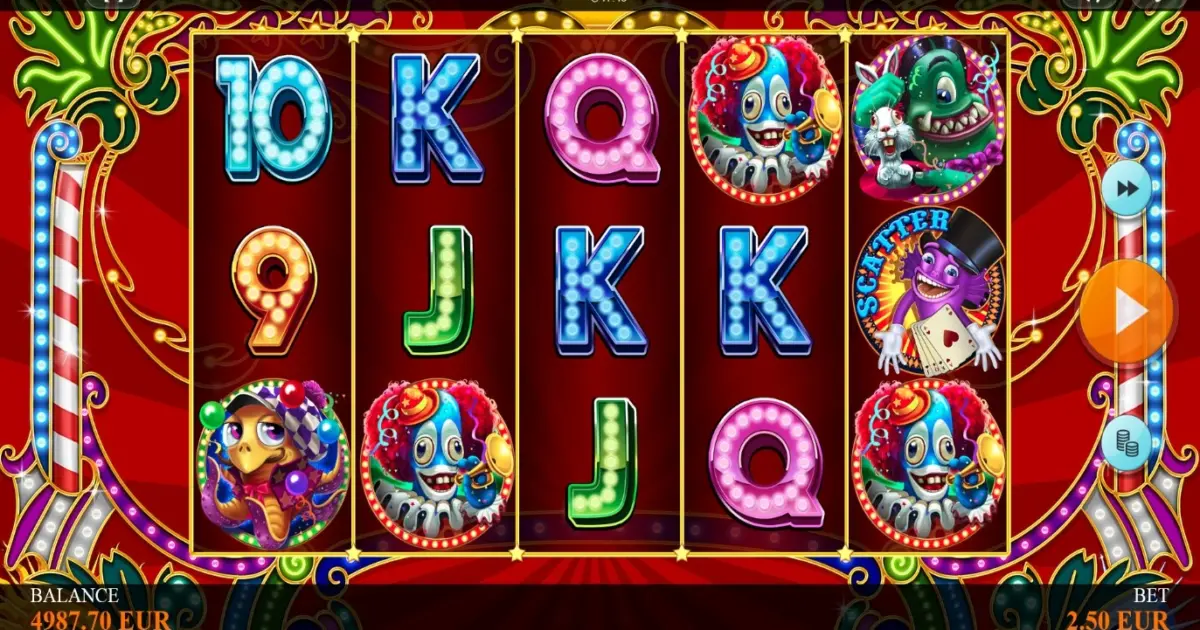
The honest answer on the cirque de fous slot is that the two numbers most worth knowing are not on the record. There is no published return-to-player figure for this title, and no published volatility rating either. What you do get is a 5-reel Betixon game, a demo you can load without spending anything, and a popularity position that puts it ahead of roughly 86% of the titles in this catalogue. If you are comfortable judging a game by feel rather than by maths, the demo is right there. If you want the numbers first, this page will be a short read.
Who makes Cirque De Fous
Betixon is the studio behind it, and this catalogue lists 49 Betixon titles in total. That is a mid-sized library by supplier standards: large enough that the studio has house habits you can learn by playing a few, small enough that you can work through the whole range in a few sessions of demo play.
Across those 49 games, the average published return is 95.29%. That is a useful anchor even when a specific game’s figure is missing, because studios tend to build within a band rather than scattering wildly from title to title. It is an anchor, not a promise: an average tells you where the middle of a group sits, not where any single member sits. A studio averaging 95.29% can still ship a 94% game and a 97% game in the same quarter.
For context, the average across every game in this catalogue is 95.71%. Betixon therefore runs a little under the wider field, by about 0.42 percentage points. On £100 wagered across a very large sample, that difference is around 42p. Small per pound, but it compounds across thousands of spins, and it is the kind of gap worth knowing about before you settle on a studio.
Where Cirque De Fous sits in the Betixon catalogue
Ranked 2747 overall and sitting in the 86.2nd percentile for popularity, this one gets more attention than most titles here without being a headline release. Popularity is a measure of traffic, not quality and certainly not generosity, so read it as “other people found this game” rather than “other people did well on it”.
If you want to see how the studio behaves across different builds, the obvious next stops are its stablemates. Gemonex is the gem-styled entry in the same library, useful if you want to compare how Betixon paces a stripped-back grid against this one. Wild Fudge gives you a second data point on the studio’s lighter, sweeter side. Fortune Spirits rounds out the sample if you want a third reference before deciding whether Betixon’s style suits you at all.
A caveat that matters: none of those three has a published RTP figure in this catalogue either. So comparing them will tell you about pacing, presentation and how long a demo balance lasts, but it will not let you rank them by long-run return. That is a gap in the studio’s public disclosure, not something a review can fill in.
RTP: not published, against a 95.29% Betixon average
Betixon has not published a return-to-player figure for this game, so treat any specific percentage you see quoted elsewhere with real caution unless it comes with a source. Inventing one would be worse than admitting the gap.
Here is what the figure would have told you if it existed. RTP is a long-run statistical average, calculated across millions of simulated spins. A game at 96% returns £96 for every £100 staked when the sample is large enough, and the shortfall is the house edge. It says nothing about your next hundred spins, or your next thousand. Short sessions are dominated by variance, not by the return percentage, and every spin is independent of the one before it.
What it does affect is the slow grind. Two games, one at 95% and one at 96.5%, staked at £0.50 a spin over 2,000 spins, differ by about £15 in expected cost. That is the practical use of the number: a rough cost-per-hour estimate, not a prediction.
Without it, you are left with the studio average of 95.29% as your only guide, and a catalogue average of 95.71% as the wider benchmark. Assume this game sits somewhere near its studio’s middle and you will not be wildly wrong, but you will not be informed either.
| Detail | Value |
|---|---|
| Provider | Betixon |
| Reels | 5 |
| Category | Slot Machine |
| Theme label | 5-Reels |
| Provider titles in catalogue | 49 |
| Provider average RTP | 95.29% |
| Catalogue average RTP | 95.71% |
| Popularity rank | 2747 (86.2nd percentile) |
| Free demo | Available |
Volatility and who it suits
No volatility rating has been published for this game. That is the second blank, and for session planning it arguably matters more than the first.
Volatility describes the shape of the swings rather than their long-run average. Low-volatility games pay small amounts often, so a modest balance stretches across a long session and the graph of your balance slopes gently. High-volatility games pay rarely and larger, which means long stretches of nothing punctuated by occasional spikes, and they demand a bigger bankroll relative to your stake simply to survive the dry runs. Medium sits between the two. Crucially, all three can share the same RTP; the money arrives on a different schedule, that is all.
Since the rating is missing, the demo is your measuring tool. Set a fixed number of spins, say 200, at a fixed stake, and watch how often the balance ticks up at all. Frequent small returns suggest the lower end of the scale. Long flat stretches suggest the higher end. That is an estimate from a small sample, not a verdict, but it is better than guessing.
One thing it cannot do: no pattern you spot in a demo predicts real-money results, and no stake pattern, timing or progression changes the expected value of a spin. A game is never due, hot or cold.
Playing Cirque De Fous slot for free
The Cirque De Fous free demo is available, which makes the decision easy. You can load the 5-reel grid, see how the game actually plays, and find out whether the pacing suits you before any money is involved. Demo credits behave like real credits mechanically, so it is a fair test of feel, speed and how the game handles a losing run.
Use it deliberately rather than idly. Pick a spin count, note where the balance sits at the end, and repeat. Two or three runs of 200 spins will tell you more than an hour of aimless clicking, and it costs nothing but time.
Slots are 18+ and are paid entertainment, not income. Decide what the session is worth to you before you start, treat that figure as the price of the evening, and stop when it is spent. If the amount ever feels like money you need back, that is the moment to close the tab.
Similar picks
This game carries only the 5-Reels label, and there are no other titles filed under that tag in this catalogue, so there is no theme-based shortlist to hand you. That is a cataloguing quirk rather than a comment on the game.
What it means in practice: your best comparison set is the studio itself, which is why the Betixon slots linked above are the sensible next step. Five reels is a structural description, not a theme, and it covers most of the modern market, so a theme match would have added little anyway. Judge this one against its stablemates on pacing and presentation, since published return figures are unavailable across that group.
Verdict
A 5-reel Betixon game with real traffic behind it, a working demo, and two significant blanks in its public data. The missing return figure and missing volatility rating mean you cannot cost a session in advance or know what shape the swings will take. The studio average of 95.29% sits a little below the 95.71% catalogue average, which is the closest thing to a benchmark available.
The recommendation is straightforward: play the demo before you consider real stakes, and let the game earn its place rather than assuming it. If undisclosed numbers bother you, plenty of titles publish theirs, and there is no reason to accept less.
Frequently Asked Questions
Can I play Cirque De Fous for free?
Free demo play is available for this title, so you can try the 5-reel Betixon game without staking anything. Demo credits behave like real credits mechanically, which makes it a fair way to judge pacing and how the game handles a losing run. It is the sensible first step given the missing published data.
What is the RTP of Cirque De Fous?
Betixon has not published a return-to-player figure for this game, so treat any percentage quoted elsewhere with caution. The closest available reference is the studio average of 95.29% across its 49 titles here, against a catalogue-wide average of 95.71%. An average tells you where a group sits, not where one game sits.
Is Cirque De Fous high or low volatility?
No volatility rating has been published, which leaves the demo as your only measuring tool. Run a fixed 200 spins and watch how often the balance ticks up: frequent small returns point to the lower end of the scale, long flat stretches to the higher end. Treat that as an estimate from a small sample.
Who is Betixon and what else do they make?
Betixon is the studio behind this release, with 49 titles listed in this catalogue at an average published RTP of 95.29%. Other entries include Gemonex, Wild Fudge and Fortune Spirits, none of which publish a return figure either. That makes the studio a useful comparison set for style rather than for maths.
How does Cirque De Fous compare to Gemonex?
Both come from Betixon and neither publishes a return-to-player figure, so a direct maths comparison is not possible. What you can compare is pacing and presentation across two builds from the same studio, using demo play at a fixed stake and spin count. Gemonex is the gem-styled counterpart to this 5-reel release.