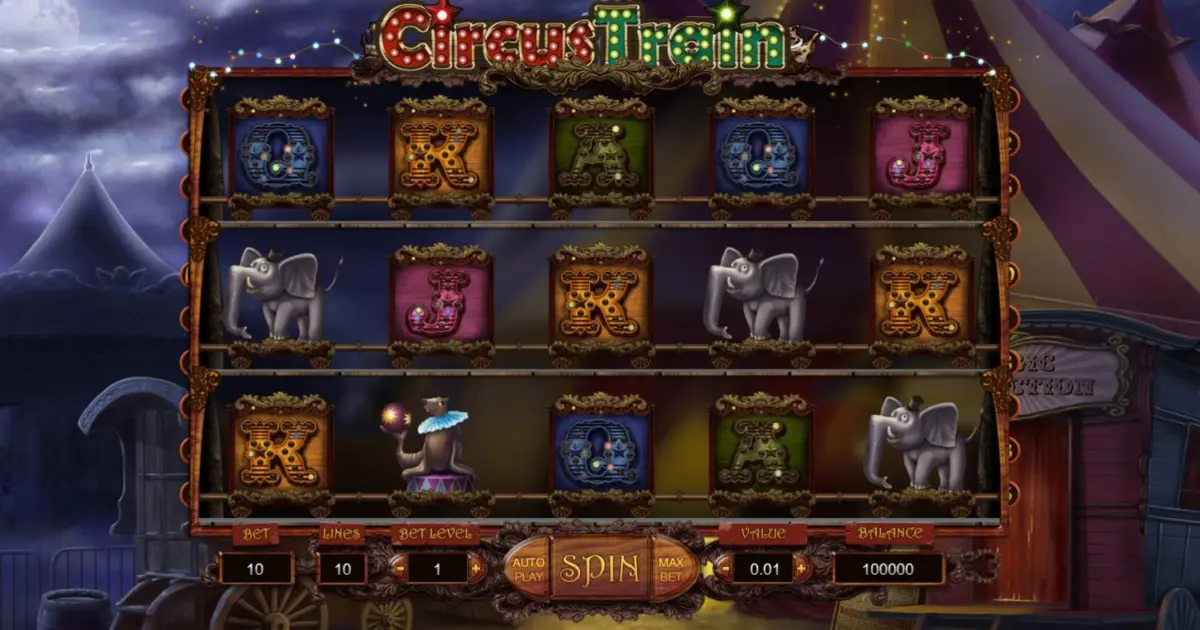
Circus Train is a five-reel slot machine from Thunderspin with a published return-to-player figure of 94.2%. That sits 1.51 percentage points below the 95.71% average across the slots we track, and below Thunderspin’s own 95.64% house average across their 43 titles. It is also one of the more heavily played games on the site, ranking 1600th overall and landing in the 92nd popularity percentile.
So the picture is mixed: plenty of people play it, but the maths is not in your favour compared with most alternatives. Whether that trade is worth making depends on how much you value the specific game over the roughly £1.50 per £100 wagered you give up by choosing it. A free demo is available, which is the sensible place to find out.
The 5-reel grid explained
Five reels is the standard modern slot layout, and it has been since video slots replaced mechanical three-reel cabinets. Each reel is an independent column of symbols that stops on a randomly selected position. Five columns give a designer enough room to build meaningful symbol combinations without the win frequency collapsing.
The practical effect of the reel count is on combination length. On a three-reel machine, a win typically needs three matching symbols and there is nowhere to hide a near-miss. On five reels, most paytables start paying at three symbols and scale up sharply at four and five, so the bulk of your returned money arrives as small three-symbol hits while the rare five-symbol lines carry the top values.
Thunderspin has not published the row count for Circus Train, so the total number of symbol positions on screen is unknown. That matters more than it sounds: a 5×3 grid and a 5×4 grid behave differently in terms of how many symbols are in play per spin. Treat the grid shape as something to confirm in the demo rather than assume. Thunderspin’s Steam Wilds Megaways takes the opposite approach with a variable-height grid and a 96.0% RTP, which is a useful contrast if grid mechanics are what interests you.
| Provider | Thunderspin |
|---|---|
| RTP | 94.2% |
| Reels | 5 |
| Free demo | Yes |
Paylines, ways and how Circus Train pays
The payline count for this title is not in the published data, so anything you read elsewhere quoting a specific figure should be checked against the game’s own info screen. What follows is general to the format, not a claim about this game.
Slots pay in one of three broad ways. Fixed paylines run set patterns across the reels and you bet on all of them each spin. Ways-to-win systems pay any matching symbols in adjacent columns regardless of row position, typically producing 243 or 1,024 combinations on a five-reel grid. Cluster or cascading systems pay groups of touching symbols instead of lines.
Each structure changes how your stake divides. With more paylines or ways, individual line wins shrink because your total bet is spread thinner, while hit frequency rises. Fewer lines means larger individual hits arriving less often. The RTP is unaffected by this choice — 94.2% is 94.2% whichever structure sits underneath it. What changes is the texture of the session.
Many five-reel slots also carry wilds that substitute for regular symbols, scatters that pay from any position, and a free-spin round triggered by scatter counts. Whether Circus Train includes any of these is not something the published data tells us, and no bonus feature, multiplier value or symbol name should be assumed. The demo will show you the paytable in full.
94.2% RTP put in context
RTP is a long-run average, not a session forecast. 94.2% means the game is built to return £94.20 for every £100 wagered across a sample large enough to smooth out variance — millions of spins, not hundreds. Over a realistic session the actual figure will land anywhere either side of that.
The comparison numbers are worth spelling out. At 94.2%, the theoretical house edge is 5.8%. The corpus average of 95.71% carries a 4.29% edge, and Thunderspin’s own average of 95.64% is close behind. Across 1,000 spins at £1 a spin, that 1.51-point gap works out to about £15 in additional expected cost versus an average game. Across 10,000 spins, roughly £150.
Two of Thunderspin’s other titles clear that bar. Book of Jam runs at 95.9% and Steam Wilds Megaways at 96.0%, both better than the corpus average. Their Jolly Roger matches Circus Train exactly at 94.2%, so it offers no mathematical improvement.
None of this makes a low-RTP game unplayable. It makes it more expensive per hour of entertainment, which is a budgeting fact rather than a moral one.
Volatility and hit patterns
Thunderspin has not published a volatility rating for Circus Train, so the swing profile is unknown. That is genuinely useful to know before you commit a bankroll, because volatility affects your session far more visibly than RTP does.
Low-volatility slots pay often and small. Balances drift down slowly, sessions last longer on a given bankroll, and the ceiling is modest. High-volatility slots do the reverse: long stretches of nothing punctuated by occasional larger hits, which means you need a bigger bankroll relative to your stake simply to survive the dry runs. Medium sits between the two.
Because the rating is unpublished, you have two options. Read the paytable in the demo — a steep jump between four-symbol and five-symbol payouts usually indicates higher variance, while a flatter table suggests lower. Or spin a few hundred demo rounds and watch the shape of the balance line rather than the total.
One thing to be clear about regardless of volatility: every spin is independent. The reels have no memory of the previous result, so a game is never due, warm or overdue for anything. A long losing run does not raise the probability of the next win, and a good run does not borrow against the future.
Choosing a stake between the game’s minimum and maximum
The stake range for Circus Train is not in the published data, so you will need to check the bet selector in the game itself. What you can plan in advance is the ratio between your stake and your total budget, and that is the part that actually determines session length.
A useful frame: divide your session budget by the number of spins you want it to last. If you have £40 and want 200 spins, your stake is £0.20. Then check whether the game’s minimum allows that. If the minimum bet is higher than your calculated stake, the game is not correctly sized for your budget and a lower-minimum title is the better fit.
At 94.2% RTP, the expected cost per spin is 5.8% of your stake. At £0.20 a spin that is about 1.2p in theoretical cost, or roughly £2.32 over 200 spins. The actual result will differ substantially in either direction — that is variance doing its work — but the figure gives you a realistic sense of what the entertainment costs when it goes to plan.
No stake pattern changes any of this. Raising bets after losses, lowering them after wins, or timing your spins does not alter the return percentage on a single spin.
Demo play versus real money
A free demo of Circus Train is available, and it runs on the same underlying random number generator with the same 94.2% return. What it does not do is predict your real-money results. A demo session that goes well tells you nothing about the next one, funded or not, because each spin is independently generated.
What the demo is genuinely good for is answering the questions the published data leaves open on this title: the grid shape, the payline or ways structure, the paytable steepness, the bet range, and whether any bonus features exist. Those are the specifics no review can supply for you here. Twenty minutes with the free version resolves all of them at zero cost, and you can try it with no download.
If you do move to real stakes: this is 18+ only. Set a figure you are comfortable losing before you start, treat it as the price of entertainment rather than an investment, and stop when you reach it. A 94.2% RTP game is designed to cost you money over time — that is the arrangement, and knowing it up front is the whole point.
Verdict on Circus Train
Circus Train is a five-reel Thunderspin slot with a below-average 94.2% return and a lot of unpublished specifics. The RTP is the clear negative: 1.51 points under the corpus average and 1.44 under Thunderspin’s own, which translates to real additional cost at any meaningful volume of play.
Its case is popularity. Sitting in the 92nd percentile means a lot of people keep coming back, and that usually reflects something the numbers do not capture. If the game itself appeals to you after a demo run, the 5.8% house edge is a known and manageable cost rather than a trap.
If you are choosing purely on maths, Steam Wilds Megaways at 96.0% and Book of Jam at 95.9% are both stronger picks from the same studio and each clears the corpus average. Jolly Roger, at an identical 94.2%, offers no improvement. Start with the free demo, decide whether Circus Train is worth the premium, then choose deliberately.
Frequently Asked Questions
Can I play Circus Train for free without downloading anything?
A free demo of Circus Train is available and runs in your browser with no download or account required. It uses the same random number generator and the same 94.2% RTP as the real-money version, so it is an accurate way to check the paytable, grid layout and bet range before deciding whether to fund a session.
What does the 94.2% RTP on Circus Train actually mean for my money?
It means the game is built to return £94.20 per £100 wagered across an extremely large sample of spins, leaving a 5.8% theoretical house edge. Over 1,000 spins at £1 each, the expected cost is about £58. Your actual session result will vary widely from that figure in either direction.
Is Circus Train high or low volatility?
Thunderspin has not published a volatility rating for Circus Train, so the swing profile is unknown. Check the paytable in the free demo — a steep gap between four-symbol and five-symbol payouts usually signals higher variance, a flatter table lower. Either way, every spin is independent and no game is ever due for a result.
Who is Thunderspin and what else do they make?
Thunderspin is the studio behind Circus Train, with 43 titles in our database and an average RTP of 95.64% across them. Their range includes Book of Jam at 95.9%, Steam Wilds Megaways at 96.0% and Jolly Roger at 94.2%. Circus Train sits below their house average by 1.44 percentage points.
How does Circus Train compare to Steam Wilds Megaways?
Steam Wilds Megaways returns 96.0% against Circus Train's 94.2%, a 1.8-point advantage that halves the house edge from 5.8% to 4.0%. It also uses a variable-height Megaways grid rather than a fixed five-reel layout. On published return alone, Steam Wilds Megaways is the stronger mathematical choice from Thunderspin's range.