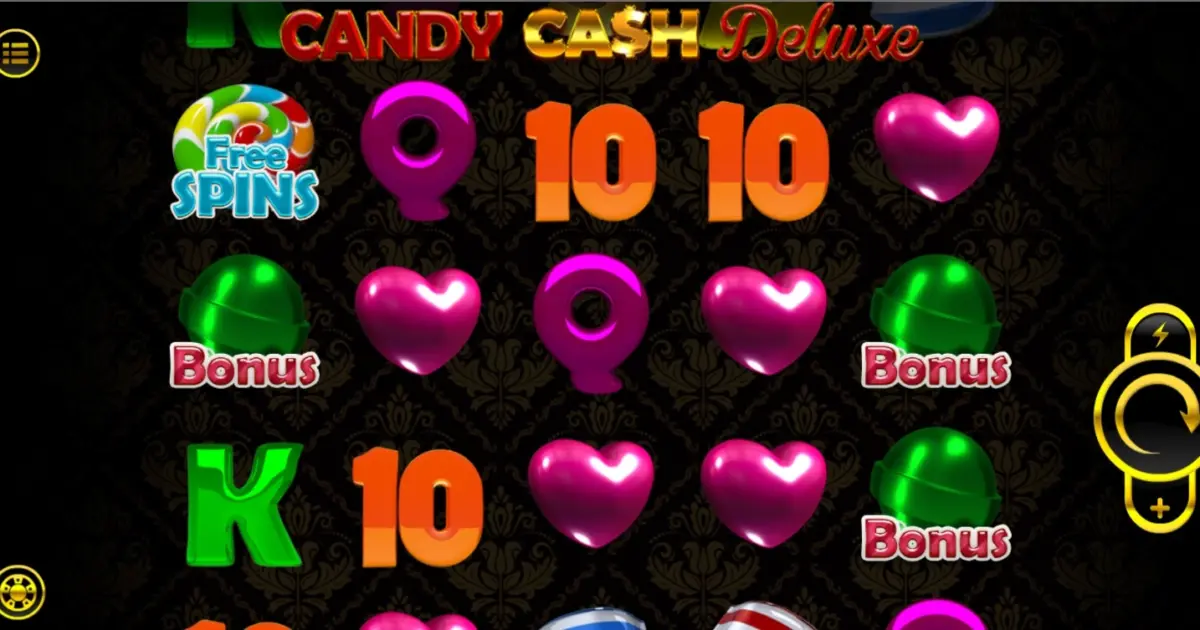
Candy Cash Deluxe is worth a look if return-to-player is high on your shortlist. At 97.0% RTP it sits 1.29 points above the corpus average of 95.71%, which is a concrete mathematical edge over many alternatives, though every spin remains independent and random. The candy cash deluxe slot is available as a free demo, so you can judge its tempo and layout without commitment before deciding if it fits your session budget.
Is candy cash deluxe slot worth playing?
The short answer is yes if you prioritise RTP and a straightforward 5-reel setup, no if you need published detail on volatility, features or max win to make a decision. The single most useful fact here is the 97.0% RTP, which is higher than the average across the reviewed corpus and just a touch below Mobilots’ own average of 97.24% across 77 games.
That puts Candy Cash Deluxe in a familiar bracket for the studio. The three related Mobilots titles supplied in the data — Mr and Mrs Joker, Sporty Smileys and Ra to Riches — all sit on the same 97.0% figure, so the studio appears to price this group consistently rather than as an outlier.
Popularity context helps too. A rank of 1431 puts the game in the 92.8th percentile for traffic within the corpus. That does not tell you whether you will enjoy it, but it does mean plenty of players have sampled it and comparison data is not thin.
What is missing matters as much as what is present. No volatility label, no hit-frequency figure, no published max win and no detailed feature list were supplied for this review. Without that, you cannot model swing size or bonus frequency in advance. Treat any such numbers you see quoted elsewhere with caution and rely on the free demo to feel the pace, keeping stakes flat and expectations anchored to the maths, not to marketing.
What 97% RTP means over 1,000 spins
RTP is a long-run statistical average, not a promise for a single session. A 97.0% RTP means that for every £100 wagered, the game is designed to return £97.00 on average when results are averaged across millions of spins. It does not mean you get £97 back from £100 in your session.
Over 1,000 spins the arithmetic is straightforward. If you stake £1 per spin, you wager £1,000 in total. The theoretical return at 97.0% is £970, for a theoretical loss of £30 over that block. At £0.50 per spin, you wager £500 and the theoretical return is £485, a £15 theoretical loss. At £2 per spin, you wager £2,000 and the theoretical return is £1,940, a £60 theoretical loss.
Those are averages, and short samples swing widely around them. Over 1,000 spins you could be ahead, behind by more than the average, or close to it. The distribution is what matters, and distribution is driven by volatility and hit frequency — neither of which were supplied for this title.
Comparison sharpens the number. The corpus average RTP is 95.71%. At that level, £1,000 wagered returns £957.10 theoretically. The gap to 97.0% is £12.90 less in theoretical loss per £1,000 wagered. Over extended play, that difference compounds, but it never overrides randomness.
Mobilots’ own average across its 77 games is 97.24%, so Candy Cash Deluxe at 97.0% is 0.24 points below the studio mean. In practice that is a small difference — about £2.40 per £1,000 wagered — and well within the range where session variance dwarfs the house-edge gap.
How volatile is Candy Cash Deluxe?
No volatility rating was supplied for Candy Cash Deluxe, so there is no verified label to quote. That absence is worth stating plainly because volatility shapes everything you feel in a session: how often wins land, how large they tend to be, and how quickly a bankroll can move up or down.
In general terms, low volatility tends to mean more frequent but smaller wins, which can stretch session time on a fixed budget but rarely produces large swings. High volatility tends to mean fewer wins with larger gaps between them, which can shorten a session on the same budget unless stakes are reduced. Medium volatility sits between those poles. These are concepts that apply across many slots; they are not claims about this specific game.
Without a published figure and without a hit-frequency percentage for this title, you cannot reliably estimate how many winning spins to expect per 100 spins, or how much cushion your balance needs to ride out a dry spell. The honest approach is to treat volatility as unknown and plan accordingly: use the free demo to gauge how the game feels, keep early stakes modest, and avoid increasing bets to chase a run of results, because each spin is independent.
If published volatility appears later from Mobilots, compare it to the RTP context you already have. A high-volatility game at 97.0% can still produce long losing stretches despite the above-average return; a low-volatility game at the same RTP will usually feel smoother but with smaller peaks.
What the 5-Reels theme brings to the game
The theme label supplied for this title is “5-Reels”. That is a structural descriptor rather than a narrative theme. It tells you the reel count is five, which is the most common layout in modern video slots, and little else. No specific characters, story, symbols or audiovisual details were included in the data for this review, so this section stays with what the label can support.
A five-reel structure generally means a grid with five vertical reels spinning independently, evaluated against a set of paylines or ways. The number of reels alone does not determine hit rate or return; those are set by the maths model. What the reel count does influence is familiarity. Players who have used other five-reel games will recognise the layout immediately.
Because the count of theme-matched games is zero in the comparison corpus, there is no peer group to rank this title against on theme grounds. That does not affect the maths — RTP remains 97.0% regardless of theme — but it does mean you should not expect theme-based comparisons to guide your choice here.
If you prefer theme as a decision driver, use the demo to see whether the presentation suits you, rather than relying on the label. The label confirms format, not feel, and with no further art or narrative detail published in the facts, any visual description you encounter elsewhere should be treated as unverified until you see the game yourself.
Stakes, session length and bankroll
No specific stake range was published in the facts for Candy Cash Deluxe, so there are no minimum or maximum bet figures to quote. That is common with some studio sheets and it limits precise bankroll planning, but you can still apply general principles to map stake to session length.
Session length is total wager divided by spin count. If you plan for 500 spins and stake £0.50, you need £250 of total turnover, not £250 in your balance at once, because wins recycle part of what you stake. The lower your stake, the more spins a fixed deposit can fund before turnover reaches your limit, and the more cushion you have for variance.
With a 97.0% RTP, the theoretical loss rate is 3.00% of turnover. At £1 per spin, 200 spins is £200 wagered for a £6 theoretical loss; 1,000 spins is £1,000 wagered for a £30 theoretical loss. Raise the stake to £2 and those theoretical losses double, because they scale linearly with turnover. Remember these are long-run averages, not forecasts for your night.
Because volatility and hit frequency are unpublished, the safest planning stance is conservative. Decide on a total budget for entertainment, divide it into a stake that allows several hundred spins, and keep that stake flat. Independence of spins means no bet pattern or timing changes the expected value; only the size of each wager and the number of wagers matter for total theoretical cost.
Alternatives if Candy Cash Deluxe is not for you
If the appeal here is the 97.0% RTP but you want to compare presentation or provider peers, the related Mobilots titles are the cleanest first check. Mr and Mrs Joker matches Candy Cash Deluxe on 97.0% RTP, so the theoretical cost per £100 wagered is identical at £3.00, letting you choose on feel rather than on return.
Another direct peer is Sporty Smileys, also listed at 97.0% from the same studio. With the same RTP and the same provider average context of 97.24%, you are not trading return for variety; you are sampling a different skin on a similar maths promise.
A third option on the same mark is Ra to Riches at 97.0%, which keeps the comparison within Mobilots and avoids introducing provider-level differences in RTP distribution. If you do look beyond Mobilots, anchor any alternative to that 95.71% corpus average. A game at 96.0% costs £4.00 per £100 wagered theoretically, a full £1.00 more than Candy Cash Deluxe per £100, which adds up over 1,000 spins.
Use the free demo on any alternative the same way: a short, low-stakes sample to check pace and clarity before you commit funds, without assuming demo results predict real-money outcomes.
Final take
Candy Cash Deluxe earns attention for one verifiable reason: 97.0% RTP on a 5-reel layout from a provider whose 77-game average is 97.24%, both above the 95.71% corpus mean. That is a solid, quantifiable starting point. The drawback is the lack of published detail beyond those figures — no volatility, no hit frequency, no stake range and no max win to model a session precisely.
That combination suggests a practical way to try it. Start in the free demo, keep stakes level, and treat the first few hundred spins as information gathering, not as a forecast. Every spin is independent, and no system of stake changes or timing can alter the house edge.
Play responsibly and keep it as paid entertainment. You must be 18+ to gamble. Set a budget before you spin, use deposit and time limits if you need them, and step away when the budget is spent. If gambling stops feeling like entertainment, seek support from a recognised help service in your jurisdiction.
| Feature | Detail |
|---|---|
| Game | Candy Cash Deluxe |
| Provider | Mobilots |
| RTP | 97.0% |
| Reels | 5 |
| Theme label | 5-Reels |
| Rank / percentile | 1431 / 92.8th |
| Provider games / avg RTP | 77 / 97.24% |
| Corpus average RTP | 95.71% |
| Free demo | Available |
Frequently Asked Questions
Can I play Candy Cash Deluxe for free before staking real money?
Yes, a free demo is listed as available for Candy Cash Deluxe. Demo play lets you see the 5-reel layout and pace without risking funds, but it uses virtual credits and cannot pay real money, and results in demo do not predict future real-money outcomes.
What is the RTP of Candy Cash Deluxe and what does it mean?
Candy Cash Deluxe has a 97.0% RTP, which is 1.29 points above the corpus average of 95.71%. That figure means £97.00 is returned per £100 wagered on average over millions of spins. Over just 1,000 spins at £1, actual results can be well above or below the £970 theoretical return.
How volatile is Candy Cash Deluxe and how does that affect my session?
No volatility rating was supplied for Candy Cash Deluxe, so risk profile cannot be verified from the facts. Volatility normally controls the size and spacing of wins, but without a published label or hit frequency you should assume unknown swing and keep stakes flat while sampling the free demo.
Who makes Candy Cash Deluxe and what else do they offer?
Candy Cash Deluxe is made by Mobilots, which has 77 games in the dataset with an average RTP of 97.24%. Other titles from the studio at the same 97.0% level include Ra to Riches, Sporty Smileys and Mr and Mrs Joker, giving direct RTP-matched alternatives within the same catalogue.
What stake should I use for Candy Cash Deluxe on a limited bankroll?
No stake range was published for Candy Cash Deluxe, so choose a stake that funds several hundred spins on your budget and keep it level. At 97.0% RTP the theoretical loss is £3.00 per £100 wagered, so 500 spins at £0.50 is £250 turnover for a £7.50 theoretical loss, though actual results will vary.