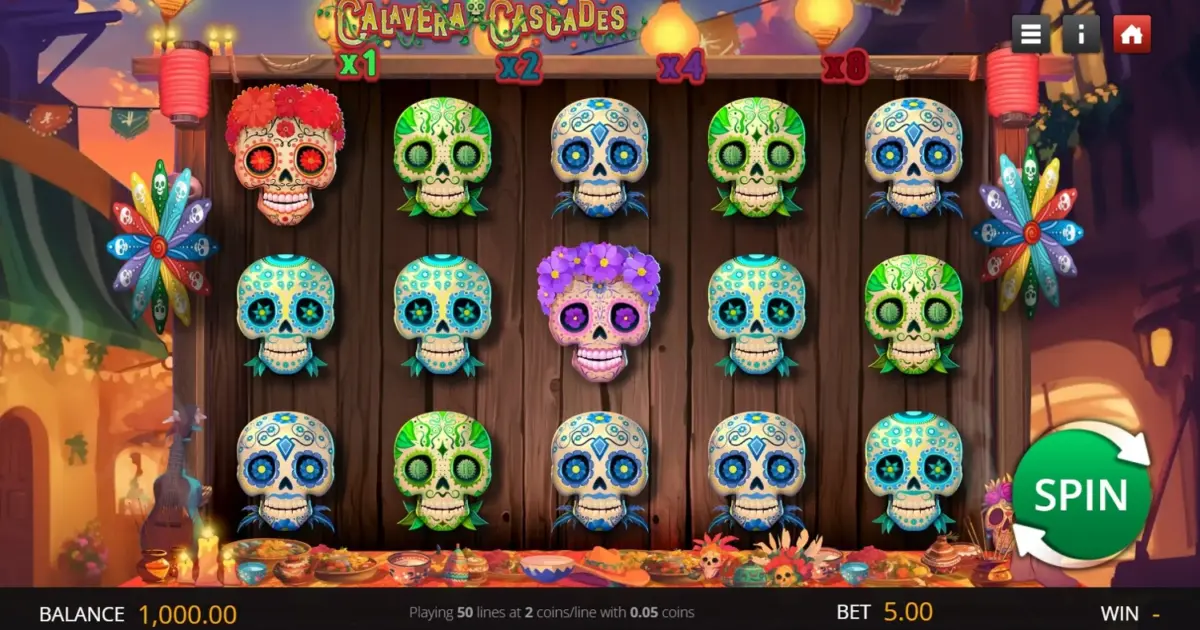
The decision here rests on one absence. No return-to-player percentage has been published for the calavera cascades slot, so you cannot compare its long-run return against anything — not Genii’s own catalogue average of 95.93%, not the 95.71% average across the games in this database. What you can do is play it free, which is available, and judge the rhythm of it without spending. If you want a known RTP before you stake money, this is not the title for that.
| Figure | Detail |
|---|---|
| Game | Calavera Cascades |
| Provider | Genii |
| Reels | 5 |
| Themes | Mexico, Music, 5-Reels |
| Type | Slot Machine |
| RTP | Not published |
| Genii average RTP | 95.93% |
| Database average RTP | 95.71% |
| Popularity rank | 2,567 (87.1st percentile) |
| Free demo | Available |
Who makes Calavera Cascades
Genii is the studio behind it, with 68 titles listed in this catalogue. That is a mid-sized library — large enough to show consistent design habits, small enough that it is not a factory churning out weekly clones. Across those 68 games the average return-to-player sits at 95.93%, a fraction above the 95.71% average for every game indexed here.
Treat that 95.93% as context, not as a substitute. A studio average tells you roughly where a developer aims; it does not tell you where any single game landed. Individual titles in any catalogue spread either side of the mean, sometimes by a percentage point or more. Operators can also be supplied with different RTP configurations of the same game, which is another reason a house average cannot stand in for a specific published figure.
What the average does support is a modest expectation. Genii is not positioning itself in the 97% bracket, and nothing about this game suggests it is an outlier from the house norm.
Where Calavera Cascades sits in the Genii catalogue
Its popularity rank of 2,567 places it in the 87.1st percentile of games tracked here — better attention than the bulk of the field, short of the front rank. Among Genii slots you can line it up against Roll up! Roll up!, which has no published RTP either, so it offers company rather than a benchmark.
The same gap appears with Pieces of Eight. That pattern matters: when a studio leaves the figure blank across several releases, you are looking at a disclosure habit rather than a one-off oversight. The practical consequence is that any RTP number you see quoted for these games on a third-party page is unsourced, and you should treat it as invented until the studio or the operator publishes it in the game’s own info screen.
Before staking, open the paytable and the help pages in the client you are using. Licensed operators usually surface the configured RTP there, and that in-game figure is the only one worth trusting.
RTP: no published figure against a 95.93% house average
RTP is a long-run average, not a session forecast. A 96% game returns £96 per £100 wagered across a very large sample of spins — hundreds of thousands, not hundreds. Over a single evening of 500 spins, results scatter widely either side of that line, and the figure tells you almost nothing about what you personally will see.
What it does control is the slow grind. At the Genii average of 95.93%, the theoretical cost of £100 in total turnover is about £4.07. Stake £0.50 a spin for 400 spins and you have turned over £200, with roughly £8 of expected cost against considerable variance in both directions. At 94% that expected cost nearly doubles. That is why the missing number matters: a two-point RTP gap is the difference between a slow session and a fast one.
Every spin is independent. Nothing that happened on the previous spin changes the odds of the next, and no stake pattern alters the expected value of the game.
Volatility and who it suits
No volatility rating has been published for this title, so the honest answer is that you will have to feel it out in the demo. What you can do is know what you are looking for.
Low-volatility slots pay small amounts often. Balances drift rather than lurch, sessions last longer on a given bankroll, and the biggest results are modest. High-volatility slots do the opposite: long dry stretches punctuated by rare larger hits, with far deeper swings and a bankroll requirement to match. Medium sits between the two.
Both extremes carry the same expected cost at the same RTP. Volatility changes the shape of the ride, not the price of the ticket. Practically, if 100 demo spins at a fixed stake leave you roughly where you started with frequent small returns, you are in low-to-medium territory and can stake a smaller fraction of your budget per spin. If the balance collapses and occasionally jumps, size stakes down and expect longer barren runs.
Playing the calavera cascades slot for free
A Calavera Cascades free demo is available, and with no published RTP it is the sensible first step. Demo mode runs the same maths as the real-money version, so it shows you pace, stake increments and how the five reels behave over a few hundred spins. What it cannot do is predict your real-money results, and it never pays real money. A run of good fortune in demo is a sample of a few hundred spins, nothing more.
Use it to check the practical things: the minimum and maximum stake offered by your operator, how quickly the balance moves at your usual bet size, and whether the game holds your interest for twenty minutes.
Slots are paid entertainment, not income. Set a budget you are comfortable losing before you open the game, treat it as spent the moment you start, and stop when it is gone. Play only if you are 18 or over, and step away if it stops being fun.
Similar picks
If a published RTP is what you want, the Mexico and Latin theme shelf — 154 games here — has better-documented options. Hot Hot Balloons lists 96.1%, the highest of the close comparisons, which on £200 of turnover implies about £7.80 of theoretical cost against roughly £8.14 at Genii’s house average.
The gap is small but it is knowable, and that is the point. Brazilian Carnival sits just behind at 96.0%, and Fiesta De Toros at 95.77% — still above the 95.71% database average, still a figure you can check before you stake.
None of these three will feel identical to this game. But if you are choosing between a title with a documented 96.1% return and one with no figure at all, the documented one gives you something to reason with.
Verdict
A five-reel Mexico-and-music release from a 68-game studio, sitting in the 87.1st percentile for popularity, with no published RTP and no published volatility rating. That combination limits how far any review can go. Genii’s 95.93% catalogue average is the closest reference point available, and it suggests ordinary rather than generous.
The free demo is the right way to approach it: spin a few hundred times, see how the balance behaves, and check your operator’s info screen for a configured RTP before committing money. If nothing is listed there, and a documented 96.1% alternative is one click away, the maths argues for the alternative.
Frequently Asked Questions
Can you play Calavera Cascades for free?
Free play is available for this title, so you can spin it without staking money. The demo runs the same underlying maths as the real-money version, which makes it useful for judging pace and stake steps across a few hundred spins. It will not pay real money, and results there do not forecast real-money sessions.
What is the RTP of Calavera Cascades?
No return-to-player figure has been published for this game, so treat any percentage quoted on third-party pages as unverified. Genii's 68 titles average 95.93%, slightly above the 95.71% average across this database, but a studio average is context rather than a substitute. Check the in-game info screen at your operator for a configured figure.
Is Calavera Cascades high or low volatility?
No volatility rating has been published, so you would need to gauge it yourself in the demo. Low volatility means frequent small returns and steadier balances; high volatility means long dry runs and deeper swings. Both carry the same expected cost at the same RTP — volatility changes the shape of a session, not its price.
Who is Genii and what other slots do they make?
Genii is the developer, with 68 games listed in this catalogue at an average return-to-player of 95.93%. Other Genii slots include Roll up! Roll up!, Pieces of Eight and Mrs Green's Plant Emporium. Notably, several of those also lack a published RTP, which points to a disclosure habit rather than a single oversight.
How does Calavera Cascades compare to Hot Hot Balloons?
Hot Hot Balloons publishes a 96.1% RTP, while this game publishes none — that is the main difference for a decision. At 96.1%, £200 of turnover carries roughly £7.80 of theoretical cost, against about £8.14 at Genii's 95.93% average. Both are five-reel titles from the 154-game Mexico and Latin theme shelf.