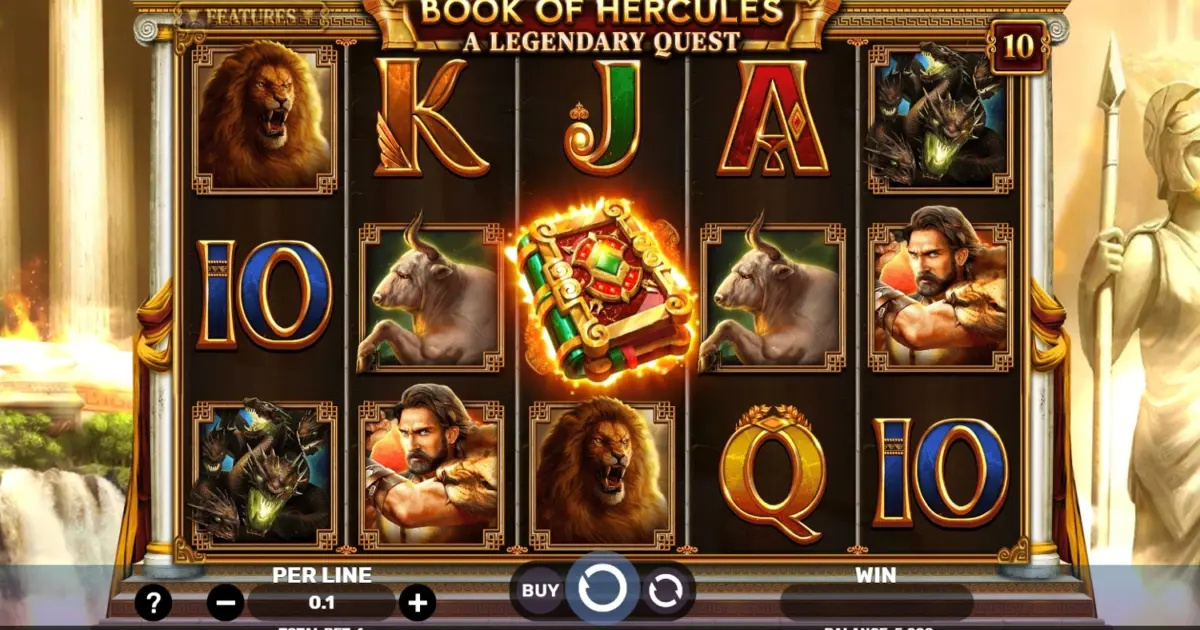
Book of Hercules – A Legendary Quest Slot is a 5-reel Mythology game from Spinomenal, but its headline figure is a 91.71% RTP that sits well below average. That single number shapes whether you should spend time with the demo at all, and how far a modest bankroll is likely to stretch. If you compare on maths first and theme second, this review gives you the context behind the figures.
Book of Hercules – A Legendary Quest at a glance
This is a 5-reel slot machine built around a Mythology theme, also tagged with 5-Reels and Gods, from provider Spinomenal. The facts available are narrow, which itself tells you something: the provider has published an RTP of 91.71%, a 5-reel layout, and broad theme labels, but no volatility rating, no stake range, and no max win figure. When information is missing, treat any numbers quoted outside this page with caution.
Spinomenal has 548 games in the data set used for this review, with an average RTP of 95.11% across its catalogue. This title’s 91.71% is therefore 3.40 points below its own provider average as well as 4.00 points below the corpus average of 95.71%. It ranks 2802 for popularity, placing it in the 86th percentile, so it is played but a long way from the most-compared titles.
The limited detail means you cannot plan around a published risk profile or stake ladder. What you can plan around is the maths that is published, and what a below-average RTP implies for expected loss per hundred wagered.
| Item | Figure |
|---|---|
| Game name | Book of Hercules – A Legendary Quest |
| Provider | Spinomenal |
| RTP | 91.71% |
| Reels | 5 |
| Primary theme | Mythology |
| Other tags | 5-Reels, Gods |
| Provider average RTP | 95.11% |
| Corpus average RTP | 95.71% |
| Popularity rank | 2802 (86th percentile) |
If you want a quick comparison on provider output, 1 Reel – Demi Gods 7 is another Spinomenal Mythology title but with a published 95.42% RTP, which makes the gap concrete. For a theme-level contrast, Gates of Olympus is a Mythology slot with a 96.50% RTP, almost five points higher than the game on this page.
What a 91.71% RTP actually returns
RTP is a long-run statistical average, not a promise for a single session. A 91.71% RTP means that for every £100 wagered, the game is designed to return £91.71 and retain £8.29 as house edge, when averaged over millions of spins. Every spin is independent, and short samples can deviate sharply above or below that average.
To make the figure tangible, take a concrete example at a nominal stake. If you played 1,000 spins at £1 per spin, you would have wagered £1,000 in total. At the published RTP, the expected return across that very large sample would be £917.10, for an expected loss of £82.90. At £0.20 per spin, the same 1,000 spins would mean £200 wagered, with an expected return of £183.42 and an expected loss of £16.58. These are not predictions for your session; they are the mathematical centre around which actual results will vary.
The comparison to the wider market matters here. The corpus average RTP in the data set is 95.71%, which would return £95.71 per £100 wagered and retain £4.29. The gap of 4.00 points translates to almost double the expected loss per £100 wagered compared with an average game. Against Spinomenal’s own average of 95.11%, this title retains £8.29 per £100 versus £4.89 for the provider average, so it keeps £3.40 more per £100 wagered than a typical Spinomenal release.
Because no hit frequency or volatility is published, you cannot assume how that expected loss will be distributed — whether as many small deductions or fewer larger swings. The only certainty is the long-run average. If RTP is your primary filter, this figure puts the game in the lower tier among both its provider peers and the wider corpus, and you should weigh that heavily when deciding how long to demo it.
Volatility and what your session will feel like
Spinomenal has not published a volatility rating for this title, so there is no official low, medium or high label to anchor expectations. That absence is useful information: you should not rely on any volatility claim you see elsewhere unless it comes directly from the provider.
Volatility as a concept describes how results are spread around the RTP average. In general terms, low-volatility slots tend to produce more frequent but smaller results, which can stretch session length on a fixed bankroll but rarely move the balance far in either direction. High-volatility slots do the opposite: longer stretches without a return, punctuated by larger individual results, which demands a larger bankroll and a higher tolerance for swings. Medium volatility sits between those poles. Many slots also use wilds, scatters or free-spin mechanics to shape that distribution, but those are general design tools, not confirmed features of this specific game.
Without a published rating, the safest way to approach this title is to treat the distribution as unknown and let the demo tell you how it feels, without assuming the demo predicts real-money outcomes. Watch how often your balance moves and by how much, rather than looking for patterns or thinking the game is due after a quiet run. If you prefer a known risk profile, you may want to compare with a title where the provider has published that detail, or where community data is more complete, before committing funds.
What you can infer from the RTP alone is cost per hundred wagered, not swing size. A lower RTP does not automatically mean higher volatility, and a higher RTP does not guarantee a smoother ride. The two figures describe different dimensions: one is the long-run average return, the other is the short-run shape of the journey.
The 5-reel layout and how wins are counted
This game uses a 5-reel layout, which is the most common reel count in modern video slots. In general, a 5-reel structure gives designers room to offer either a fixed number of paylines or a ways-to-win system, and the number of reels alone does not determine how often you will see a return.
Paylines, where used, are predefined paths across the reels that are checked after each spin; a win is counted when matching symbols land on a line from left to right, or sometimes in other defined directions, depending on the paytable. Ways-to-win systems, by contrast, count any matching symbols on consecutive reels regardless of their exact row position. Both approaches are ways of defining what counts as a hit, and neither is visible from the reel count alone.
For this title, the facts confirm five reels but do not specify a payline count, a ways count, or how wins are evaluated. No paytable detail is supplied, so symbol values, wild behaviour or scatter rules cannot be described here. That limits how precisely you can model hit rate or session length from the layout alone.
What you can take from the 5-reel label is familiarity: the grid will feel recognisable if you have played other 5-reel games, and you can focus your demo time on observing how the game counts wins rather than learning an unusual reel structure. If payline or ways information is important to your decision, look for the in-game help screen or paytable where the provider will define it, and treat any third-party claim as unverified until you see it there. For comparison within the same theme family, 9 Arrows of Odysseus is another Mythology title with a published 94.00% RTP, though its reel mechanics should be checked in its own paytable.
Stake range and sizing a bankroll
No minimum stake, maximum stake or default coin range has been published for this title in the facts available. Without that, you cannot calculate the exact cost of a 100-spin or 500-spin session in advance, nor can you set a precise bankroll multiple.
Stake range matters because it converts RTP from a percentage into pounds and pence per session. Even with a low RTP, a low minimum stake can keep the absolute expected loss small: £0.10 per spin for 200 spins is £20 wagered, with an expected return of £18.34 at 91.71% and an expected loss of £1.66 across a large sample. At £1 per spin, the same 200 spins would be £200 wagered, with an expected return of £183.42 and an expected loss of £16.58. The percentage is identical; the cash effect scales with stake and spins played.
Until you can see the stake controls in the game itself, a practical approach is to decide your total entertainment budget first, then check the in-game stake selector before you spin. Divide your budget by the stake you intend to use to see how many spins that buys, and remember that variance will push real results away from the average in either direction. Because no volatility is published, you should also allow for the possibility of longer losing stretches than a low-volatility game would produce.
If stake flexibility is a deciding factor, compare the in-game range you find here with other Spinomenal titles where the range is visible in the lobby. The absence of a published range here does not mean the game lacks options; it simply means you need to verify them directly in the client rather than relying on review text.
Playing the book of hercules – a legendary quest slot demo before you commit
A free demo is available for this title, which lets you see the reel layout, the paytable as presented in the game, and how wins are evaluated, without wagering. That is its main value: familiarisation with the interface and the maths that is actually shown in the help screens, rather than any indication of future results.
Use the demo to answer practical questions. How are wins counted on the 5 reels? What stake options appear in the selector? How does your balance move over 100 or 200 spins at the lowest stake you can select? Because every spin is independent, a good run in the demo does not make a real-money session more likely to pay, and a cold run does not make the game due. Random number generation does not adjust for past outcomes.
There is no published max win figure for this title, so you cannot frame upside from a provider-supplied ceiling. Treat any max win claim you encounter elsewhere with caution unless you can trace it to Spinomenal’s own game sheet or the in-game rules.
Set a budget before you move from demo to real play, and treat that budget as the price of entertainment. Only stake what you can afford to lose, set a time limit as well as a deposit limit, and step away if you feel you are chasing losses. You must be 18+ to gamble in the UK. If you need support, tools like deposit limits, time-outs and self-exclusion are available, and organisations such as GamCare and GambleAware offer free, confidential help.
Verdict: who should play Book of Hercules – A Legendary Quest
This game will suit players who prioritise Mythology and Gods theming on a familiar 5-reel grid and who are comfortable testing a title with a lower-than-average RTP. If you enjoy sampling a wide range of Spinomenal output and you judge games by theme first, the demo gives you a no-cost way to see whether the presentation and win-counting hold your attention.
It is a harder recommendation if RTP is your primary filter. At 91.71%, the expected loss per £100 wagered is £8.29, compared with £4.29 for the corpus average and £4.89 for Spinomenal’s own average. Over a few hundred spins that difference compounds, and without a published volatility rating or max win figure you cannot offset the lower average return against a defined swing profile or ceiling.
There is also the question of information. With no published stake range, no volatility label and no max win figure, you are making decisions with less than a full picture. For some players that is fine; for others it is a reason to favour a title where the provider has disclosed more.
If you decide to try it, do so in the free demo first, verify the stake range and paytable inside the game, and compare the feel and the figures with higher-RTP Mythology peers before you commit a bankroll. The demo is the right place to learn the 5-reel flow and to see whether the theme alone justifies the maths for you.
Frequently Asked Questions
Can I play Book of Hercules - A Legendary Quest for free without downloading?
Free demo play is available for this title, so you can load it in your browser and explore the 5-reel layout without wagering. The demo shows the in-game paytable and stake selector but does not predict real-money results, as every spin is independent and random. Use it to check how wins are counted before deciding on a bankroll.
What is the RTP of Book of Hercules - A Legendary Quest and what does it mean?
The published RTP is 91.71%, which means that for every £100 wagered the game is expected to return £91.71 over millions of spins, keeping £8.29. Over 1,000 spins at £1, you would wager £1,000 with an expected return of £917.10. That is 4.00 points below the corpus average of 95.71%.
What volatility is Book of Hercules - A Legendary Quest?
Spinomenal has not published a volatility rating for this title, so no official low, medium or high label is available. Without that disclosure you cannot assume whether sessions will feel steady or swingy, and you should treat any third-party volatility claim as unverified. Judge the distribution by observing the demo and checking the in-game help screens.
Who makes Book of Hercules - A Legendary Quest and what else do they offer?
The game is made by Spinomenal, a provider with 548 games in the data set and an average RTP of 95.11% across its catalogue. Its Mythology range includes 1 Reel - Demi Gods 7 at 95.42% RTP and Hades' Infernal Blaze, giving you higher-RTP and same-provider comparisons within the same theme family.
How does Book of Hercules - A Legendary Quest compare to Gates of Olympus on RTP?
Book of Hercules - A Legendary Quest has a 91.71% RTP, while Gates of Olympus, another Mythology slot, is listed at 96.50%. That is a gap of 4.79 points, so Gates of Olympus retains £3.50 per £100 wagered versus £8.29 here over the long run. If RTP is your filter, the difference is material for expected loss.