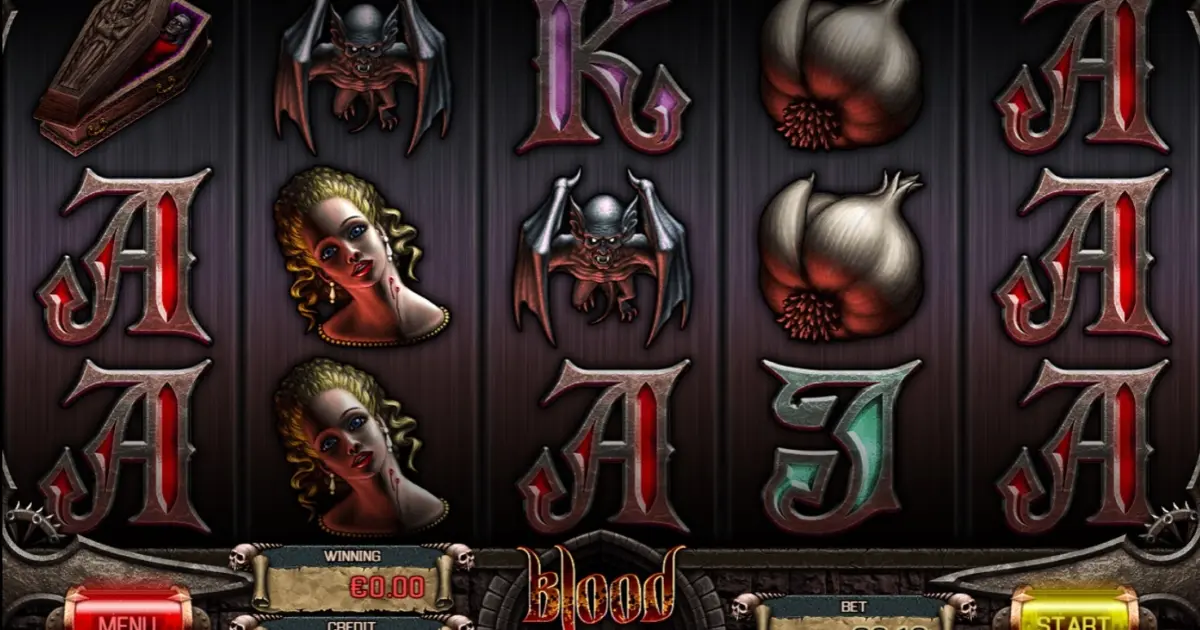
Blood sits in the top decile of tracked games by popularity—90.8th percentile, to be exact—despite arriving from a mid-tier provider with 57 titles catalogued here. That combination of audience traction and sparse published specs makes it worth examining what you actually get when you load the demo, and what you cannot know going in.
Apollo Games has withheld the RTP figure, the volatility rating, the payline structure, the stake range, and any detail about bonus mechanics. The absence is not an oversight; it is a pattern across much of their portfolio. For a player comparing options, missing RTP is missing the single number that governs long-run cost, so treat any session as exploratory rather than planned around expected return.
| Attribute | Value |
|---|---|
| Provider | Apollo Games |
| Reels | 5 |
| Theme | Horror and scary |
| RTP | Not published |
| Volatility | Not published |
| Popularity rank | 1,841 (90.8th percentile) |
Who makes Blood
Apollo Games is a Czech developer with 57 titles in this catalogue, operating primarily in central and eastern European land-based and online markets. The studio focuses on straightforward reel games with minimal feature complexity, often built around classic fruit and card symbols rather than licensed IP or narrative themes. Blood is an outlier in their lineup—horror motifs are uncommon for Apollo, which tends toward bright, arcade-style presentation.
The provider does not routinely publish technical specifications. Of the 57 Apollo Games slots tracked here, RTP figures are absent for the majority, and volatility ratings are rarer still. This is not a studio pitching itself on transparency or on catering to the spec-comparison shopper. If you need the numbers before you play, Apollo Games releases will consistently frustrate that workflow.
Where Blood sits in the Apollo Games catalogue
Blood’s 90th-percentile popularity rank places it well ahead of most Apollo Games output. For context, Smiling Joker, Bonus Joker II, and Gangster World are three other Apollo titles in the catalogue, and none of them publish RTP data either. The pattern holds: if you are considering an Apollo Games slot, you are choosing on theme, visual style and demo feel rather than on a known return percentage or a documented volatility band.
The horror theme differentiates Blood within the Apollo portfolio, which skews heavily toward fruit classics and joker-card designs. Whether that thematic choice drives the popularity or whether the game simply found the right distribution channels is not something the rank alone can tell you, but the data confirm that more people are searching for and clicking through to Blood than to nine out of ten other games in the catalogue.
RTP: not published against a provider average that cannot be calculated
Apollo Games has not disclosed an RTP figure for Blood. The catalogue-wide average RTP across all providers and all games is 95.71%, but that number includes studios publishing in the 96–97% range and studios publishing below 94%. Apollo Games does not contribute enough published RTP data points to generate a meaningful provider average, so there is no house baseline to anchor expectations.
RTP is the percentage of total stakes a slot returns to players as winnings over a statistically large sample—millions of spins. A game with 96% RTP returns £96 per £100 wagered in the very long run; the remaining £4 is the house edge. Individual sessions will deviate wildly from that figure—wins and losses swing based on volatility and luck—but RTP is the anchor that governs cost over time. When that anchor is absent, you cannot plan session budget or compare value against alternatives in any rigorous way.
If you decide to play Blood, understand that you are operating without the primary tool for session planning. Set a fixed amount you are comfortable losing in full, and do not assume the game will perform in line with the catalogue average or with any other published benchmark.
Volatility and who it suits
Apollo Games has not published a volatility rating for Blood. Volatility describes the size and frequency of wins: low volatility means smaller, steadier payouts that stretch your balance; high volatility means longer dry spells punctuated by larger wins that can either recover losses or accelerate them. Medium volatility sits in between. Without a published rating, you cannot know which profile applies here until you play enough spins in demo mode to observe the pattern yourself.
In practical terms, unknown volatility means you cannot size your starting bankroll to the game’s rhythm. If Blood turns out to be high-volatility and you bring a bankroll suited to low-volatility play, you will likely hit zero before any feature or big win materializes. If it is low-volatility and you are chasing a large multiplier, you may find the top payouts underwhelming relative to the grind required to hit them. The only way to gauge fit is to run the free demo for 200–300 spins, note the payout frequency and size, and decide whether that matches your session goals.
Horror themes in slots often pair with medium-to-high volatility and feature-driven gameplay—free spins triggered by scatter symbols, multipliers that build during bonus rounds—but that is a genre tendency, not a fact about this specific game. Do not assume Blood follows that pattern without evidence from your own demo session.
Playing Blood for free
Blood offers a free demo mode with no download and no registration required. The demo uses virtual credits that reset when you refresh the page, so there is no continuity between sessions and no way to track long-term results. Demo play is useful for learning the reel layout, testing the stake buttons, and observing payout frequency, but it cannot tell you the RTP, it cannot predict what will happen in real-money mode, and it does not pay winnings you can withdraw.
Every spin in a slot—demo or real—is an independent event governed by a random number generator. The result of one spin has no influence on the next. There is no such thing as a machine being “due” after a cold streak, and there is no pattern or timing that changes your expected return. The RTP, whatever it is, applies equally to every spin over a large enough sample, and no betting system or stake adjustment can improve it.
If you move from demo to real-money play, set a budget before you start—a fixed amount you can afford to lose in full—and stop when you hit it. Slots are paid entertainment with a built-in house edge, not an income strategy. Only players aged 18 and over may participate in real-money play, and if gambling stops feeling like entertainment, support is available through BeGambleAware and GamCare.
Similar picks
Blood belongs to the horror and scary theme category, which contains 479 games in this catalogue. If you are comparing options within that theme, Hand of Anubis publishes a 96.24% RTP—above both the catalogue average and the typical Apollo Games release, assuming Apollo were to publish figures—and offers a different visual style rooted in Egyptian mythology rather than Gothic horror. Halloween Crystals is another horror-themed alternative, though it also lacks a published RTP. Trickstar Spins sits at 94.0% RTP, below the catalogue average, but the number is at least known.
The choice between these games depends on whether you prioritize a known RTP over thematic preference. If you want to compare return percentages and plan your session around published specs, Hand of Anubis gives you that option and Blood does not. If theme is paramount and you are willing to play blind on the maths, both Blood and Halloween Crystals remain viable, but you accept the trade-off.
Verdict
Blood ranks in the 90th percentile for popularity, which confirms player interest, but Apollo Games has not published the RTP, the volatility, the payline count, or the stake range. That leaves you with a free demo, a horror theme, a 5-reel layout, and no technical foundation for session planning. The absence of specs is not unusual for this provider, but it is a meaningful limitation when you are comparing games and trying to manage cost.
If you are shopping on RTP and volatility—the two numbers that govern session behaviour and long-run cost—Blood offers no data to shop with. The demo is worth 200–300 spins to observe payout frequency and decide whether the game feels like a fit, but that subjective feel is not a substitute for published maths. You cannot calculate expected loss per hour, you cannot size a bankroll to the volatility, and you cannot compare value against alternatives in the same theme that do publish their figures.
The 90th-percentile rank tells you other players are finding something here, but rank measures clicks and searches, not return or fairness. If you decide to play Blood, treat it as entertainment spending with no expectation of recovering your stake, and set a fixed loss limit before you start. The game may suit players who prioritize theme and demo feel over technical transparency, but for anyone building a session plan around published specs, the absence of an RTP figure is disqualifying.
Frequently Asked Questions
Can I play Blood slot for free without downloading software?
Yes, Blood offers a free demo mode that runs directly in your browser with no download, no installation, and no registration required. The demo uses virtual credits that reset when you refresh the page, so you can test the game and observe payout frequency without risking real money. Demo play does not pay withdrawable winnings.
What is the RTP of Blood slot and how does it compare to other Apollo Games titles?
Apollo Games has not published an RTP figure for Blood, and the majority of their 57 catalogued titles also lack published RTP data. The catalogue-wide average RTP across all providers is 95.71%, but without a published number for Blood or a reliable Apollo Games provider average, you cannot calculate expected long-run return or compare value against alternatives in any rigorous way.
Is Blood a high-volatility slot suitable for small bankrolls?
Apollo Games has not published a volatility rating for Blood, so you cannot know whether it is low, medium, or high-volatility until you play enough demo spins to observe the payout pattern yourself. Unknown volatility means you cannot size your bankroll to the game's rhythm in advance—if it turns out to be high-volatility and you bring a small bankroll, you risk hitting zero before any significant win materializes.
How does Blood compare to other horror-themed slots like Hand of Anubis?
Blood ranks in the 90th percentile for popularity but does not publish an RTP figure, while Hand of Anubis publishes 96.24% RTP—above the catalogue average of 95.71%—and offers a known baseline for session planning. If you prioritize published specs and the ability to compare return percentages, Hand of Anubis provides that transparency and Blood does not, though both offer free demo play and share a supernatural theme angle.
Can demo play on Blood predict what will happen in real-money mode?
No, demo play cannot predict real-money results because every spin—demo or real—is an independent event governed by a random number generator. The outcome of one spin has no influence on the next, and there is no such thing as a machine being "due" after a cold streak. Demo mode is useful for learning the reel layout and observing payout frequency, but it does not change the RTP or give you any edge when you switch to real money.