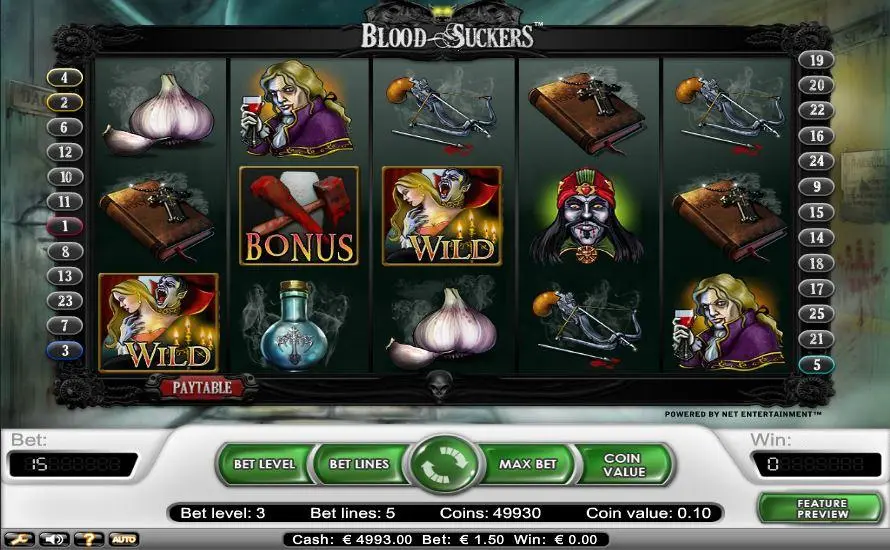
The blood suckers slot earns its place in reviews on one number above all others: 98% RTP. That is two points higher than NetEnt’s own portfolio average and nearly two and a half above the broader corpus, making it a statistically favourable pick before you read a single sentence about theme or grid. What the page does not tell you — and what you need before committing real money — is how volatile the game actually is or how wide a stake range it runs. Those gaps shape the verdict below.
The 5-reel grid explained
Five reels is the industry standard layout, and NetEnt ships Blood Suckers in that familiar format. Five reels give developers enough columns to create meaningful symbol clusters without overwhelming the screen, and they pair well with both fixed-payline and “ways to win” mechanics. The practical consequence for you is a moderate number of positions where a winning combination can land per spin — more than a 3-reel classic, fewer than a 7-reel cascade game.
Where five reels can differ is what happens between the first and last column. Some titles use expanding symbols that fill entire columns; others lock a wild in place for consecutive spins. Without NetEnt’s documentation for this specific build, you cannot assume either. The reel count alone guarantees a mid-range grid; the bonus structure on top is where the game differentiates itself.
Paylines, ways and how Blood Suckers pays
FACTS lists no payline count or “ways to win” figure for this title. Many 5-reel slots in NetEnt’s catalogue use between 10 and 50 fixed lines, and a handful shift to 243 or 1,024 ways; the same provider has produced both systems. Until a line count is confirmed, treat any paytable screenshot you find on a third-party site as unverified.
What does hold true across the genre is that more active lines increase your total stake per spin without changing the underlying RTP. A game paying on 20 lines at 0.10 per line costs 2.00 per spin; the same grid paying on 25 lines at 0.10 costs 2.50. Your per-spin bankroll drain scales with lines, but the return percentage stays fixed over a large sample. That is the single most important relationship between lines and wallet.
98% RTP put in context
RTP is a long-run theoretical average. A 98% figure means that across a very large sample of spins — tens of thousands, often millions — the game returns 98 units for every 100 wagered. Over a 200-spin session, the variance from that figure is enormous; you could finish up or down by fifty percent on a single evening without the maths being broken.
The comparison that makes 98% interesting is what surrounds it. NetEnt’s 191-game portfolio averages 96.1% RTP, and across the full review corpus the average sits at 95.71%. Blood Suckers exceeds both. Starburst from the same provider lands at 96.1% — two full points lower. Gonzo’s Quest sits at 96.0%. The gap between Blood Suckers and its provider siblings is unusually wide for a single studio, and it is the primary reason this game still ranks in the 95th percentile of popularity despite being in a much older generation of releases.
| Metric | Blood Suckers | NetEnt Avg | Corpus Avg |
|---|---|---|---|
| RTP | 98.0% | 96.1% | 95.71% |
| Reels | 5 | — | — |
| Popularity percentile | 95.2 | — | — |
| Free demo available | Yes | — | — |
Volatility and hit patterns
NetEnt has not published a volatility rating for Blood Suckers in the data available here, and that omission matters more than most readers realise. Volatility determines the shape of your session: low-volatility games pay small wins frequently and keep a bankroll alive over hundreds of spins, while high-volatility games deliver long stretches of dead spins punctuated by rare, large hits. The RTP figure alone tells you the total return; volatility tells you how painful or pleasant the path to that return feels.
Hit frequency is equally absent. Without both pieces, you cannot model your expected bankroll curve. A 98% RTP on a high-volatility slot might require a 500-unit starting balance to survive a typical dry stretch, while the same RTP on a low-volatility build could sustain a 50-unit bankroll indefinitely. The recommendation: play in demo mode for at least 100 spins, track how often the reels hit, and note the maximum gap between payouts before wagering real money.
Choosing a stake between unknown limits
No minimum or maximum stake range appears in FACTS. NetEnt slots commonly open from 0.10 to 1.00 per line with totals ranging from 1.00 up to 200.00 per spin, but that spread varies title to title and operator to operator. Until the exact limits are confirmed, budget with the wider assumption and adjust once you load the game.
Use the standard rule of thumb: divide your session bankroll by the number of spins you want to survive. A 100-unit budget at a 0.50-per-spin stake gives you 200 spins. At a 2.00-per-spin stake, you get 50. The difference between those two sessions in a high-volatility slot is the difference between a long, steady grind and a coin-flip on whether you last long enough to trigger any feature.
Demo play versus real money
A Blood Suckers free demo is available, and it is the correct first move for any serious session planner. Demo play replicates the RNG and paytable exactly — every spin outcome you observe is drawn from the same distribution you would face with real money. What it does not replicate is the emotional decision-making under loss pressure, which is where most bankroll discipline breaks down.
Use demo mode to learn the spin rhythm, identify where wins cluster, and test whether the stake you have in mind keeps you engaged for a full session. When you switch to real money, treat the activity as paid entertainment with a fixed budget. Set a deposit limit before you log in, never chase a loss, and stop when the budget is gone. Gambling is for adults aged 18 and over; if it stops feeling like entertainment, contact a helpline.
Verdict on Blood Suckers Slot
The headline number is genuinely exceptional: 98% RTP places this game in the top tier of anything in the corpus, roughly two points ahead of NetEnt’s own portfolio norm. If your primary filter is theoretical return, Blood Suckers is one of the strongest choices available from a major provider.
The honest caveat is that the published data stops at that number. No volatility rating, no hit frequency, no confirmed stake range, and no payline count means you are planning a session without the secondary variables that shape whether a high-RTP game is actually enjoyable to play. The theme draws on medieval and horror imagery with a crime-adjacent narrative layer, but the presentation is a product of its generation and will feel dated against modern releases. Centurio, for instance, carries the same classical-era flavour at 96.08% RTP — a full point and change lower, but potentially with a more refined visual build. For pure return-per-pound, Blood Suckers wins. For overall session experience, verify the volatility through demo play before committing.
Frequently Asked Questions
What is the RTP of Blood Suckers?
Blood Suckers carries a 98.0% RTP, which means the game returns an average of 98 units for every 100 wagered across a very large sample. That figure exceeds NetEnt's portfolio average of 96.1% and the full corpus average of 95.71%, placing it among the highest-return slots in the review database.
Can I play Blood Suckers for free without downloading anything?
Yes, a Blood Suckers free demo is available and can be played in your browser with no download required. The demo uses the same RNG and paytable as the real-money version, so it is the most accurate way to observe the game's spin rhythm and win frequency before committing funds.
Is Blood Suckers a high or low volatility slot?
NetEnt has not published a volatility rating for Blood Suckers in the available data, so no definitive answer exists. This is a meaningful gap because volatility determines whether you face frequent small wins or rare large hits. Playing 100 or more demo spins is the practical way to assess the swing pattern yourself.
How does Blood Suckers compare to Starburst by the same provider?
Both are 5-reel NetEnt slots, but Blood Suckers has a 98.0% RTP against Starburst's 96.1% — a nearly two-point difference in theoretical return. Starburst is far more popular in current rankings, but the RTP advantage clearly favours Blood Suckers for players whose primary metric is expected value.
Does playing the Blood Suckers demo predict real-money results?
The demo replicates the exact RNG and payout distribution, so the statistical properties are identical. However, it cannot predict whether your individual real-money session will match those averages, because short-term variance is enormous regardless of the RTP figure. No demo outcome guarantees or foretells a real-money result.




