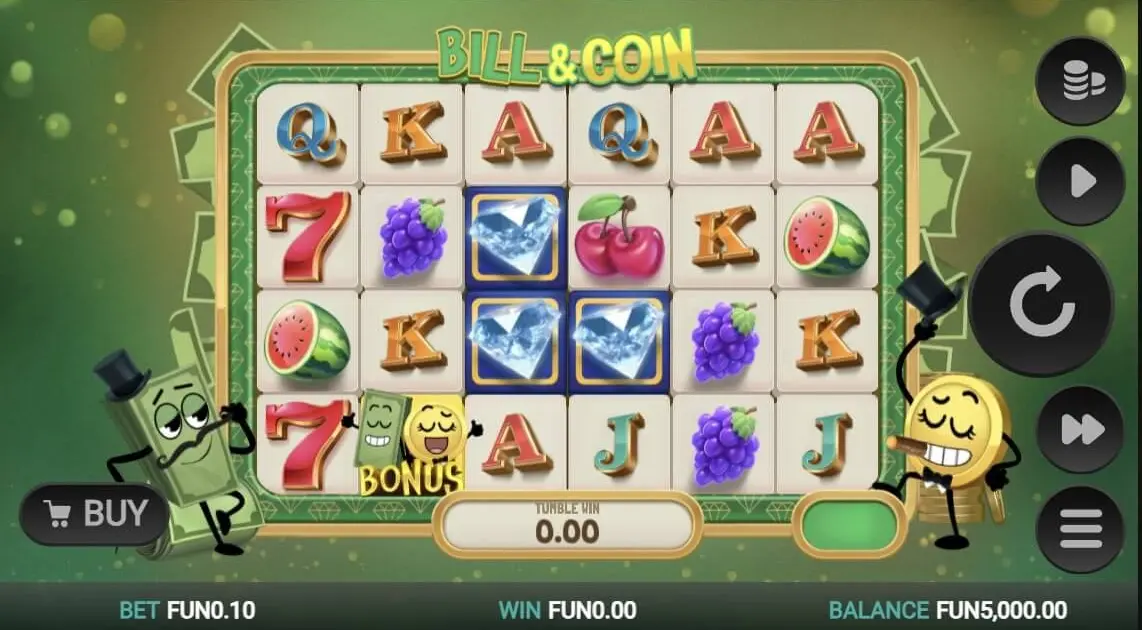
Bill & Coin is worth a look if you want a straightforward 6-reel game with an above-average return figure and no download needed to test it. The bill & coin slot comes from Relax Gaming at 96.1% RTP and is available as a Bill & Coin free demo, so you can see how the grid feels before you commit any budget.
This review sticks to what is actually published for the game, explains what the numbers mean over hundreds of spins, and flags where information has not been made public so you are not misled by numbers quoted elsewhere.
The 6-reel grid explained
Six reels changes the maths and the feel compared with the classic 5-reel template that dominates most lobbies. With an extra column in play, there is more horizontal space for symbols to land, which tends to allow for more possible symbol combinations on each spin and a slightly busier screen. It does not automatically mean more wins or bigger wins, but it does alter how often you see near-misses, partial lines and full-screen coverage.
For session planning, the reel count matters because it shapes variance even before paylines or ways are considered. A 6-reel layout often pairs with a larger pay-table that spreads value across more symbols, which can make individual line hits feel smaller but more frequent depending on how the game is tuned. Without the published pay-table for this title, you cannot assume a specific distribution, so treat the reel count as a structural clue rather than a promise about hit rate.
In practical terms, six reels also means you should watch your spin cost rather than assuming a 6-reel game costs more per spin. Stake is set per spin, not per reel, so bankroll planning stays tied to your chosen stake and spin count, not to the number of columns. That distinction helps keep expectations steady when you move between 5-reel and 6-reel games from the same provider. Relax Gaming has built its catalogue around varied grid sizes, and with 170 titles in its portfolio the studio is comfortable working outside the standard 5×3, so the 6-reel choice here fits a broader pattern of grid experimentation rather than standing as a novelty.
Paylines, ways and how Bill & Coin pays
FACTS for this title do not list a payline count, a ways-to-win figure, or a pay-table, and that absence is important. Paylines are fixed lines across the reels that require matching symbols to land on specific positions, while ways mechanics typically pay for matching symbols on consecutive reels from the left regardless of exact row. Both systems still pay only when the game’s rules are met on a single spin, and neither creates momentum from one spin to the next.
Many slots do use wilds to substitute for regular symbols, scatters to trigger features from any position, and free-spin rounds that add modifiers, but those are general concepts and are not confirmed as features of this specific game because they are not in the published facts. You should not assume Bill & Coin includes them until the provider documents them in the official game sheet or help file.
What you can do with the information you have is focus on structure over speculation. A 6-reel Money and wealth themed slot tells you the thematic direction and the grid size, but not how wins are evaluated or how often they occur. If you open the Money Coming listing you will see another Money and wealth title where the ways or lines are also not disclosed in the summary data, which shows how common missing payline detail is in aggregated feeds. For comparison, Money Train 2 from the same provider is documented with its own specific mechanics, but that detail cannot be transferred to Bill & Coin. Until payline or ways data is published, the most honest approach is to test the free demo and check the in-game help screen for the definitive rules rather than relying on third-party previews that may be guessing.
96.1% RTP put in context
Relax Gaming lists Bill & Coin at 96.1% RTP. That is a long-run statistical average, not a prediction for a single session. Over many millions of spins it implies a theoretical return of £96.10 for every £100 wagered, with the remaining £3.90 representing the house edge in the same large sample. In a short run of, say, 200 or 500 spins, actual returns can sit well above or well below that figure because each spin is independent and randomly determined.
Context helps you judge the number. The average RTP across the provider’s catalogue in this dataset is 95.77%, so Bill & Coin sits 0.33 percentage points above the Relax Gaming average. Against the wider corpus average of 95.71% it is 0.39 points higher. That gap is modest but directionally favourable; it does not make the game low-risk, it simply means the theoretical retention is slightly lower than the typical title in these samples.
Useful comparisons from the same family of related games sharpen the picture. Money Train 2 is listed at 96.4% and Money Train 3 at 96.25%, both marginally above Bill & Coin, while Outlaw Territory is listed at 94.0%, notably lower. Among Money and wealth themed peers, Dogmasons MegaWOOF is listed at 96.8%, a touch higher than Bill & Coin. These differences only matter over very large samples, and they do not override volatility or stake choice in any single session.
| Item | Figure |
|---|---|
| Game | Bill & Coin (Relax Gaming) |
| RTP | 96.1% |
| Reels | 6 |
| Themes | Money and wealth, 6-Reels |
| Provider games in sample | 170 |
| Provider average RTP | 95.77% |
| Corpus average RTP | 95.71% |
| Popularity rank | 2,434 (87.8th percentile) |
| Free demo | Available (no download) |
Rank data adds another layer. At rank 2,434 this is not a chart-topping title, landing in the 87.8th percentile in this dataset. Popularity does not measure quality or value, but it can signal how much community discussion and independent verification exists around a game’s published figures.
Volatility and hit patterns
No volatility rating has been published in the facts for Bill & Coin, and without it you should avoid any assumption about swing size. Volatility, where disclosed, describes how results are distributed over time rather than how much is returned overall. Low volatility typically means more frequent but smaller hits and a smoother bankroll curve that supports longer sessions on a modest budget. High volatility typically means fewer hits, longer flat stretches, and the possibility of larger spikes when a win lands, which demands a larger buffer to ride out dry spells. Medium volatility sits between those poles, mixing steadier hits with occasional bigger swings.
Hit frequency and max win are also not listed here, so there is no verified figure for how often any win occurs or how large the top payout could theoretically be. Be cautious of any site quoting a specific max win for this title when the provider has not published one in the data supplied; treat that number as unverified.
What you can control without a volatility label is exposure. Because every spin is independent, previous results do not make a win more likely on the next spin, and no pattern of stakes changes the 96.1% long-run expectation. If you prefer to keep variance more tangible, decide in advance on a spin count and a loss limit, then keep stake flat across the session rather than chasing after a gap. That keeps the maths as close as possible to the published RTP model over the sample you actually play, even when the volatility profile is unknown. If you later find an official volatility label in the game’s help file, you can use it to refine stake and session length rather than to predict outcomes.
Choosing a stake between limits not published
The summary facts for Bill & Coin do not include a minimum or maximum stake, bet increments, or default coin values. When stake range is not published in aggregated data, the only reliable place to confirm it is the in-game settings or pay-table accessed from the demo itself. Third-party listings sometimes copy limits from other regions or older versions, so they can be misleading.
Even without a stated range, general principles for stake selection still apply and they do not depend on this specific game. Your stake determines how many spins a given bankroll supports. A £20 budget allows 200 spins at £0.10, 100 spins at £0.20, or 40 spins at £0.50. A £50 budget allows 500 spins at £0.10 or 250 at £0.20. Fewer spins mean higher exposure to short-term variance; more spins smooth that curve but do not change expected value. Choosing a stake is therefore about session length and comfort with swings, not about improving odds.
Until the range is verified in-game, plan conservatively. Start the free demo, open the bet panel, and note the lowest and highest options actually offered in your jurisdiction, plus whether the game uses fixed bet levels or continuous adjustment. If you compare to other Relax Gaming slots, you will see varied staking structures across the catalogue, so do not assume Bill & Coin matches any single sibling. For example, Money Train 3 is a useful reference point within Relax Gaming slots for how the same studio can structure stakes and features differently, which underlines why direct transfer of limits between titles is unreliable. Once you know the real limits, you can map your total budget to a target spin count and keep stakes consistent through the session.
Demo play versus real money
Free demo play is available for Bill & Coin and that matters for decision-making. The demo lets you check the grid, read the in-game rules, and see how stake controls work without spending. No download is indicated as required to try it, which keeps the barrier low when you just want to verify mechanics that are not listed in summary data, such as exact payline or ways rules and the real stake limits offered to you.
Demo credits have no cash value and demo results do not predict real-money outcomes. The random mechanism is designed to operate independently on each spin in both modes, so a hot or cold streak in demo tells you nothing about what will happen when you play with real funds. Use demo as a rules check and a feel check, not as a forecast.
Keep play within safe bounds. You must be 18+ to gamble in the UK, and you should set a budget before you start, use deposit and time limits where offered, and treat slots as paid entertainment rather than a way to make money. If you need support, contact GamCare or GambleAware. If you decide to move from demo to real money, keep the same flat-stake, fixed-session approach you used while learning the game; consistency helps you stay in control regardless of short-term results.
Verdict on Bill & Coin
Bill & Coin is a 6-reel, Money and wealth entry from a large, experienced provider, priced at 96.1% RTP which is a little above both the provider average and the corpus average in this sample. That gives it a slightly more efficient long-run theoretical return than the typical title in the set, but without published volatility, hit frequency, or a detailed pay-table, the day-to-day experience remains an open question you can only answer in the demo.
The absence of published detail is itself a signal. It means you should not rely on speculative previews for specifics like paylines, max win or feature triggers. The upside is that free demo access is confirmed, so you can verify the real stake options, read the help file, and decide whether the pacing suits the session length you prefer. If you want a documented alternative with similar theming but a slightly higher listed RTP, look at the theme peer mentioned above; if you want to stay inside the provider’s better-known series, the Money Train titles offer fully documented contrasts.
For a measured trial, load the demo, confirm the rules and limits in-game, pick a stake that gives you at least a couple of hundred spins on your planned budget, and keep expectations tied to the long-run maths rather than any single session.
More from Relax Gaming
- Money Cart 3 — 96.0% RTP
- Outlaw Territory — 94.0% RTP
- Money Train 3 — 96.25% RTP
- Wild Chapo 2 — 96.1% RTP
- Temple Tumble Megaways — 96.25% RTP
- Titan Strike — 96.09% RTP
- Krakens Cove — 96.1% RTP
- Banana Town — 96.12% RTP
Frequently Asked Questions
Can I play Bill & Coin for free before wagering real money?
Free demo play is listed as available for Bill & Coin and no download is indicated as required. The demo uses play credits with no cash value and does not predict real-money outcomes, since each spin is independent. Use it to check the 6-reel layout, in-game rules and stake controls in your jurisdiction.
What is the RTP of Bill & Coin and what does 96.1% mean?
Bill & Coin has a published RTP of 96.1%, meaning a theoretical return of £96.10 per £100 wagered over a very large sample of millions of spins. Your short-term results over tens or hundreds of spins can vary widely above or below that figure. It sits 0.39 points above the corpus average of 95.71%.
What volatility is Bill & Coin and how risky is it?
No volatility rating is provided in the published facts for Bill & Coin, so its risk profile cannot be verified from this dataset. Without that label you should not assume low, medium or high variance. Keep stakes flat, plan a fixed spin count and loss limit, and check the in-game help file for any official volatility disclosure.
Who makes Bill & Coin and what else do they offer?
Bill & Coin is made by Relax Gaming, credited with 170 games in this sample and an average provider RTP of 95.77%. Known titles from the same studio include Money Train 2 at 96.4% RTP and Money Train 3 at 96.25% RTP, both marginally above Bill & Coin, plus Outlaw Territory at 94.0% for contrast.
What stake should I choose for Bill & Coin on my bankroll?
Minimum and maximum stake are not listed in the published facts, so confirm limits in the demo's bet panel before planning. As a guide, £20 allows 200 spins at £0.10 or 100 at £0.20, while £50 allows 500 at £0.10. More spins smooth short-term variance but do not change the 96.1% long-run expectation.