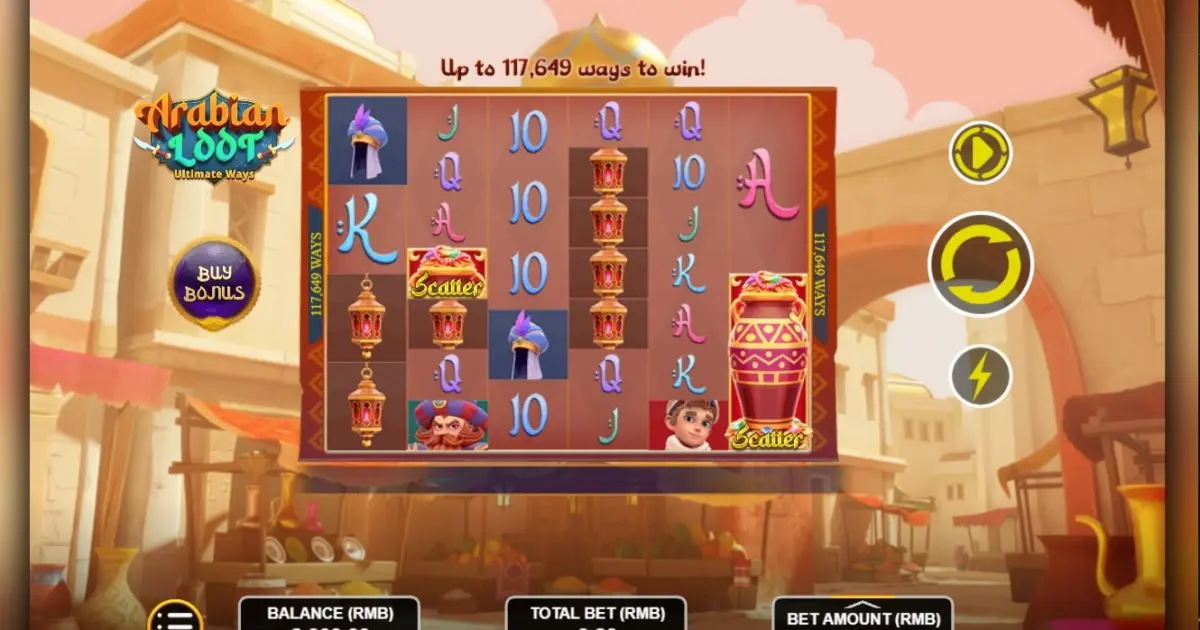
The number that matters most here is 96.76%. That is the published return-to-player figure for this six-reel Arabian-themed game, and it sits above both the Gameplay Interactive house average of 96.69% and the 95.71% average across every slot on this site. If you judge games by the maths rather than the artwork, that puts it in the better half of the pile.
What FACTS does not give us is equally worth knowing up front. There is no published volatility rating, no max win multiplier, no stake range, no payline or ways count, and no feature list. So this review covers what the figures support and is explicit about where the data stops. The arabian loot slot is playable as a free demo, which is the cheapest way to answer the questions the spec sheet leaves open.
Who makes Arabian Loot
Gameplay Interactive is the studio behind this title, and it has 118 games catalogued on this site. That is a mid-to-large portfolio by studio standards — big enough that the developer has a house style and a measurable average return, small enough that individual releases are not lost in a catalogue of thousands.
The useful thing about a studio with 118 catalogued titles is that its average RTP becomes a meaningful benchmark rather than a statistical accident. Gameplay Interactive’s average across those games is 96.69%. When a single release from the same studio comes in at 96.76%, you are looking at a game configured very slightly more generously than its stablemates rather than an outlier in either direction.
Beyond the catalogue size and that average, FACTS carries no information about the studio’s licensing, its certification bodies, or how long it has been operating. Those are reasonable things to check directly with the developer if they matter to you. What can be said from the data here is that this is not a one-game studio, and its typical return sits comfortably above the 95.71% site-wide mean.
| Provider | Gameplay Interactive |
|---|---|
| RTP | 96.76% |
| Reels | 6 |
| Theme | Arabian |
| Free demo | Yes |
Where Arabian Loot sits in the Gameplay Interactive catalogue
Its popularity rank is 1487, which places it in the 92.5th percentile of games on this site. That is a genuinely high placement — roughly nine in ten catalogued slots see less traffic. Popularity is not a quality signal and it certainly is not a payout signal, but it does tell you the game gets found and played, which usually means it loads reliably and runs on the devices people use.
Three other Gameplay Interactive titles are worth putting alongside it. Fountain of Fortune is the one to look at first if RTP is your deciding factor: at 97.0% it returns about 24p more per £100 wagered over a very large sample than the 96.76% here. Small in isolation, but it is the only listed sibling with a published figure that beats this one.
The other two, Pharaoh (Gameplay Int.) and Monsters Cash, have no RTP published in this data set. That absence is not a red flag on its own, but it does mean you cannot compare them on return. If you want an ancient-world theme from the same studio, Pharaoh is the closest match; if you want a complete change of subject, Monsters Cash is the outlier of the three.
RTP: 96.76% against a 96.69% house average
RTP describes what a game returns across an enormous number of spins, not what it returns to you tonight. At 96.76%, the theoretical return is £96.76 for every £100 staked across a very large sample — hundreds of thousands of spins, not hundreds. The 3.24% that stays behind is the house edge, and it is the reason the maths favours the operator over any long enough run.
Scaled down to a real session, the figure loses most of its predictive power. Two hundred spins at £1 means £200 wagered, and the RTP says the long-run expectation is £193.52 back. Your actual result could plausibly be nothing or several multiples of that stake, because short sequences are dominated by variance rather than by the average. Every spin is independent of the last; nothing accumulates and nothing becomes owed.
Against the 96.69% provider average, this game is 0.07 points ahead — effectively identical, and not a reason to choose it. Against the 95.71% site-wide average it is 1.05 points ahead, which is a more meaningful gap: that difference is worth about £1.05 per £100 wagered over the long run compared with a typical catalogue game.
Volatility and who it suits
Gameplay Interactive has not published a volatility rating for this title, so anyone quoting one is guessing. That is a real gap, because volatility affects your session more directly than RTP does. Two games with identical returns can behave completely differently — one paying small amounts often, the other paying rarely and larger.
In general terms: low volatility means frequent small returns, a bankroll that drains slowly, and long sessions with modest swings. High volatility means long dry stretches punctuated by bigger hits, and a bankroll that needs to be several hundred times your spin size to survive the gaps. Medium sits between the two. Many slots publish this rating; this one does not.
The six-reel layout is the only structural clue in the data. Six-reel grids can support more paylines or ways than a standard five-reel setup, though FACTS does not state how this particular game is configured, so no conclusion follows from it. Without a published rating or a stated stake range, the practical answer is to run the demo, watch how often returns land across a couple of hundred spins, and judge the rhythm yourself before committing a real bankroll.
Playing Arabian Loot free demo
A free demo is available, which means you can spin the full game with virtual credits and no deposit — no download, no account balance at risk. This is the right way to fill in the blanks the spec sheet leaves: how the six reels are laid out, how often returns land, whether the pace suits you.
What the demo cannot do is predict real-money results. Demo credits and cash play use the same random number generator, but a few hundred demo spins is far too small a sample to reveal anything about a 96.76% long-run average. A great demo run and a flat one are both entirely normal outcomes of the same maths.
If you move to real stakes: this is 18+ entertainment you pay for, like a cinema ticket. Decide the amount before you start, treat it as spent the moment you deposit it, and stop when it is gone rather than topping up. No stake pattern, spin timing or bet progression changes the house edge — the maths is identical whatever order you play in.
Similar picks
Three Arabian and adjacent-theme games sit in the same corner of the catalogue, out of 154 titles sharing the Arabian tag. All three publish an RTP below the 96.76% here, so on return alone this game leads the group.
The closest thematic match is Riches of Caliph at 96.07% — about 69p less per £100 wagered over the long run, which is the largest gap of the three. Book of Ganesha returns 96.03% and swaps the Arabian setting for an Indian one, so it is a reasonable pick if you want a different backdrop and can accept slightly lower theoretical return.
Further out, Ultimate Fire Link Cash Falls China Street lists 96.0%. It is a different theme entirely and the widest departure from this game’s setting. Every one of these figures is a long-run average, and none of them predicts what any of the four games will do in a single session.
Verdict
The case for this game rests on one solid number and a lot of missing ones. A 96.76% RTP beats the site-wide 95.71% average by 1.05 points and edges its own studio’s 96.69% average, and it is the highest published return among the related Arabian-theme titles listed here. The 92.5th-percentile popularity ranking suggests it is a game people actually find and keep playing.
Against that: no published volatility, no stake range, no max win, no feature detail. You cannot plan a bankroll around a game whose swing profile is undocumented, and you cannot compare it properly against two of its own studio-mates because their RTPs are unpublished. If a higher return is the only thing you care about, Fountain of Fortune at 97.0% is the better pick from the same developer.
Sensible approach: run the free demo for a couple of hundred spins to see how it behaves, then decide. The return figure is genuinely competitive; everything else about how it plays is something you will have to establish for yourself.
Frequently Asked Questions
Can I play Arabian Loot for free without downloading anything?
A free demo is available, so you can spin the game with virtual credits in your browser with no download and no deposit. It runs the same random number generator as real-money play. That makes it the best way to see how the six-reel layout behaves, since no volatility rating or stake range is published for this title.
What is the RTP of Arabian Loot and is that good?
The published RTP is 96.76%, meaning a theoretical return of £96.76 per £100 staked across a very large sample. That beats the 95.71% site-wide average by 1.05 points and slightly edges Gameplay Interactive's own 96.69% house average. It says nothing about a single session, where variance dominates and every spin is independent.
Is Arabian Loot high or low volatility?
Gameplay Interactive has not published a volatility rating for this game, so treat any figure quoted elsewhere with caution. That gap matters, because volatility affects session length and bankroll needs more directly than RTP does. The only structural detail in the data is the six-reel layout, which on its own supports no conclusion about swing size.
Who is Gameplay Interactive and what else do they make?
Gameplay Interactive is the studio behind this release, with 118 titles catalogued on this site and an average RTP of 96.69% across them. Other listed games include Fountain of Fortune at 97.0%, plus Pharaoh (Gameplay Int.) and Monsters Cash, neither of which has a published RTP in this data set.
How does Arabian Loot compare with Riches of Caliph?
On published return, this game leads: 96.76% against 96.07% for Riches of Caliph, a gap worth roughly 69p per £100 wagered over the long run. Both share the Arabian theme, one of 154 titles carrying that tag here. Neither publishes a volatility rating, so the demo is the only way to compare how they actually play.