If you are weighing whether the age of the gods: god of storms slot deserves a place in your rotation, the short answer is: the RTP is solidly above average at 96.14%, the free demo is available here for no-download testing, and the title carries a 94th-percentile popularity score. The long answer requires a look at what is missing from the published spec sheet.
Age of the Gods: God of Storms at a glance
This table gathers every figure this provider has confirmed. Gaps are gaps — not oversights on your part.
| Detail | Value |
|---|---|
| Game | Age of the Gods: God of Storms |
| Provider | Vikings (Playtech) |
| Type | Slot Machine |
| RTP | 96.14% |
| Volatility | Not published |
| Reels / Rows | Not published |
| Paylines / Ways | Not published |
| Stake range | Not published |
| Free demo | Available |
| Popularity rank | #1,170 (94.1st percentile) |
The game sits in the upper band of this catalog’s popularity. Out of all indexed titles it ranks around 1,170th, yet that still places it in the 94th percentile — a signal that thousands of players engage with it regularly. Vikings (Playtech) has 34 titles in this index with an average RTP of 95.86%, so God of Storms clears its own house average by 0.28 percentage points.
What a 96.14% RTP actually returns
RTP is a long-run statistical average measured across tens of millions of spins. It does not predict your next hundred spins, your next thousand, or whether today is your day. What it does tell you is the rate at which the game is engineered to return stake to players over that enormous sample.
Run a concrete scenario. Suppose you settle on 1,000 spins at £1 per spin. You have wagered £1,000 total. The mathematical expectation at 96.14% RTP is a return of £961.40, meaning £38.60 in theoretical net loss. Double the stake to £2 per spin and the expected loss scales proportionally to £77.20. The percentage stays fixed; only your absolute exposure changes.
Now put that in context. The corpus average across all indexed slots is 95.71%. God of Storms sits 0.43 percentage points above that benchmark. Over the same £1,000 wagered at the corpus average, the theoretical return would be £957.10 — roughly £4.30 more in loss. The difference is real but modest: it means this game is a slightly better value proposition than a median slot, not a dramatically different one.
The provider average of 95.86% puts God of Storms even further ahead within its own family. If you are choosing among the 34 titles from Vikings (Playtech), this one gives back more than the house norm, which matters when you are sampling within a single provider’s portfolio.
Missing volatility data and what your session will feel like
No volatility rating has been published for this slot. That absence is decision-relevant, because volatility is the single factor that shapes how your bankroll feels during a session more than RTP does.
As a general framework: low-volatility slots deliver frequent small wins, keeping your balance relatively flat and extending play time. High-volatility slots deliver long dry stretches punctuated by occasional large returns, meaning a bigger starting bankroll is prudent to survive the gaps. Medium volatility sits between the two.
Without a confirmed rating here, your approach should be conservative. Start at the lowest available stake, observe how often wins land, and note whether any single win covers more than ten times your spin cost. That observation in the free demo is your substitute for a volatility label. If you want a game where the volatility figure is confirmed and you can plan accordingly, Kingdoms Rise: Chasm of Fear from the same provider offers a verified 97.06% RTP — and checking its published volatility alongside the higher return gives you a complete risk picture before you commit.
The reel layout and how wins are counted
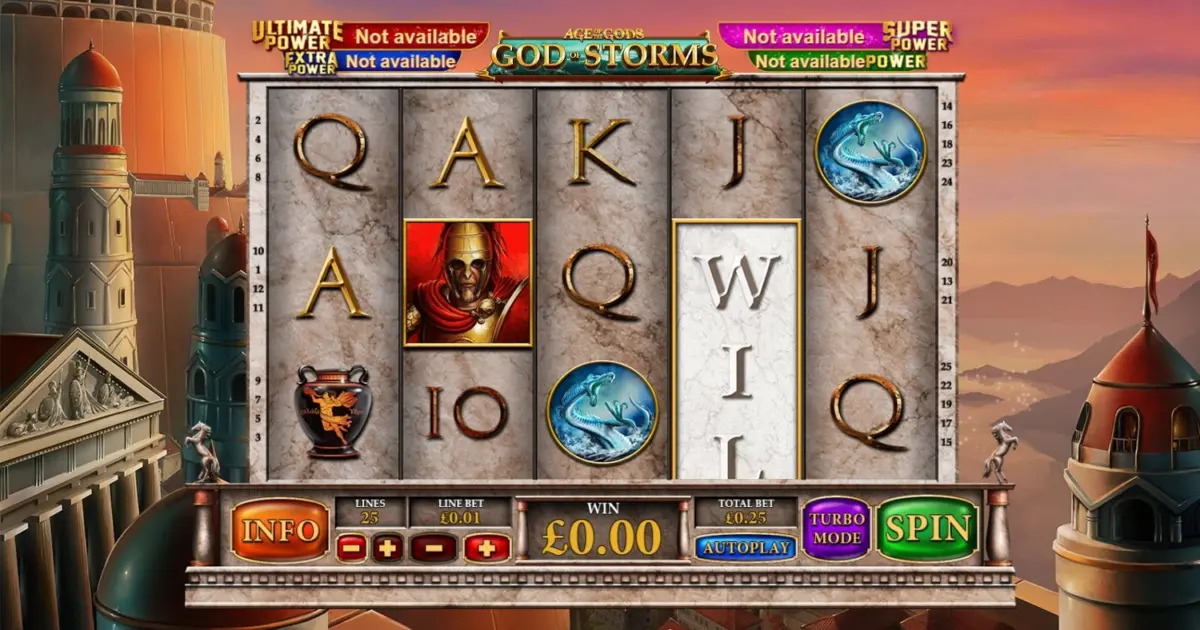
The reel and row configuration is not listed in the available data, nor is a payline or ways count. For a slot in the Age of the Gods brand, players familiar with earlier entries in that series will expect a conventional grid, but expectation is not information.
In general terms, a 5×3 layout with fixed paylines means wins form when matching symbols land on a specific horizontal or diagonal line from left to right. A “ways” mechanic removes fixed lines and instead counts any matching adjacent symbols across neighbouring reels, which increases the number of possible combinations and typically produces more frequent — if smaller — wins.
The practical consequence of missing layout data is that you cannot calculate your own hit frequency before playing. Load the demo, spin fifty times at minimum stake, and count how many spins return any payout. That raw observation tells you whether the mechanic feels like a 20-payline traditional slot or a megaways-style high-frequency game, regardless of the label on the spec sheet.
Stake range and sizing a bankroll
No minimum or maximum stake has been published for this title. Without that range, the following guidance applies generally.
A common planning rule divides your entertainment budget by your chosen spin cost to estimate how many spins a session will last. At £0.10 per spin, a £20 budget gives 200 spins. At £1.00 per spin, the same budget yields 20 spins. The RTP figure does not change which budget lasts longer — it only tells you what fraction of that total wagering will theoretically come back.
For a game with unpublished volatility, the safest approach is to size your spin stake so that your budget covers at least 200 spins. That sample size is large enough to give you a rough read on whether this is a game of small frequent returns or lumpy infrequent ones, and whether the experience matches what you want from a slot session.
Playing the Age of the Gods: God of Storms demo before you commit
A free demo is available for this game, requiring no download and no account registration. The demo uses the same paytable and random-number logic as real-money play, so the mechanics you observe are genuine — but the outcome sequence in demo mode has zero predictive power for real-money sessions. No pattern you spot in practice carries forward.
Use the demo for the specific unknowns this fact sheet leaves open: confirm the reel layout by watching the grid, gauge the feel of the game’s rhythm across a few dozen spins, and note whether the theme’s mythological references engage you. That last point matters more than most players admit. A slot you find aesthetically tedious will drain your focus even if its math is favourable.
When you move to real play, treat the session as paid entertainment with a fixed budget you are prepared to lose entirely. Players must be 18 or older. Set your stop-loss before you place the first real-money spin and honour it — the RTP figure is an average across millions of spins, not a promise for any single one.
Verdict: who should play Age of the Gods: God of Storms
If you select slots by RTP first and everything else second, this one clears both the corpus average (95.71%) and the provider average (95.86%) with room to spare. The 94th-percentile popularity score suggests it is well-tested by a large player base, reducing the risk that undocumented quirks will surface mid-session.
The honest weakness is information: no volatility rating, no reel specification, no stake range. That makes this a game suited to players who are comfortable spending time in demo mode to fill the gaps themselves rather than relying on a published spec sheet. If you prefer complete transparency before you stake a penny, Jungle Trouble from the same provider carries a comparable 96.07% RTP and may present a fuller data profile for direct comparison.
One final note of caution for anyone expecting a sequel upgrade: Age of the Gods: God of Storms 2 has an RTP of 88.0% — over eight percentage points below the original. The first entry is the statistically stronger choice in this pair by a wide margin.
For Vikings (Playtech) slots as a whole, this title sits at the upper end of the provider’s RTP distribution. It rewards a player who does their homework, plays the demo, and sets a firm budget before touching real money. That is a reasonable standard for any slot, but it matters more here because the game asks you to verify what its spec sheet does not.
Frequently Asked Questions
Can I play Age of the Gods: God of Storms for free?
Yes, a free demo is available with no download required. The demo mirrors the real-money game's mechanics and paytable, so you can evaluate the layout, rhythm and theme without staking anything. Outcome sequences in demo mode carry no predictive value for real-money results.
What is the RTP of Age of the Gods: God of Storms?
The RTP is 96.14%, which is 0.43 percentage points above the corpus average of 95.71% and 0.28 points above the provider average of 95.86%. Across a theoretical 1,000 spins at £1 each, the expected return is £961.40 on £1,000 wagered over a very large sample.
Is Age of the Gods: God of Storms high or low volatility?
No volatility rating has been published for this slot. That gap means you cannot determine from the spec sheet whether sessions will feel flat and steady or lumpy and high-variance. Loading the free demo and counting your wins across fifty to a hundred spins is the most direct substitute for a confirmed label.
How does Age of the Gods: God of Storms compare to its sequel?
The original carries a 96.14% RTP while Age of the Gods: God of Storms 2 drops to 88.0% — a gap of over eight percentage points. If RTP is your selection criterion, the first game is substantially better value. The provider, Vikings (Playtech), maintains a portfolio average of 95.86% across 34 indexed titles.
What stake should I use to play Age of the Gods: God of Storms?
No minimum or maximum stake has been published for this game. A general planning approach is to size your spin cost so that your entertainment budget covers at least 200 spins, giving you enough sample data to gauge the game's rhythm. At £0.10 per spin, a £20 budget covers 200 spins.