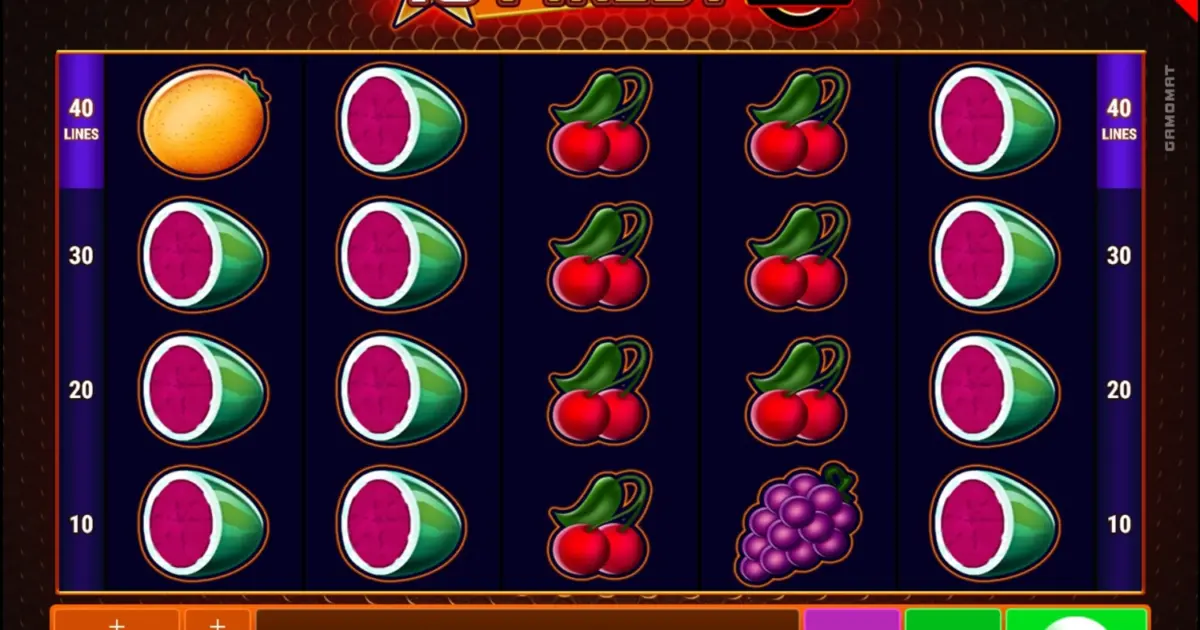
40 Finest – XXL is a 5-reel Fruits slot from Gamomat with a 96.11% RTP, which puts it a touch above the broader market average. That single figure tells you more about long-run expectation than any theme description, so it is worth unpacking before you decide if this is the right fit for your session length and bankroll. If you want to compare numbers first, the 40 finest – xxl slot free demo lets you see the reel structure and pace without risk.
40 Finest – XXL versus the average slot
This game returns 0.40 percentage points more than the corpus average of 95.71% across the site’s tracked titles. In practical terms, that gap is modest but directionally favourable for extended play. On a notional £100 wagered, the long-run statistical average for this title is £96.11 returned to players as a group, compared with £95.71 on the average tracked game. Over a very large sample — hundreds of thousands to millions of spins — you would expect the average cost per £100 staked to be about £3.89 here versus £4.29 on the average title.
That does not make any single session cheaper or more profitable. Every spin is independent, and short-term results can land far above or far below the average. What the comparison does tell you is where this game sits in the market: not an outlier at the top end, but above the middle. Its rank of 2360 and popularity percentile of 88.2 also provide context. A percentile of 88.2 means it is more commonly viewed than about 88% of titles in the dataset, despite a mid-range rank number that reflects a very large catalogue. For a player comparing options, the takeaway is straightforward: you are not paying a higher statistical price for the Fruits theme here than you would on the typical slot, and you are getting a mainstream, widely sampled game rather than an obscure outlier.
RTP breakdown: 96.11% in context
A 96.11% RTP is a long-run average, not a promise for your session. It describes the proportion of total stakes that the game is designed to return to players collectively over an extremely large number of spins. If you staked £100, the theoretical average return across that huge sample would be £96.11; if you staked £1,000 across many sessions, the theoretical average would be £961.10 back, with £38.90 retained as the house edge on that sample. The same maths applies proportionally at any stake.
Scale that to spin counts to see why short sessions diverge so much from the headline figure. At £1 per spin, 100 spins is £100 staked, so the statistical average return is again £96.11, an average cost of £3.89 for those 100 spins. At 1,000 spins at £1, you have staked £1,000 and the average return is £961.10. At 10,000 spins, you have staked £10,000 and the average return is £9,611. You will almost never land exactly on those averages in one sitting; some sessions will be well ahead, many will be behind, and that variance is normal.
Because the provider average for Gamomat is also 96.11% across its 174 tracked games, this title sits exactly on its studio average. That consistency can help when you compare siblings: you are not choosing between a high-RTP and low-RTP Gamomat game in this instance, you are choosing on other characteristics not covered by RTP alone. When no hit frequency or feature data is published, RTP remains your only objective pricing signal, so use it to set expectations for average cost per £100 wagered rather than to predict when a return will arrive.
Volatility profile
Gamomat has not published a volatility rating for this title in the data supplied for this review, and no hit frequency, maximum win, or feature volatility descriptor is available in FACTS. Missing data is itself useful: without a stated low, medium or high volatility label, you cannot reliably anticipate whether the game is designed to produce longer stretches of smaller returns or rarer, larger swings.
Volatility, as a general concept, describes how results are distributed around the RTP average. Many slots that are described as low volatility tend to produce more frequent, smaller returns that can extend session length on a fixed bankroll, while many described as high volatility tend to produce less frequent returns with larger potential swings, which usually requires a larger bankroll and a higher tolerance for losing streaks. Medium volatility, where a provider uses that label, is typically positioned between those two patterns.
Because you do not have that label here, the most honest approach is to treat stake sizing and session planning conservatively. Decide on a total budget for paid entertainment, divide it into a number of spins that gives you the session length you want, and keep stakes flat. Do not adjust stakes after wins or losses in an attempt to chase the average, since each spin remains independent and no progression changes expected value. If you trial the free demo, focus on how quickly balance would move at your planned stake, how long 100 spins takes, and whether that pace suits your budget, rather than trying to infer a volatility label from a short sample.
Gamomat as a studio
Gamomat is recorded here with 174 games and a provider average RTP of 96.11%, which matches this title exactly. That average suggests the studio generally prices its catalogue around the current market middle-to-upper band rather than clustering at the lower end, though individual titles will still differ on mechanics and pace that are not captured by RTP alone.
With a catalogue of that size, direct comparison is more useful than general statements about house style. For example, Fancy Fruits – Red Hot Firepot is listed at 96.09% RTP, a fraction below this game, which means its long-run average cost per £100 staked is £3.91 versus £3.89 here — a negligible 2p difference on that sample, but still a consistent way to rank options. Book of Crazy Chicken – Golden Nights sits at 96.15%, slightly above this title, with an average return of £96.15 per £100 staked, or 4p more than 40 Finest – XXL on the same sample.
Those small gaps show why RTP is best used as a tie-breaker when you already like a theme or reel layout, not as a reason to chase a marginally higher number. Gamomat’s breadth also means you will find many Fruits-leaning titles inside its set, but without published volatility or feature details for this specific game, the cleanest studio-level judgment is this: the pricing is exactly in line with what Gamomat typically offers, and the game does not carry a provider-level RTP premium or discount.
Three Fruits alternatives worth comparing
The Fruits theme is one of the largest on the site, with 2,560 tracked titles, so comparison is essential. Two numbers should drive your shortlist: RTP and what is missing from the data.
Hot Hot Fruit is listed at 96.84% RTP, which is 0.73 points above 40 Finest – XXL. Across £100 staked in the long-run average, that is £96.84 returned versus £96.11 here, an average saving of 73p per £100 wagered. If pricing is your primary filter, it is the more favourable of the two on that measure alone, though you would still need to assess session pace and bankroll fit separately.
Trickstar Spins is listed at 94.00% RTP, which is 2.11 points below this game. The average cost per £100 staked on that basis is £6.00 versus £3.89 here, so the statistical price is notably higher. Some players may still prefer its structure, but the pricing difference is large enough to be the deciding factor if you are otherwise indifferent.
A third entry, Sevens High, is listed without a published RTP in the supplied data. That absence matters: without an RTP figure you have no objective pricing anchor. Treat any number quoted elsewhere for that title with caution until the provider publishes it. In a theme catalogue this large, preferring games with a published, comparable RTP — like the two alternatives above — makes your comparison more reliable and avoids basing a decision on unverified figures.
Getting the most out of the free demo
Free demo play is available for this title, which is the most practical way to answer personal fit questions that RTP alone cannot. Use the demo to map your own session length at a fixed stake. For example, set a notional bankroll, choose a single stake that divides into at least 100–200 spins, and run that flat stake without changing it. Note how many spins you get before a notional budget would be exhausted and how variable the balance feels, without trying to label that variability as a formal volatility rating.
Because the demo runs on the same reel count — 5 reels — and the same 96.11% theoretical RTP as the real-money version, the pacing you observe is a useful guide to time on device, but it does not predict real-money results. Short-term outcomes in demo can be above or below the average, just as in paid play, and a good run in demo does not make a subsequent real-money session more likely to pay.
Keep play in the entertainment frame. You must be 18+ to gamble in the UK. Set a budget before you play, use deposit and time limits if you move to real money, and treat any spend as the cost of paid entertainment, not a way to make money. If you need support, tools and help are available from independent services. Demo is best used as a try-before-you-decide aid for stake and session planning, not as a test of future returns.
Should you play 40 Finest – XXL?
Choose this game if you want a 5-reel Fruits slot priced exactly on its provider’s average and a touch above the wider market average on RTP. At 96.11%, its long-run average cost of £3.89 per £100 staked is modestly lower than the 95.71% corpus average, and it avoids the higher statistical price seen on some Fruits alternatives at 94.00%. Its popularity percentile of 88.2 also suggests it is a well-sampled, mainstream choice rather than a niche title.
The main reservation is the lack of published volatility, hit frequency and max win data in the supplied facts. Without those, you cannot fine-tune expectations for swing size or session length beyond what RTP implies for average cost. If you need that level of predictability before committing funds, you may prefer to compare directly with alternatives where more data is available, or rely more heavily on a structured demo trial at your intended stake.
For many players, the sensible path is to use the single objective advantage this title has — its slightly above-average RTP — as a baseline, test pace in the free demo at a flat, affordable stake, and only then decide if the Fruits presentation and 5-reel rhythm earn a place in your regular rotation. On pricing alone it is solid; on information transparency it leaves you to do more of the work.
| Feature | Detail |
|---|---|
| Game | 40 Finest – XXL |
| Provider | Gamomat (174 games) |
| RTP | 96.11% |
| Reels | 5 |
| Primary theme | Fruits (2,560 Fruits titles tracked) |
| Subcategory | Slot Machine |
| Popularity rank / percentile | 2360 / 88.2 |
| Provider average RTP | 96.11% |
| Corpus average RTP | 95.71% |
| Free demo | Available |
Frequently Asked Questions
Can I play 40 Finest - XXL for free before staking real money?
Free demo play is listed as available for 40 Finest - XXL, so you can trial the 5-reel structure without funding an account. The demo uses the same 96.11% theoretical RTP, but short-term results in demo do not predict real-money outcomes because each spin is independent.
What does the 96.11% RTP on 40 Finest - XXL actually mean for my session?
RTP is a long-run average across a very large number of spins. At 96.11%, the theoretical average is £96.11 returned per £100 staked as a group, with £3.89 retained as house edge. Your individual session will almost always land above or below that average due to natural variance.
What is the volatility of 40 Finest - XXL and how will it feel to play?
No volatility, hit frequency or max win figure is published in the supplied facts for 40 Finest - XXL, so there is no official low/medium/high label to guide expectations. Use a flat stake in the free demo to gauge session length and balance swings rather than assuming a volatility profile.
Who makes 40 Finest - XXL and what else do they offer?
The game is by Gamomat, tracked here with 174 titles and a provider average RTP of 96.11%. Related Gamomat titles for comparison include Fancy Fruits - Red Hot Firepot at 96.09% and Book of Crazy Chicken - Golden Nights at 96.15%, both very close to this game on pricing.
How does 40 Finest - XXL compare to Hot Hot Fruit?
Hot Hot Fruit is listed at 96.84% RTP, which is 0.73 points higher than 40 Finest - XXL at 96.11%. That translates to an average return of £96.84 versus £96.11 per £100 staked over a huge sample, so Hot Hot Fruit is statistically cheaper per £100 wagered if pricing is your main comparison point.