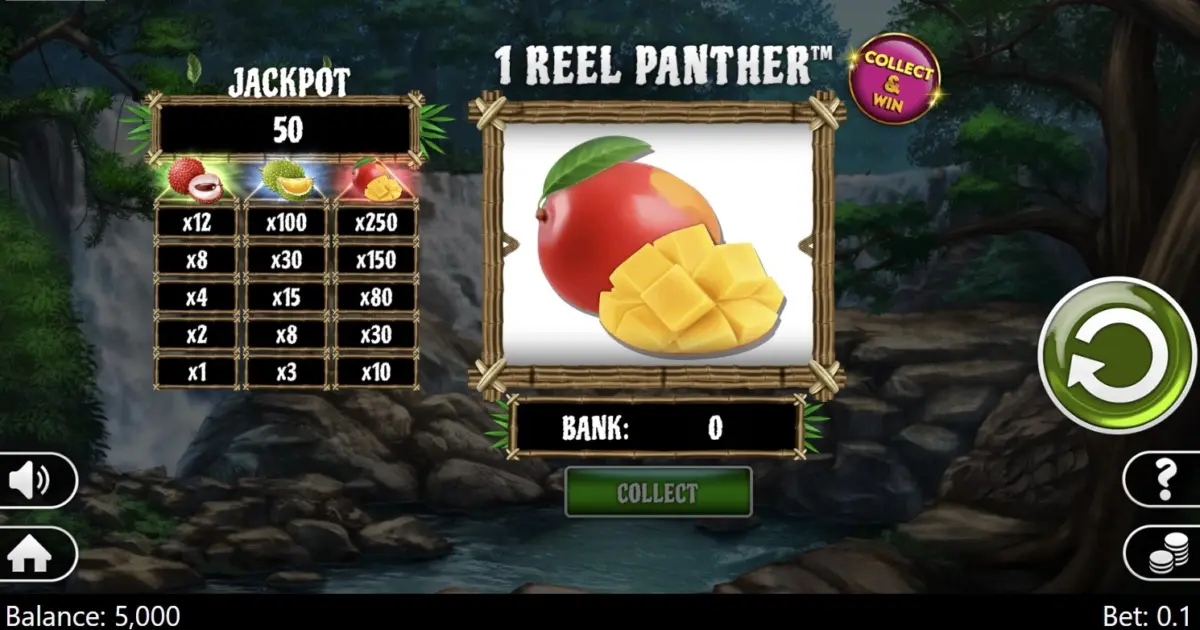
Spinomenal has put out 548 games, and 1 Reel Panther sits at rank 78 among them — a game that draws attention despite, not because of, its numbers. The RTP of 91.55% is the first thing you should notice, and the last thing that should reassure you. This is a minimal single-reel title with a “Slot Machine” label, no published volatility rating, and no stake range disclosed in the available data. If you are comparing demos before committing money, this is the full picture to work from.
1 Reel Panther at a glance
The key figures are few but pointed. The game runs at 91.55% RTP across a single reel, produced by Spinomenal, and sits in the generic “Slot Machine” subcategory rather than a themed collection. It ranks 78th among Spinomenal’s 548 titles, placing it in the 99.6th popularity percentile — meaning it attracts more attention than almost every other game in the provider’s catalogue. Whether that attention comes from curiosity about the format or from casino placement, the data does not say.
| Metric | Value |
|---|---|
| Provider | Spinomenal |
| RTP | 91.55% |
| Reels | 1 |
| Volatility | Not published |
| Stake range | Not published |
| Rank (provider) | 78 of 548 |
| Free demo | Yes |
No max win figure, hit frequency, or bonus description is available. Treat any third-party claims about those values with scepticism.
What a 91.55% RTP actually returns
RTP is a theoretical long-run average calculated across millions of spins. It is not a prediction for your session. The practical implication of a 91.55% figure is that, over an enormous sample, the game retains 8.45% of all money wagered. The corpus-wide average across all reviewed slots is 95.71%, and Spinomenal’s own portfolio averages 95.11%. This game sits 4.16 percentage points below the market average and 3.56 below its own provider’s norm — a gap that compounds over time.
To make that concrete: if you played 1,000 spins at a hypothetical £0.50 stake (total wagered £500), the theoretical return at 91.55% would be £457.75, a loss of £42.25. The same 1,000 spins at the corpus average of 95.71% would return £478.55 — a difference of roughly £20.80 in your pocket over the same session length. That difference is not trivial, and it exists purely in the math of the game’s design, not in any sequence of symbols you happen to land on.
Volatility and what your session will feel like
Spinomenal has not published a volatility rating for 1 Reel Panther. That absence matters. Volatility determines whether a game pays small wins frequently or large wins rarely — it shapes your experience as much as RTP does. Without a rated volatility tier, you cannot plan a session around expected swing size or predict how long a given bankroll will last at this game compared to others.
In general terms, a single-reel format tends toward simplicity: fewer combinations mean fewer distinct outcomes per spin, which often correlates with a tighter distribution of results. But “often” is not a substitute for a published figure. If you need to know whether this game will grind your balance down in small increments or deliver occasional larger hits, you have to determine that empirically through extended demo play — not from any data Spinomenal has provided.
The single-reel layout and how wins are counted
One reel means one spin produces a single symbol in a single position. There are no payline patterns to memorise, no ways to count, no cascading mechanics. The win condition is singular: the symbol that lands either matches a winning combination in the paytable or it does not.
Spinomenal has released other single-reel titles. 1 Reel – Demi Gods 7 uses the same mechanical skeleton but operates at 95.42% RTP — nearly four points higher than 1 Reel Panther. If you are drawn to the stripped-down format specifically, that alternative returns significantly more per wager over time. For broader Spinomenal catalogues, Hades’ Infernal Blaze and Story of The Little Mermaid show the provider’s range beyond single-reel experiments, though neither publishes an RTP figure in the available data either.
Stake range and sizing a bankroll
No minimum or maximum stake has been published for 1 Reel Panther. Without that information, you cannot calculate a precise session length at a given budget. As a general planning rule: at a 91.55% RTP, a 50-spin session at any stake will on average return about 91.55% of what you wagered, but variance in a short sample means you will almost never land exactly there. Your actual result will deviate — sometimes dramatically — from the theoretical figure.
If you decide to play this game, check the stake limits directly at the casino where you are playing. Set a stop-loss before your first spin, based on money you are fully prepared to lose, and treat that figure as immovable. The absence of published volatility makes disciplined bankroll management even more important here than in games where the risk profile is rated.
Playing the 1 Reel Panther Slot demo before you commit
A free demo is available, and given how many data points are missing from this game’s specification, demo play is not just advisable — it is the only way to observe the payout rhythm, symbol frequency, and practical stake range without financial risk. Use the demo to log outcomes over at least 200–300 spins and note how often the reel produces a winning symbol versus a blank or losing one. That empirical record will tell you more than any theoretical figure can.
Remember that demo results carry no predictive weight for real-money sessions. Every spin is an independent random event; no prior outcome shifts the probability of the next one. This game is for players aged 18 and over, and you should treat it as paid entertainment with a fixed budget rather than an investment opportunity.
Verdict: who should play 1 Reel Panther
At 91.55% RTP, this is one of the lower-return titles in the reviewed corpus. It is not a game you should play for value. It is a game you might play for the specific minimalism of the single-reel format, or because a casino has surfaced it in a lobby you are browsing. If you choose to play, do so knowing exactly what the math costs you relative to the market average, and use the higher-RTP alternative from the same provider as your reference point for what the format can offer without the penalty.
The missing volatility rating, absent stake range, and lack of published bonus or hit-frequency data all point in the same direction: this is a game where the operator is telling you less than usual. That asymmetry of information is itself a reason to be cautious with your bankroll, regardless of how entertaining the simplicity might be.
Frequently Asked Questions
Is the 1 Reel Panther slot available to play for free?
Yes, Spinomenal offers a free demo version of 1 Reel Panther. Demo play lets you observe the single-reel mechanics, symbol outcomes, and practical stake range without depositing money. However, demo results do not predict real-money outcomes since each spin is an independent random event.
What does 91.55% RTP mean in practical terms for 1 Reel Panther?
The 91.55% RTP means the game theoretically retains 8.45% of all money wagered across a very large sample. Compared to the corpus average of 95.71%, this game returns roughly 4.16 percentage points less over time, making it one of the lower-value titles available for sustained play.
Does 1 Reel Panther have a published volatility rating?
No volatility rating has been published by Spinomenal for this title. Without that data, you cannot determine whether the game pays small wins frequently or concentrates returns into rare larger hits. You can observe the payout rhythm through extended demo sessions, but no official risk classification exists.
How does 1 Reel Panther compare to other Spinomenal single-reel games?
Spinomenal's 1 Reel - Demi Gods 7 operates at 95.42% RTP — nearly four points higher than 1 Reel Panther's 91.55%. Both use the same single-reel format, so if you prefer the mechanical simplicity, the Demi Gods version offers substantially better long-term return per wager.
Can I win real money playing the 1 Reel Panther demo?
No, demo play uses virtual credits and does not pay real money. The demo exists so you can evaluate the game's mechanics and feel before committing a deposit. If you later play for real money, treat any winnings as entertainment outcomes rather than expected returns.




