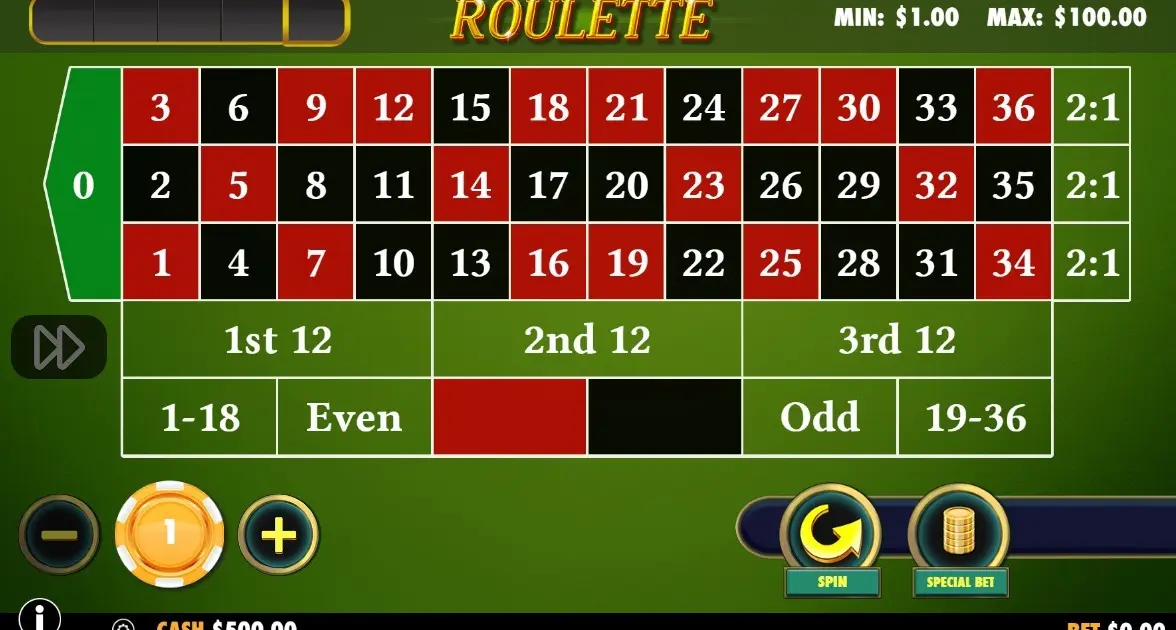
Roulette (Pragmatic Play) sits at 97.3% RTP, which translates to a 2.70% house edge—the number you get from one green zero across 37 pockets. That edge applies to every standard bet on the felt, from a single number to red/black. Pragmatic Play built this as a clean European-format wheel with no multipliers, no side bets, and no French rules to soften the hit. If you want the lowest house edge roulette offers without hunting for La Partage tables, you want a single-zero wheel. This is one.
The 97.3% figure is confirmed in FACTS and matches the mathematical expectation of European roulette. The question is whether you value a no-frills layout and Pragmatic Play’s execution over feature-heavy alternatives or French-rule tables that push even-money bets down to 1.35% house edge.
Is Roulette (Pragmatic Play) worth your spins?
Yes, if you want transparent maths and a single-zero wheel with no gimmicks. The 97.3% RTP is as good as European roulette gets without French rules, and Pragmatic Play delivers it in a straightforward package. The game does not invent side bets, does not reduce payouts to fund multipliers, and does not obscure the house edge behind bonus features. Every bet on this table carries the same 2.70% disadvantage, and that number is lower than the 5.26% you face on an American double-zero wheel.
The downside is equally transparent: this is the only roulette table Pragmatic Play offers in the dataset, so if you want variety within the same provider ecosystem, you will not find it here. If you want French rules, look at French Roulette (NetEnt), which returns half your stake on even-money bets when zero lands and cuts the house edge to 1.35% on those bets—the best standard deal in roulette.
Pragmatic Play and this wheel
Pragmatic Play operates one roulette table in the available dataset, and this is it. The provider’s average RTP across its roulette catalog is 97.3%, because there is only one table to average. That figure sits 0.33 percentage points above the corpus-wide roulette average of 96.97%, a gap that reflects the prevalence of American wheels and multiplier formats in the wider market.
Pragmatic Play is a prolific slots studio, but its roulette footprint is minimal. That is not inherently bad—a single well-built European wheel does the job—but it means you get no in-house alternatives if you want a different format. For comparison, European Roulette (Red Tiger) also delivers 97.3% RTP at a single-zero wheel, and Red Tiger maintains multiple roulette variants.
House edge: 2.70%, 5.26% or 1.35%?
The three house-edge figures correspond to three wheel formats. A European wheel has 37 pockets—numbers 1 through 36 plus a single zero—and pays 35:1 on a straight-up bet. The true odds are 36:1, so the house keeps one unit in 37, which is 2.70%. That edge applies to every standard bet: inside, outside, dozens, columns. An American wheel adds a second zero, expanding the grid to 38 pockets while keeping the 35:1 payout. The house now keeps two units in 38, or 5.26%. The five-number basket bet (0, 00, 1, 2, 3) is worse still, at 7.89%.
French rules—La Partage or En Prison—return half the stake on even-money bets (red/black, odd/even, high/low) when zero lands, cutting the house edge on those specific bets to 1.35%. The 97.3% RTP confirmed for this table points strongly to a European single-zero wheel with no French rules. If French rules were active, the blended RTP across all bet types would typically differ. Confirm the wheel format and any rule variations on the game’s own paytable before betting real money, because names alone are not contracts.
Bet types, payouts and true odds
Every bet on a European wheel gives the house the same 2.70% edge, but the bets differ sharply in variance. Inside bets pay more and hit less often; outside bets pay less and hit more often. Neither changes your expected loss per unit wagered. The table below shows standard payouts, true odds, and the house edge for a 37-pocket European wheel.
| Bet type | Payout | True odds | House edge |
|---|---|---|---|
| Straight (single number) | 35:1 | 36:1 | 2.70% |
| Split (two numbers) | 17:1 | 17.5:1 | 2.70% |
| Street (three numbers) | 11:1 | 11.33:1 | 2.70% |
| Corner (four numbers) | 8:1 | 8.25:1 | 2.70% |
| Line (six numbers) | 5:1 | 5.17:1 | 2.70% |
| Dozen / Column | 2:1 | 2.08:1 | 2.70% |
| Red / Black, Odd / Even, High / Low | 1:1 | 1.06:1 | 2.70% |
The gap between payout and true odds is identical across every row. A straight-up bet loses one unit in 37 spins on average; a red/black bet loses one unit in 37 spins on average. Inside bets concentrate that loss into fewer, larger swings. Outside bets spread it across more frequent, smaller outcomes. Your choice of bet type is a choice about volatility, not value.
What experienced players actually do
Experienced players pick the bet with the lowest house edge available and stake it flat. On a European wheel with no French rules, every standard bet has the same 2.70% edge, so the choice comes down to volatility tolerance. If French rules are available, even-money bets drop to 1.35% house edge, and that is where the smart money goes. Players set a session budget in advance, divide it into a fixed number of units, and stop when the budget is gone or the session target is hit. No progression—Martingale, Fibonacci, D’Alembert—changes the house edge. Spins are independent. The wheel has no memory.
Betting systems redistribute variance. Martingale doubles the stake after every loss, which means you win small amounts frequently and lose large amounts occasionally when you hit a bad streak and the table limit. The expected value remains negative at the same rate. Tracking previous results—waiting for five reds, betting on “cold” numbers—has no predictive power on an RNG wheel. The probability of red on the next spin is always 18/37, regardless of what happened before.
Free play before real money
This table offers free demo play, and using it is the correct first step. Demo mode gives you the full layout, the same RTP, and the same house edge as real-money play, with no financial risk. You can test bet types, confirm the wheel format, check the interface, and verify that the table limits suit your session budget. Demo results are generated by the same RNG as real-money results, so the variance you see in demo is the variance you will face when betting real money. Demo play does not predict specific outcomes, but it does let you experience the pacing and volatility of the game before committing funds.
If you choose to play for real money, set a budget you can afford to lose before you start, and treat that budget as the cost of entertainment, not an investment or income strategy. Roulette has a negative expected value on every spin. Over time, you will lose 2.70% of everything you wager on a European wheel. That is the price of playing, and it does not change with bet size, betting pattern, or session length. This is a game for players aged 18 and over. If you find yourself chasing losses or playing beyond your budget, stop and seek support.
Final take
Roulette (Pragmatic Play) is a single-zero European wheel with confirmed 97.3% RTP and a transparent 2.70% house edge on every bet. It does not add multipliers, side bets, or French rules, so what you see is what you get: classic roulette maths with no surprises. The game ranks in the 96.9th popularity percentile, and its RTP sits 0.33 percentage points above the roulette corpus average, which reflects the advantage of a single-zero wheel over American double-zero formats and multiplier tables that reduce base payouts.
The limitation is variety. Pragmatic Play offers one roulette table, so if you want alternatives within the same provider, they do not exist. If you want the lowest house edge roulette offers, you need French rules and even-money bets, which bring the edge down to 1.35%. Without French rules, this table delivers the standard European edge, and that edge is unforgiving. No betting system beats it. No pattern predicts the next spin. The game is worth playing if you value simplicity, confirmed RTP, and a straightforward single-zero wheel. It is not worth playing if you expect a betting progression to turn a negative-expectation game into a positive one. For a comparison at the same RTP, try European Roulette Pro, which also delivers 97.3% RTP in a European format.
Frequently Asked Questions
Is there a free demo version of Roulette (Pragmatic Play)?
Yes, free demo play is available for this table. Demo mode gives you the full layout and the same 97.3% RTP as real-money play, with no financial risk. Use it to test bet types, confirm the wheel format, and check that the table limits suit your session budget before committing real money.
What is the RTP of Roulette (Pragmatic Play)?
The confirmed RTP is 97.3%, which corresponds to a 2.70% house edge on every standard bet. That figure is the mathematical expectation of a European single-zero wheel with 37 pockets and no French rules. The house edge is identical whether you bet a single number, red/black, or any other standard option.
Does Pragmatic Play use a single-zero or double-zero wheel?
The 97.3% RTP points strongly to a European single-zero wheel with a 2.70% house edge, not an American double-zero wheel, which would deliver 94.74% RTP and a 5.26% house edge. Confirm the wheel format on the game's own rules screen before betting real money, because RTP alone is a strong hint but not a contract.
Can a betting system like Martingale beat the house edge in this game?
No. Martingale, Fibonacci, D'Alembert, and every other progression system redistribute variance but do not change the expected value. Every spin is independent, the wheel has no memory, and you will lose 2.70% of total wagers over time regardless of bet size or pattern. Progressions accelerate the risk of hitting table limits during a losing streak.
How does Roulette (Pragmatic Play) compare to French Roulette tables?
This table delivers the standard European 2.70% house edge. French Roulette tables with La Partage or En Prison rules return half your stake on even-money bets when zero lands, cutting the house edge on those bets to 1.35%—the lowest in standard roulette. If you play even-money bets and French rules are available, the French format is mathematically superior.




