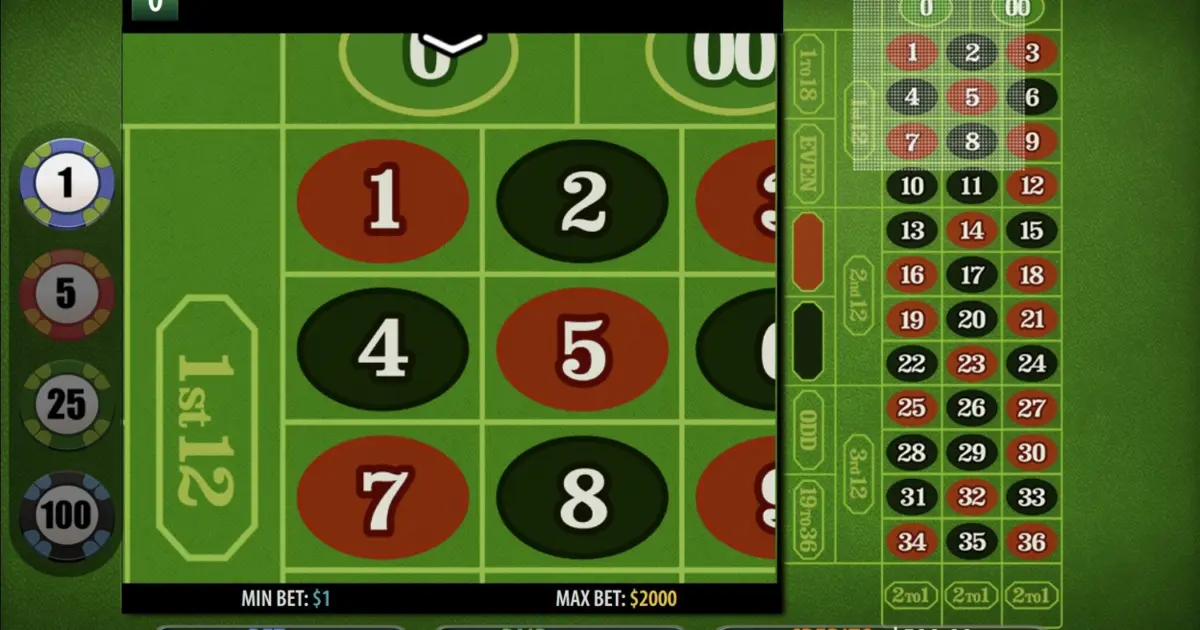
Roulette (Multislots) offers a genuinely tempting headline figure — a published return to player of 97.3% — but the details that matter most are exactly the ones MultiSlot has not confirmed. The wheel type is unnamed, the table limits are absent, and no side bets or multiplier features are declared. That makes this a review about what you can verify, what you cannot, and why the gaps are the story.
Start with the one number you do have. The 97.3% RTP puts this table roughly in line with the corpus average of 96.97% and slightly above it, which is a reasonable starting point for any roulette variant. But RTP is only half the picture. The other half is the wheel itself, and on that the facts are silent.
What kind of roulette is Roulette (Multislots)?
The title points toward a single-zero European wheel — that is the standard reading of a plain “roulette” name from most providers. If that is correct, you are looking at 37 pockets and a house edge of 2.70% on every standard bet. That would make the 97.3% RTP figure consistent: 100 minus 2.70 equals 97.30, and the numbers line up neatly.
But the name is a hint, not a confirmation. The FACTS available for this table do not state the pocket count, do not confirm whether French rules like La Partage apply, and do not name the wheel family explicitly. Treat the European reading as the most likely scenario, then verify it on the game’s own rules screen before you commit real money. If the table turns out to be double-zero instead, the house edge jumps to 5.26% and the story changes completely.
The “Multislots” suffix in the title is more of a brand descriptor than a gameplay clue. It tells you which provider line this game belongs to, not what the wheel contains. Do not read it as a promise of multiplier mechanics or side bets — nothing in the available facts supports that.
Return to player and house edge
The published RTP for Roulette (Multislots) is 97.3%. That figure is your best single number for comparing this table against others, and it sits slightly above the site-wide average of 96.97%. The gap is small — 0.33 percentage points — so do not treat this as a dramatically better game than the field.
What that RTP actually means depends entirely on the wheel. On a single-zero European wheel, a 97.3% return implies a 2.70% house edge, which is exactly the standard figure for that format. On a double-zero American wheel, the standard house edge is 5.26%, which would make a 97.3% published RTP an anomaly that needs explanation — likely a rule variation you would have to read directly from the game.
If French rules apply — La Partage or En Prison returning half your stake on even-money bets when zero lands — the even-money house edge drops to about 1.35%, the best standard bet in roulette. But the facts do not confirm any of this. The honest position is this: 97.3% is a good headline, but the wheel type is the variable that decides whether that number is ordinary, excellent, or impossible to reconcile.
Reading the MultiSlot paytable before you bet
Before you place a single chip, open the paytable and confirm three things. First, the pocket count — 37 for European, 38 for American. Second, whether the RTP screen matches the 97.3% figure published here; provider paytables occasionally change after updates. Third, whether any rule variations apply to even-money bets, because those change the house edge on your most common wagers.
The absence of a confirmed paytable in the available facts is not a minor omission. Without it you cannot know whether the 97.3% figure applies to all bets equally or only to a subset. In standard roulette, every bet on a given wheel carries the same house edge — that is the beauty of the game’s mathematics. But the moment a provider introduces a side bet, a multiplier, or a rule tweak, that uniformity breaks.
MultiSlot is a small provider by volume — just two games in the catalogue — and the average RTP across those two games is 97.3%, identical to this table. That consistency is mildly reassuring, but it tells you nothing about the wheel itself. Check the rules screen. It takes thirty seconds and it is the only way to turn a hint into a fact.
Bet coverage, variance and session length
Because the wheel type is unconfirmed, the most honest table here is the comparison of standard payouts and true odds for both possible formats. This is the table you should hold next to the game’s own paytable when you open it.
| Bet type | Payout | European true odds | American true odds |
|---|---|---|---|
| Straight up | 35:1 | 36:1 | 37:1 |
| Split | 17:1 | 17.5:1 | 18:1 |
| Street | 11:1 | 11.33:1 | 11.67:1 |
| Corner | 8:1 | 8.25:1 | 8.5:1 |
| Six line | 5:1 | 5.17:1 | 5.33:1 |
| Column / Dozen | 2:1 | 2.08:1 | 2.11:1 |
| Even money | 1:1 | 1.01:1 | 1.05:1 |
The gap between payout and true odds on every row is the entire house edge. On a straight-up bet, the wheel pays 35:1 against true odds of 36:1 — that single pocket is where the casino’s advantage lives. Inside bets like straight-ups and splits produce wild swings in your balance; outside bets like red/black or even/odd produce steadier, smaller movements. The expected value is identical across all of them on a given wheel.
Session length follows from variance, not from RTP. If you are playing even-money bets, your bankroll will last longer but move in small increments. If you favour straight-ups, you will see long dry stretches punctuated by occasional 35:1 hits. Neither approach is better in expected value — they just feel different.
Patterns, hot numbers and the gambler’s fallacy
No betting system changes the mathematics of this game. Martingale, Fibonacci, D’Alembert, “wait for five reds” — every one of them redistributes variance and accelerates your exposure to the table limit, but none of them moves the expected value by a single decimal point. Spins are independent. The wheel has no memory.
Track previous results if you find it entertaining, but understand that a run of five reds has zero predictive value for the next spin. Each spin starts from exactly the same distribution. A number is never “due”, a colour is never “hot”, and a sector is never “cold”. Those words describe human pattern-seeking, not wheel physics.
The most dangerous idea in roulette is the belief that a losing streak makes a win more likely. It does not. If you are using a progression to recover losses, you are not managing risk — you are increasing your stake on every losing spin, which is the fastest route to the table limit and the end of your session. Set your budget, play for entertainment, and treat any system you read online as fiction.
Trying the demo
A free demo of Roulette (Multislots) is available, and it is the right place to start. Use it to test the interface, check the paytable for the wheel type and pocket count, and get a feel for the variance of different bet types without risking a single unit of your bankroll. The demo is also the fastest way to confirm whether the 97.3% RTP figure matches the game’s own rules screen.
One honest caveat: demo play is a practice environment, not a predictor. The random number generator in the demo may be the same one used in real-money play, but the results you see there carry no information about what will happen when you bet for real. Use the demo to learn the game, not to scout for patterns.
Play responsibly. This is an 18+ game of chance, and the house edge — 2.70% on a European wheel, 5.26% on an American one — guarantees that the casino wins over time. Set a budget in advance, treat every spin as entertainment spend, and never chase losses with money you cannot afford to lose.
Verdict on Roulette (Multislots)
The 97.3% RTP is a solid headline and the game sits slightly above the site average, which makes it a reasonable candidate for your attention. But the unresolved wheel type is the deciding factor. If it is European, you have a standard 2.70% house edge and a perfectly playable table. If it is American, the edge nearly doubles and the game becomes a worse choice than almost anything else in the catalogue.
Start with the free demo. Open the rules screen, confirm the pocket count, and check whether the 97.3% figure matches what the game displays. If the wheel is European, this is a competent, unremarkable table worth a session. If you want a confirmed single-zero table with the same RTP, European Roulette (Red Tiger) is a direct comparison at the same 97.3% figure. For a second benchmark, European Roulette Pro offers the same return with a more established track record.
The verdict: playable, honest about its headline number, but unverified on the detail that matters most. Confirm the wheel before you fund a real-money session.
Frequently Asked Questions
Is Roulette (Multislots) free to play?
Yes, a free demo of Roulette (Multislots) is available. The demo lets you check the interface, confirm the wheel type and pocket count on the rules screen, and test different bet types without risking real money. Demo results do not predict real-money outcomes.
What is the RTP of Roulette (Multislots)?
The published RTP is 97.3%, which sits slightly above the site-wide average of 96.97%. That figure is only meaningful once you confirm the wheel type — on a European wheel it matches a 2.70% house edge, but on an American wheel the standard edge is 5.26%.
Which wheel does Roulette (Multislots) use?
The wheel type is not confirmed in the available facts. The name suggests a single-zero European wheel with 37 pockets and a 2.70% house edge, but you must verify this on the game's own rules screen before betting real money. A double-zero American wheel would carry a 5.26% edge.
Does any betting system work on Roulette (Multislots)?
No. Martingale, Fibonacci, and every other progression leave the expected value unchanged because spins are independent and the wheel has no memory. Systems only redistribute variance and accelerate your path to the table limit. No pattern or streak has predictive value.
What is the best bet on Roulette (Multislots)?
On a standard European wheel, every bet carries the same 2.70% house edge, so "best" depends on your goal. Even-money bets give the longest sessions with the smallest swings; straight-ups offer 35:1 payouts with far higher variance. If French rules apply, even-money bets drop to about 1.35%.




