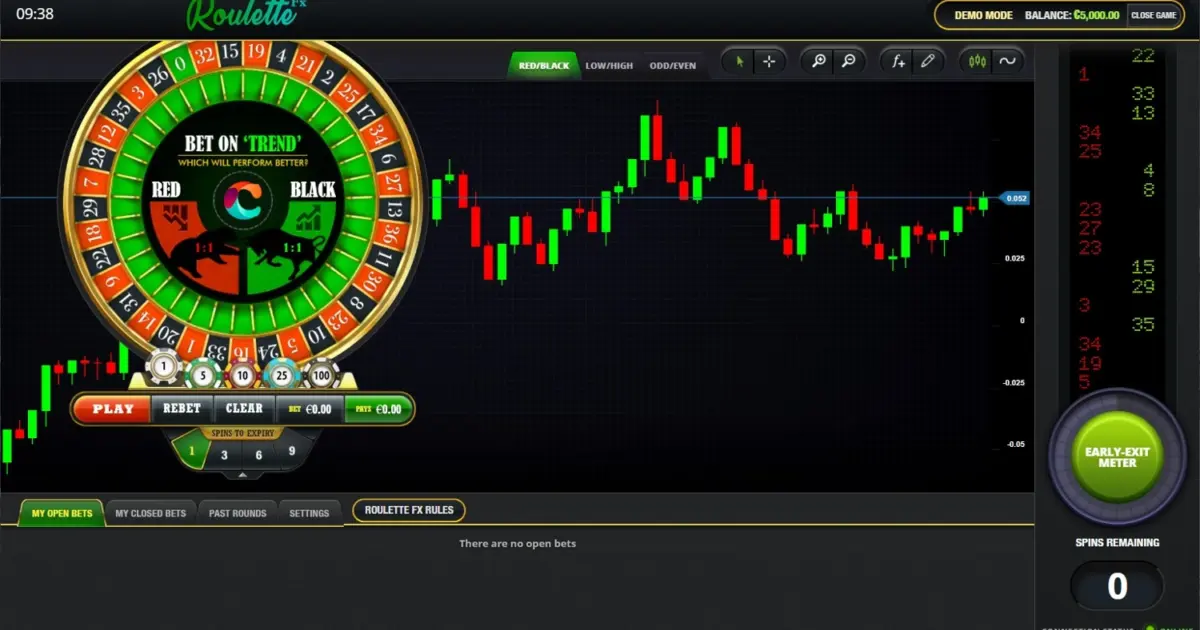
Roulette FX is worth a look if you want a table with a published return figure rather than a guess: CandleBets lists it at 97.3% RTP, which sits just above the 96.97% average across the tables in this corpus. What the FACTS available for this table do not tell you is the pocket count, and on a roulette wheel that single number matters more than anything else on the page. Free demo play is available, so you can open the rules screen and confirm it before any money moves.
How Roulette FX plays
The mechanics of any RNG roulette table are the same at the surface: you place chips on the layout, the wheel spins, a number lands, winning bets pay and everything else is swept. The differences between tables live in three places — the pocket count, the treatment of zero on even-money bets, and the interface features like a racetrack for call bets, favourite-bet saving and autoplay.
For this table, the confirmed facts are narrow. CandleBets is the provider, and it is the only game listed from them here, so there is no wider studio catalogue to infer house conventions from. The demo is available without a deposit, which is the practical route to answering the questions this page cannot: whether there is a racetrack, whether neighbour bets are offered, what the minimum and maximum stakes are, and whether any multiplier or side-bet layer sits on top of the classic layout.
The name gives nothing away either. “FX” is styling, not a wheel family — it does not signal European, American or French rules the way those words would. Treat the layout you see in the demo as the source of truth, and count the zeros yourself.
The pocket count is the whole story
Roulette maths is fully solved, and the whole edge comes from one structural gap. On a single-zero wheel there are 37 pockets. A straight-up number pays 35:1 when the true odds against it are 36:1. That one-pocket shortfall produces a house edge of 2.70% on every standard bet — straight-up, split, corner, column, red, even, all of it. Nothing on the layout is better or worse than anything else.
Add a second zero and there are 38 pockets. The payouts stay the same, so the gap widens and the house edge nearly doubles to 5.26%, with the five-number basket bet worse still at 7.89%. French rules go the other way: La Partage returns half your stake on even-money bets when zero lands, and En Prison holds the bet for one more spin. Either rule cuts the even-money edge to roughly 1.35%, the best standard bet in roulette.
So the same chip on red can cost you 1.35%, 2.70% or 5.26% depending only on the wheel and rules in front of you. The pocket count for Roulette FX is not in the data available here, which makes it the first thing to check in the demo. A 97.3% figure is consistent with a single-zero layout, but consistency is not confirmation.
Reading the 97.3% figure
RTP and house edge are the same statement in different clothes. A 97.3% return means a 2.70% edge, and 2.70% is exactly the arithmetic of a 37-pocket wheel. That makes the published number a strong indication that Roulette FX is a single-zero table with zero losing the full even-money stake — no La Partage, since that would push the even-money return closer to 98.65%.
It is worth understanding what the number describes. It is a long-run average across an enormous number of spins, not a session forecast. Over 100 spins of even-money bets, outcomes scatter widely around the expected result; the average only asserts itself over sample sizes no player reaches in an evening. It also assumes standard bets. If this table carries any multiplier or side-bet layer, those components can be priced differently, and the paytable on the game’s own rules screen is the only place to read them.
Against the field, 97.3% is solid rather than exceptional. It matches European Roulette (Red Tiger) and European Roulette Pro exactly, and it beats the corpus average by 0.33 points. If you specifically want the lower even-money edge that partage delivers, French Roulette (NetEnt) is the format to compare against.
Choosing bets for the session you want
On a single-zero wheel every standard bet costs the same 2.70%. What changes is the shape of the ride. Inside bets pay large and land rarely; outside bets pay small and land often. Neither is smarter — they buy different distributions of the same expected loss.
| Bet | Pays | True odds (37 pockets) | Win chance |
|---|---|---|---|
| Straight up (1 number) | 35:1 | 36:1 | 2.70% |
| Split (2 numbers) | 17:1 | 17.5:1 | 5.41% |
| Corner (4 numbers) | 8:1 | 8.25:1 | 10.81% |
| Dozen / column (12) | 2:1 | 2.08:1 | 32.43% |
| Red / black / odd / even | 1:1 | 1.06:1 | 48.65% |
Read the table as a menu of variance, not value. If you want a long session from a small budget, even-money and dozen bets keep the swings shallow. If you want the chance of a large result and accept most sessions ending quickly, straight-ups do that. Spreading chips across many numbers does not reduce the edge either — it just averages your own outcomes toward the same 2.70%.
Martingale and friends: the honest answer
No betting system improves expected value. Not Martingale, not Fibonacci, not D’Alembert, not Labouchère, not waiting for five reds before backing black. This is not a matter of opinion or execution quality; it follows from the fact that spins are independent. The wheel has no memory, the RNG has no memory, and the probability of red on the next spin is identical whether the last ten were red or the last ten were black.
What progressions actually do is redistribute variance. Martingale converts many small wins into a rare catastrophic loss, and it collides with table maximums exactly when you need one more double. Seven consecutive losses on an even-money bet requires a 128-unit stake to continue from a 1-unit base. That sequence is not rare over a few hundred spins, and the table limit — whatever it is on Roulette FX, which the available data does not state — will stop you before your budget does or shortly after.
Likewise, no number, colour or sector is ever due, hot or cold. Tracking past results on an RNG wheel tells you about the past and nothing else. If you enjoy the structure a progression gives a session, that is a legitimate reason to use one. Profitability is not.
Bankroll and table limits
Set your stake from your budget, not from the payout you are hoping for. A workable rule for even-money play is a bankroll of at least 40 to 50 base units, which absorbs ordinary losing runs without forcing you to stop mid-session. Straight-up play needs deeper reserves because dry stretches of 50 or more spins are routine at a 2.70% hit rate per number.
The minimum and maximum stakes for this table are not in the data available here, and they matter more than they look. The minimum sets how far your budget stretches, and the maximum caps any progression you might attempt. Both appear on the game’s stake selector, and the free demo shows them without risking anything.
Roulette is 18+ entertainment, not a source of income. Decide your budget before you open the game, treat it as the cost of the session, and stop when it is spent rather than topping it up. If tracking losses or chasing them starts to feel compulsory, step away and use the deposit limits, time-outs and self-exclusion tools your operator provides. Demo results, good or bad, tell you nothing about how real-money play will go.
Verdict on Roulette FX
A 97.3% published return is a fair deal by roulette standards, and it is the strongest argument for this table: the arithmetic behind it matches a 37-pocket wheel, which is the format most players should prefer. It is not the best available structure, though — a French table with La Partage prices even-money bets at around 1.35% instead of 2.70%, and if that is your main bet type, the difference compounds over a long session.
What holds this review short of a firm recommendation is how much remains unconfirmed: the pocket count, the treatment of zero, the stake range, and whether any racetrack or extra betting layer exists. None of that is in the data available here, and none of it should be guessed. The free demo answers all four in about a minute, and it costs nothing to check. Do that first, confirm the wheel matches the RTP, then decide whether the table earns your budget.
Frequently Asked Questions
Can I play Roulette FX free with no download?
Yes. A free demo of Roulette FX is available, so you can spin with virtual credits and no deposit. It runs in the browser, which makes it the quickest way to check the wheel layout, stake range and any interface features before committing real money. Demo outcomes carry no predictive value for real-money sessions.
What is the Roulette FX RTP?
CandleBets lists Roulette FX at 97.3%, which is 0.33 points above the 96.97% average across the roulette tables covered here. That return corresponds to a 2.70% house edge. Remember it is a long-run average across a huge number of spins, not a guide to what a single session will return.
Is Roulette FX a European or American wheel?
The available data does not confirm the pocket count, and the name gives no clue. The 97.3% RTP is consistent with a 37-pocket single-zero wheel, since that structure produces exactly a 2.70% edge, but consistency is not proof. Open the rules screen in the demo and count the zeros before betting.
Does the Martingale system work on Roulette FX?
No. Spins are independent and the wheel has no memory, so no progression changes expected value. Martingale trades frequent small wins for rare large losses and runs into the table maximum quickly: seven straight even-money losses demands a 128-unit stake from a 1-unit base. No number or colour is ever due.
Who makes Roulette FX and what should I compare it to?
CandleBets developed it, and it is the only game from that studio listed here, so there is no wider catalogue to judge them on. Its 97.3% return matches European Roulette Pro and European Roulette (Red Tiger) exactly. For a lower even-money edge, compare it with French Roulette (NetEnt) and its partage rule.




