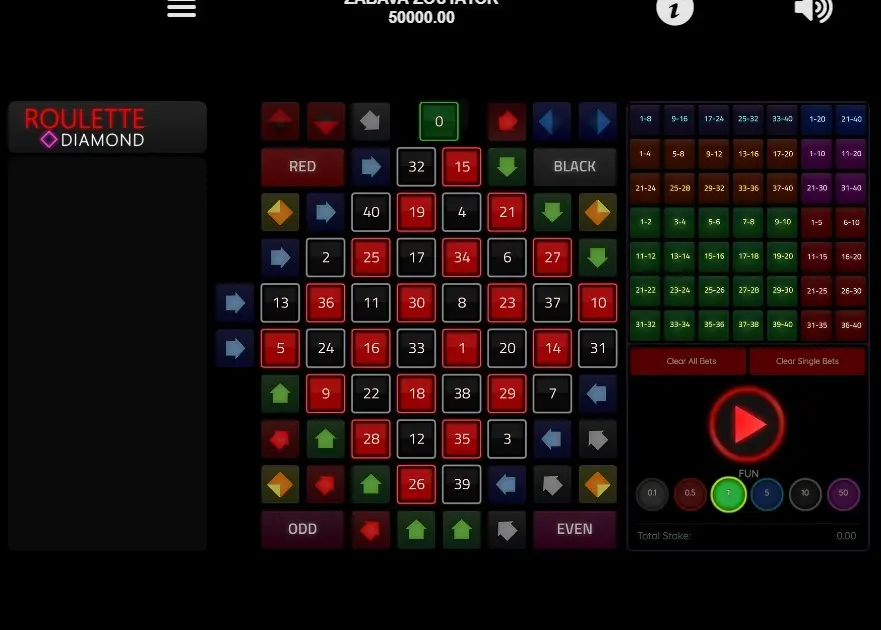
Roulette Diamond is worth a close look before you wager real money. The listed return-to-player figure of 97.56% is the single most useful number on this page, because it tells you which wheel you are probably facing: a single-zero European layout, where the house edge sits at 2.70% on every standard bet. That figure is slightly above the site-wide average of 96.97% across the roulette games we track, which puts this table on the better side of the field. The catch is that the name itself does not confirm the rules, so your first job is to open the game’s own rules screen and verify the pocket count before you trust any payout table.
This is a free-demo review, and the demo is available right now, no download and no sign-up required. That is exactly how you should approach a table whose RTP depends on rules you have not yet confirmed: spin the demo, read the paytable, and only then decide whether real-money play is worth it.
Is Roulette Diamond worth your spins?
Yes, with one condition attached. A 97.56% RTP is a strong starting point — it is 0.59 percentage points above our corpus average of 96.97%, and it is the figure 1X2 Gaming lists for this table. On a single-zero wheel, that RTP corresponds to the standard 2.70% house edge, which is the benchmark every serious roulette player should measure a table against. The condition is that you confirm the wheel type yourself. The name “Roulette Diamond” carries no explicit “European” or “French” marker, and while the RTP strongly implies a 37-pocket wheel, a double-zero American layout with 5.26% edge would be a very different game at the same name.
What you are getting here is a clean, conventional roulette presentation from a provider with a modest single-game footprint in our catalogue. There are no multipliers, no side bets and no Lightning-style gimmicks in the facts we hold, which means the game’s expected value should be readable straight from the classic payout table. That is a virtue: fewer moving parts means fewer places for the house to hide extra edge.
1X2 Gaming and this wheel
1X2 Gaming is the provider behind Roulette Diamond, and in our tracked catalogue this is their single roulette entry — a provider_game_count of 1. That matters for a simple reason: you cannot judge the developer’s roulette style from a body of comparable tables, so you should treat this game on its own merits rather than assuming it plays like anything else they have made. The average RTP across their tracked games is 97.56%, which is identical to this table’s figure, so at least the provider is consistent in what they advertise.
If you want a direct comparison, the closest reference points in our database are other European-style tables. European Roulette (Red Tiger) lists a 97.3% RTP, and European Roulette Pro sits at the same 97.3% figure. Roulette Diamond’s 97.56% is fractionally higher on paper, though the difference of 0.26 percentage points is small enough that you should weigh it against how each game actually behaves in demo play rather than treating the numbers as a decisive ranking.
House edge: 2.70%, 5.26% or 1.35%?
These three figures are the whole story of roulette fairness, and which one applies to Roulette Diamond depends entirely on the wheel it uses. A single-zero European wheel has 37 pockets and a house edge of 2.70% on every standard bet. A double-zero American wheel has 38 pockets and a house edge of 5.26% on every standard bet except the five-number basket, which jumps to 7.89%. French rules — La Partage or En Prison — return half your stake on even-money bets when zero lands, cutting that even-money edge to about 1.35%, the best standard bet in the game.
The 97.56% RTP listed for Roulette Diamond points squarely at the 2.70% European figure. A 5.26% American edge would advertise roughly 94.74% RTP, and a French-rules table would typically show a higher blended number because of the half-stake returns. So the math points one way, but the name does not confirm it. Treat the 2.70% edge as a strong probability, not a stated fact, and verify the wheel type on the game’s own rules screen before betting real money. If it turns out to be American, every bet you make carries roughly twice the edge.
Bet types, payouts and true odds
Roulette’s bet structure is identical across every classic wheel, and the table below shows the standard payouts and true odds for a single-zero European layout — the wheel type this game’s RTP points to. Inside bets change the shape of variance, not the expected value: a straight-up number pays 35:1 against true odds of 36:1, and that single-pocket gap is the entire house edge. Outside bets pay less but hit more often, which suits a different temperament, not a different expected return.
| Bet type | Payout | True odds (European) | House edge |
|---|---|---|---|
| Straight-up (single number) | 35:1 | 36:1 | 2.70% |
| Split (two numbers) | 17:1 | 17.5:1 | 2.70% |
| Street (three numbers) | 11:1 | 11.33:1 | 2.70% |
| Corner (four numbers) | 8:1 | 8.25:1 | 2.70% |
| Six line (six numbers) | 5:1 | 5.17:1 | 2.70% |
| Column / Dozen | 2:1 | 2.08:1 | 2.70% |
| Even-money (red/black, odd/even, high/low) | 1:1 | 1.01:1 | 2.70% |
Every row carries the same 2.70% edge on a European wheel. The only way to change that number is to change the wheel — French rules for even-money bets, or a double-zero layout for everything. If Roulette Diamond’s rules screen confirms French rules, the even-money bets become the best deal on the table at roughly 1.35%.
What experienced players actually do
Experienced players understand that no betting system changes the mathematics. Martingale, Fibonacci, D’Alembert, “wait for five reds” — none of these alter expected value, because spins are independent and the wheel has no memory. Progressions merely redistribute variance and accelerate your path to the table limit when a losing streak runs long. A system that doubles your stake after every loss looks protective until a run of eight or ten losses empties your session budget in a handful of spins.
What experienced players actually do is flat stake: bet the same amount on every spin, set a session loss limit before you start, and pick the lowest-edge bet available. On a confirmed European wheel, that means any standard bet at 2.70% edge, or the even-money bets at 1.35% if French rules apply. They also treat variance honestly — a straight-up number can pay 35:1 but will lose 36 times out of 37 on average, and no pattern of previous results makes the next spin more predictable. The wheel does not know what happened before.
Free play before real money
The free demo for Roulette Diamond is available right now, with no download and no registration required. This is the correct way to test the table: confirm the wheel type on the rules screen, check that the payout table matches what you expect from a European layout, and get a feel for the game’s pace and interface without risking a cent. You can also use the demo to compare it directly against French Roulette (NetEnt), another 97.3% table in our catalogue that may offer the 1.35% even-money edge if its French rules are confirmed.
One honest caveat: demo play tells you how the game feels and whether the rules match the advertising, but it does not predict real-money results. The RNG behaves the same way, yet the emotional weight of real stakes changes how most people bet. Use the demo to verify the mechanics, not to build confidence in a winning streak.
Roulette is entertainment, not income. Play only with money you can afford to lose, set a budget before you start and stick to it, and walk away when the session limit hits. If gambling stops being fun, take a break. 18+.
Final take
Roulette Diamond is a solid, conventional European-style table with a listed RTP of 97.56%, slightly above the site average and a hair better than comparable 97.3% tables in our catalogue. Its one weakness is the unconfirmed wheel type: the name does not say “European” or “French,” so the 2.70% edge is a strong inference, not a stated fact. Verify it on the rules screen, then decide.
Play the free demo first, check the paytable, and if the wheel is confirmed single-zero, this is a table worth your real-money spins — provided you flat stake, set a session limit and skip any system that promises to beat the maths. None of them do.
Frequently Asked Questions
Can I play Roulette Diamond for free?
Yes. The free demo is available right now with no download and no registration required. Use it to confirm the wheel type on the rules screen and check the payout table before you consider staking real money on the game.
What is the RTP of Roulette Diamond?
1X2 Gaming lists Roulette Diamond at 97.56% RTP, which is 0.59 percentage points above our corpus average of 96.97%. This figure points to a single-zero European wheel with a 2.70% house edge, but confirm the wheel type on the game's own rules screen.
Which wheel is this, and what is the house edge?
The 97.56% RTP strongly implies a European single-zero wheel with a 2.70% house edge on every standard bet. A double-zero American layout would show roughly 94.74% RTP. The name alone does not confirm the wheel, so verify the pocket count before playing for real money.
Does any betting system work on this table?
No. Martingale, Fibonacci and every other progression change variance, not expected value. Spins are independent and the wheel has no memory, so no pattern of previous results predicts the next spin. Flat staking with a session loss limit is the only sensible approach.
How does Roulette Diamond compare to other roulette tables?
Its 97.56% RTP is slightly higher than European Roulette (Red Tiger) and European Roulette Pro, both at 97.3%. The 0.26 percentage point difference is minor, so weigh it against how each game behaves in demo play rather than treating the numbers as decisive.




