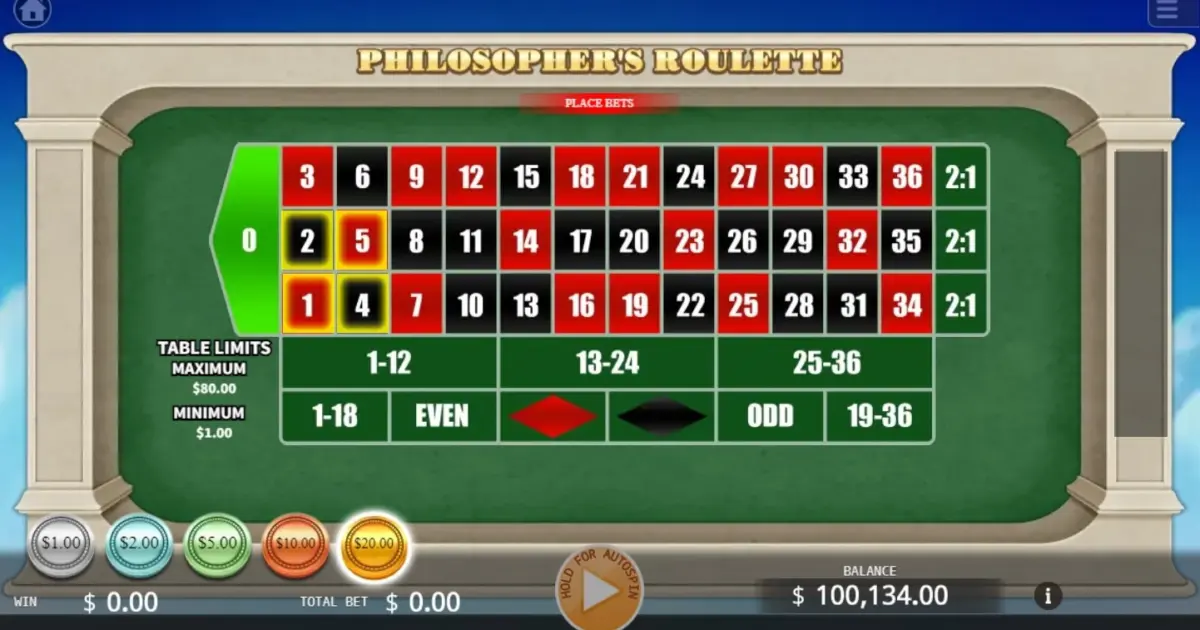
Philosopher’s Roulette by Ka Gaming is a roulette variant that demands caution: at a reported 90.0% RTP, it sits roughly 6–7 percentage points below the European standard and well below the corpus average for online roulette. If you are evaluating whether to spin here or pick a different table, that single number is the most important thing to understand, and the rest of this review explains why.
How Philosopher’s Roulette plays
Based on the available facts, Ka Gaming has not disclosed the exact pocket configuration, wheel type, or rule set for Philosopher’s Roulette. The name and the provider’s catalogue suggest it may follow a European single-zero layout, but that is an inference, not a confirmed specification. Without explicit confirmation of the wheel format, you cannot assign a reliable house-edge figure to any individual bet type — which is a problem when you are comparing this table against alternatives like European Roulette (KA Gaming), which reports an RTP of 96.0%.
The gameplay itself, from what is listed, appears to be a straightforward roulette format — no multipliers, no side bets, and no special features are documented in the facts. If Ka Gaming has added bonus mechanics, modifier rounds, or unique call bets, those details are not available in the data we have. Always open the game’s own rules or paytable screen before wagering real money, because the specifics of how Philosopher’s Roulette handles zero, whether any La Partage or En Prison rule applies, and what the minimum and maximum bets are will directly determine your expected loss per spin.
| Provider | Ka Gaming |
|---|---|
| RTP | 90.0% |
| Free demo | Yes |
The pocket count is the whole story
In roulette, every decision about odds, edge, and expected value flows from one thing: how many pockets the wheel has. A single-zero European wheel has 37 pockets, producing a house edge of 2.70% on standard bets. A double-zero American wheel has 38 pockets, pushing the edge to 5.26%. That gap — one extra pocket — is the difference between a reasonable table game and a poor one.
The problem with Philosopher’s Roulette is that the pocket count is not disclosed in the available facts. At a 90.0% RTP, the implied house edge is 10.0%, which is roughly four times the European standard and nearly double the American rate. That is an unusually steep figure for a game labelled as roulette, and it raises the question of whether the wheel uses additional zero pockets, a restricted paytable, or rule modifications that reduce returns on certain bet types. Without the pocket breakdown, you cannot calculate the true odds on any specific bet — and without that calculation, you are choosing bets blind. The universal rule of roulette maths still applies: on any given wheel, a straight-up number bet pays 35:1 against true odds of (pocket count minus one) to one, and the difference between those two numbers is the house edge. But whether that edge is 2.70%, 5.26%, or 10.0% depends entirely on what is behind the glass.
Reading the 90.0% figure
The RTP — return to player — is the percentage of all wagered money the game is expected to pay back over a statistically large number of spins. At 90.0%, Philosopher’s Roulette returns 90 cents for every dollar wagered, on average, over millions of spins. The remaining 10 cents is the house edge, and it is baked into every single bet on the table regardless of how you structure your play.
To put that in context: the corpus average for online roulette sits around 96.97%, and Ka Gaming’s own average RTP across its portfolio is approximately 93.0%. Philosopher’s Roulette falls below both benchmarks. Over 1,000 spins at a $5 average bet, a 90% RTP game costs you $500 in expected losses, while a 96% game costs $200 — the same session, three times cheaper. That gap compounds across sessions. It is not theoretical: it is the mathematical certainty that this table takes more from each dollar than most alternatives. If you choose to play Philosopher’s Roulette, you should do so with the clear understanding that its RTP is objectively low compared to nearly every other roulette option available online.
Choosing bets for the session you want
No bet on any roulette wheel changes the house edge — that stays fixed for a given wheel configuration. What changes is the variance profile, which is the shape of your session. Outside bets like red/black, odd/even, and high/low produce long, grinding sessions with small swings. Inside bets like straight-up numbers and splits produce wild swings with the possibility of large single-spin wins or rapid losses.
On Philosopher’s Roulette, you are making that choice inside a 90.0% RTP framework, meaning every bet type is carrying an unusually heavy house edge. If the wheel is European-format (37 pockets), a straight-up bet pays 35:1 against true odds of 36:1, and a colour bet pays 1:1 against true odds of roughly 1.056:1. The maths is the same on every bet — the edge is the same — but the experience is very different. If you want to maximise time at the table, outside bets stretch your bankroll. If you want a shot at a big win relative to your stake, inside bets are the only option, but the 10% implied edge makes that expensive per spin. For comparison, European Roulette (Red Tiger) offers a 97.3% RTP — meaning the same bet structure on that table costs you less than half as much per spin in expected losses.
Martingale and friends: the honest answer
No betting system changes the expected value of a roulette bet. This is not opinion — it is arithmetic. The Martingale system doubles your bet after each loss, aiming to recover all previous losses plus one unit on the next win. On paper, it looks airtight: you must eventually win, right? In practice, you hit the table limit, your bankroll runs out, or a losing streak of eight or more spins wipes you out completely.
On Philosopher’s Roulette, the Martingale is especially dangerous because the 10.0% implied house edge accelerates losses compared to a standard 2.70% European table. Every losing streak costs more, every recovery bet is larger, and the table limit approaches faster. The same is true of Fibonacci, D’Alembert, and flat-bet progressions — they redistribute variance, they do not reduce it, and they do not touch the underlying edge. A sequence of past results on an RNG wheel has zero predictive power. Red is not “due” after five blacks. The wheel has no memory. If you enjoy the rhythm of a progression for entertainment purposes only, that is a personal choice, but understand it is a choice that costs exactly the same expected value as flat betting — or more, if the system tempts you into larger bets.
Bankroll and table limits
Set a fixed budget before you open Philosopher’s Roulette, and treat it as the cost of entertainment, not an investment. A sensible bankroll for any roulette session covers at least 100 spins at your chosen bet size — fewer than that and normal variance will end your session before you have had a fair sample of the game. On a 90.0% RTP table, that bankroll depletes faster than it would on a 96% or 97% table, so plan accordingly: either reduce your average bet, or reduce your session length, or both.
Table limits matter here because they cap the effectiveness of any progression system and define how long a bankroll can last. Ka Gaming has not disclosed the minimum and maximum bets for Philosopher’s Roulette in the available facts — check the game’s interface for those figures before committing. If you are playing the free demo, use it to understand the bet range and how quickly your balance moves.
Play only with money you can afford to lose, set a firm loss limit before each session, and stop when you reach it. Roulette is entertainment, not income. If gambling stops being fun, step away — resources like GamCare and BeGambleAware are available 24/7. You must be 18 or older to play.
Verdict on Philosopher’s Roulette
Philosopher’s Roulette is a Ka Gaming title with a 90.0% RTP — a figure that places it among the lower-returning roulette games available online. The wheel configuration, rule set, and bet limits are not disclosed in the available facts, which means you cannot verify the edge on any specific bet type until you open the game’s own rules screen. That lack of transparency, combined with the low RTP, makes this a hard table to recommend when alternatives exist.
If you want to explore what Ka Gaming does with roulette, their European Roulette variant offers a 96.0% RTP — a materially better return for essentially the same game format. For the best standard roulette odds online, European Roulette Pro from the broader market delivers 97.3% RTP. Philosopher’s Roulette may appeal if you are curious about the theme or simply want to try every variant, but the maths here is not in your favour relative to the field.
Frequently Asked Questions
Is Philosopher's Roulette available as a free demo?
Yes, Philosopher's Roulette has a free demo available, so you can try the game without downloading anything or risking real money. Use the demo to check the wheel layout, bet limits, and how the RTP feels over a session before deciding whether to play for real.
What is the RTP of Philosopher's Roulette?
The reported RTP of Philosopher's Roulette is 90.0%, which is significantly below the online roulette corpus average of approximately 96.97%. That means the game returns less per dollar wagered than most competing roulette tables.
What is the house edge on Philosopher's Roulette?
At a 90.0% RTP, the implied house edge is 10.0%, assuming standard roulette rules. The exact edge on individual bet types depends on the wheel configuration, which Ka Gaming has not disclosed in the available facts — confirm it on the game's own rules screen.
Does the Martingale system work on Philosopher's Roulette?
No. No betting system changes the expected value of any roulette bet, and the Martingale is especially risky on Philosopher's Roulette because the 10.0% implied house edge accelerates losses during losing streaks, and the table limit will eventually block your next doubling bet.
How does Philosopher's Roulette compare to European Roulette by KA Gaming?
European Roulette by KA Gaming reports a 96.0% RTP, which is 6 percentage points higher than Philosopher's Roulette's 90.0%. That gap means European Roulette costs roughly three-fifths less in expected losses per dollar wagered over the same number of spins.




