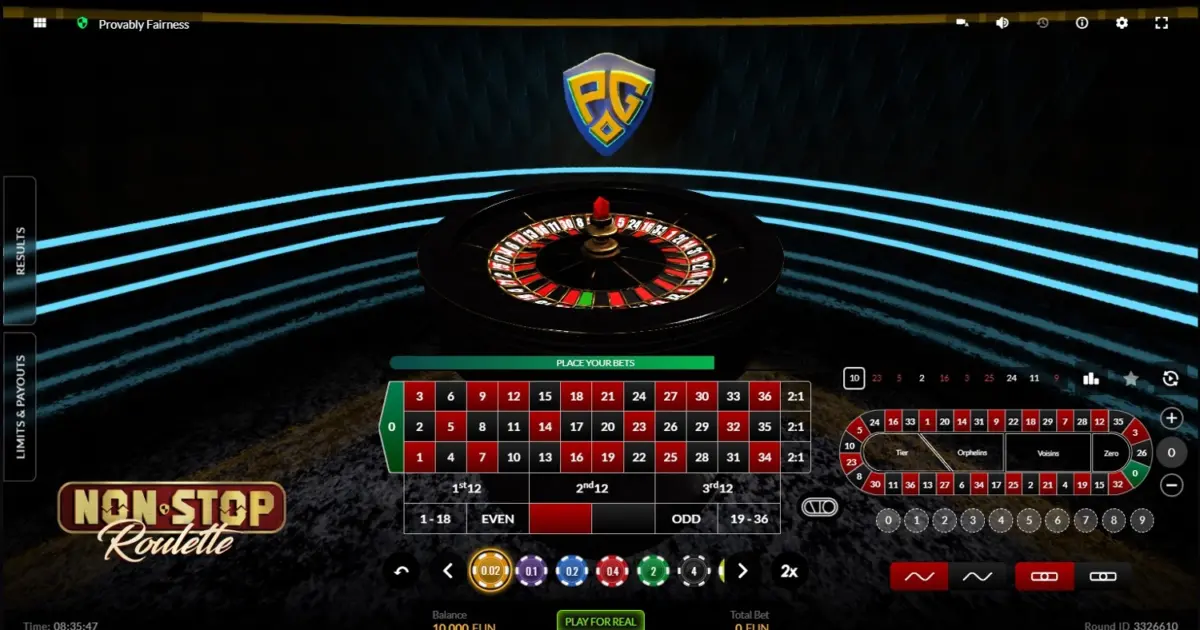
Non-stop roulette is a name that promises pace, and the one number worth starting with is the published RTP: 97.3%. That figure matches what a single-zero wheel returns on standard bets, but the game data available here does not confirm the pocket count, the presence of French rules, or the table limits. The demo is free to open, so the fastest way to settle those questions is to read the game’s own rules screen for two minutes before you commit money.
Non-Stop Roulette at a glance
Here is everything that is actually confirmed about this table, and nothing beyond it.
- Provider: Pascal Gaming. This is the only Pascal Gaming roulette listed in this corpus, so there is no sibling table to compare its behaviour against.
- RTP: 97.3%, which sits 0.33 percentage points above the 96.97% average across the roulette games catalogued here.
- Category: roulette.
- Free demo: available, no deposit and no download required.
- Popularity: ranked 210th, in the 6.3rd percentile of traffic. This is a quiet table, not a headline release.
What is not in the data matters just as much. There is no confirmed pocket count, no confirmed La Partage or En Prison rule, no listed minimum or maximum stake, no racetrack or call-bet information, no side bets and no release date. None of those absences make the game bad. They do mean you should treat the rules screen as mandatory reading rather than optional. Table limits in particular decide whether a betting plan survives a losing run, and you cannot see them from a review page.
Which wheel is this, and what it costs you
The title gives no wheel hint at all. “Non-Stop” describes tempo, not geography, so the layout has to be read in-game. That is unusual: most roulette titles signal the variant in the name. Here you get nothing, and guessing is expensive.
The three families and their fixed costs:
- Single-zero (European), 37 pockets: 2.70% house edge on every standard bet. A straight number pays 35:1 against true odds of 36:1, and that one-pocket gap is the whole edge.
- Double-zero (American), 38 pockets: 5.26% on every standard bet, and 7.89% on the five-number basket bet. Almost twice the cost of a European wheel for identical gameplay.
- French rules, 37 pockets plus La Partage or En Prison: about 1.35% on even-money bets, because half your stake comes back when zero lands. This is the best standard bet available anywhere in roulette.
A 97.3% published RTP is consistent with single-zero maths, since 100% minus 2.70% is 97.3%. That is suggestive, not proof, and it is not the same as the game telling you so. Confirm the pocket count on the rules screen before betting real money. If you want a table where the wheel type is settled by the title, European Roulette Pro states it outright at the same 97.3% RTP.
What a 97.3% RTP means per spin
RTP is a long-run average, calculated across millions of spins, and it describes the game rather than your session. At 97.3%, the theoretical cost is 2.7 units for every 100 units wagered. Bet 1 unit per spin for 100 spins and the expected loss is 2.7 units.
Two things people misread. First, the figure applies to turnover, not to deposits. Stake 1 unit a hundred times and you have wagered 100 units, even if you only ever put 20 in your balance. Fast tables raise turnover per hour, which raises expected cost per hour without changing the percentage. A game called Non-Stop Roulette invites exactly that, so pay attention to spins per hour, not just stake size.
Second, on a standard roulette wheel the RTP is identical across bet types. A straight-up number and a red/black bet return the same 97.3% in theory. What changes is variance: the straight number wins about 1 spin in 37 and pays 35:1, while red pays 1:1 and lands close to half the time. Same expected value, wildly different distribution of outcomes. Short sessions swing far from the average in both directions, which is exactly why no single session tells you anything about the RTP.
Inside versus outside bets
The table below uses single-zero figures, the family this game’s 97.3% RTP is consistent with. If the rules screen shows a double zero, every edge in the last column becomes 5.26% instead.
| Bet | Pockets covered | Payout | True odds | House edge |
|---|---|---|---|---|
| Straight up | 1 | 35:1 | 36:1 | 2.70% |
| Split | 2 | 17:1 | 17.5:1 | 2.70% |
| Street | 3 | 11:1 | 11.33:1 | 2.70% |
| Corner | 4 | 8:1 | 8.25:1 | 2.70% |
| Six line | 6 | 5:1 | 5.17:1 | 2.70% |
| Column or dozen | 12 | 2:1 | 2.08:1 | 2.70% |
| Red/black, odd/even, high/low | 18 | 1:1 | 1.06:1 | 2.70% |
The pattern is the point: every row carries the same edge. Inside bets are not worse value than outside bets, they are simply louder. Choose by how much swing you want per hour, not by chasing a better number, because there isn’t one. The only genuine improvement available is La Partage on even-money bets, which is why French Roulette (NetEnt) is worth a look if red/black is your main bet.
Why no betting system changes the maths
If you arrived here looking for a system, the useful answer is blunt: none of them work, and that includes the ones with impressive names. Martingale, Fibonacci, D’Alembert, Labouchere, waiting for five reds before backing black — every one of them leaves expected value untouched.
The reason is structural. Spins are independent events. An RNG wheel has no memory of the previous result, so the probability of red on the next spin is the same whether the last eight were red or black. No number, colour or sector is ever due, and tracking history gives you no predictive information whatsoever.
What progressions actually do is reshape the distribution of outcomes. Martingale converts many small wins into a rare, very large loss, and it collides with two hard walls: your balance and the table maximum. Eight consecutive losses on an even-money bet is roughly a 1-in-300 sequence over a session, and it demands a 256-unit stake to continue. Hit the ceiling and the recovery plan is finished. Flat betting keeps the same 2.7% expected cost with far gentler swings, which is why it is the honest default.
Playing the Non-Stop Roulette demo
The Non-Stop Roulette free demo is available with no download and no registration, and it is the practical way to answer the questions this data leaves open. In the first minute, check four things: how many zero pockets are on the wheel, whether even-money bets get half back on zero, what the minimum and maximum stakes are, and whether a racetrack for call bets exists. All four affect real-money decisions and none are confirmed here.
Use the demo to test comfort with pace too. A fast table can quadruple your spins per hour, and expected cost scales directly with turnover.
Demo results predict nothing about real-money sessions. A hot run in play money is variance, not a signal. Roulette is entertainment, not income, and the maths guarantees a long-run loss on every standard bet. Play only if you are 18 or over, set a budget before you open the game, treat it as spent the moment you sit down, and stop when it is gone rather than topping up. If it stops being fun, close the tab.
Verdict
The published 97.3% RTP is competitive, sitting just above the 96.97% corpus average, and it is consistent with single-zero maths. That is the strongest thing on the page and it is a fair reason to open the table.
The weakness is disclosure. No confirmed pocket count, no confirmed French rules, no limits and no side-bet detail means you are relying on the rules screen for everything that determines cost. If it turns out to be a double-zero layout, the honest edge is 5.26% regardless of what the RTP line suggests, and you should walk. Pascal Gaming has a single roulette in this catalogue, so there is no track record here to lean on either.
Play the demo, confirm the wheel, and if even-money bets are your habit, compare it against a table with La Partage, where the edge drops to around 1.35%. For a straightforward single-zero benchmark at the same RTP, European Roulette (Red Tiger) is the easier comparison.
Frequently Asked Questions
Can I play Non-Stop Roulette for free?
Yes. A free demo is available with no download and no registration, so you can load the table and place play-money bets immediately. Use it to check the pocket count, the stake limits and whether zero returns half on even-money bets, since none of those details are confirmed outside the game itself.
What is the Non-Stop Roulette RTP?
The published RTP is 97.3%, which is 0.33 percentage points above the 96.97% average across the roulette tables catalogued here. That means a theoretical cost of 2.7 units per 100 units wagered over the long run. It describes turnover across millions of spins, not what happens in your session.
Which wheel does Non-Stop Roulette use, and what is the house edge?
The game data does not confirm the pocket count, and the title gives no hint. A 97.3% RTP is consistent with a single-zero wheel at 2.70%, but a double-zero layout would cost 5.26% on standard bets. Check the rules screen before staking real money.
Does the Martingale system work on this table?
No. Spins are independent, the wheel has no memory, and no progression changes expected value. Martingale trades many small wins for rare large losses and stalls once you hit the table maximum or your balance limit. Eight straight even-money losses already require a 256-unit stake to continue.
How does it compare to European Roulette Pro?
Both publish a 97.3% RTP, so the theoretical cost per unit wagered is the same. The difference is transparency: European Roulette Pro names its wheel in the title, while this table leaves the layout to the rules screen. If you want the variant settled before you sit down, the named option is simpler.




