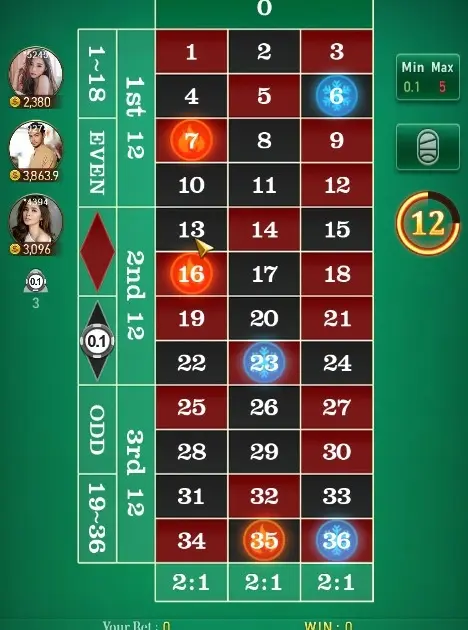
European Roulette (TaDa Gaming) sits in the 90th popularity percentile despite coming from a provider with just one roulette title in its catalogue. That narrow focus can mean a clean execution of the fundamentals, or it can mean limited features compared to studios that iterate across dozens of tables. The name signals a single-zero wheel, which normally means a 2.70% house edge—the standard for European roulette—but TaDa Gaming has not published confirmed RTP figures for this table, so you must check the game’s own paytable and rules screen before betting real money.
What kind of roulette is European Roulette (TaDa Gaming)?
The title indicates a European-format wheel: 37 pockets numbered 0 through 36, with the zero coloured green and the numbers 1–36 alternating red and black. A single-zero wheel gives every standard bet—whether inside or outside—a house edge of 2.70%, calculated as 1 divided by 37. That is the lowest edge available in classic roulette, nearly half the 5.26% you face on an American double-zero wheel.
TaDa Gaming has one roulette game in its portfolio, so there is no sibling variant to compare feature sets or interface choices. The provider is known for slots and other table games, but detailed RTP certification and paytable screenshots for this specific table are not widely published. That absence is unusual but not disqualifying; it simply means you carry the responsibility to verify the figures in-game. A European wheel that pays 35:1 on a straight-up bet and follows the standard payout ladder will deliver the expected 2.70% edge. If the paytable deviates—for example, reducing the straight-up payout to fund a multiplier feature—the effective RTP changes, and you need that number before you stake real money.
Return to player and house edge
No confirmed RTP figure for European Roulette (TaDa Gaming) appears in the facts available for this review. On a true European wheel with standard payouts, RTP is 97.30% and the house edge is 2.70% on every bet except those covered by French rules. If this table offered La Partage or En Prison—rules that return half your stake when zero lands on an even-money bet—the RTP on red, black, odd, even, high and low would climb to approximately 98.65%, and the house edge on those bets would fall to 1.35%. French rules are the single best deal in non-live roulette.
The corpus average RTP across all roulette games in the comparison set is 96.97%, a figure that includes American double-zero wheels and multiplier variants with reduced base payouts. A standard European wheel at 97.30% beats that average. The popularity percentile of 90.6 suggests players are finding the table, but popularity does not confirm RTP; it reflects traffic, interface appeal and placement on casino homepages. Always read the game’s rules screen for the certified return-to-player percentage and the paytable before you commit a stake.
Reading the TaDa Gaming paytable before you bet
Every roulette game is required to display its paytable, usually accessible via an information or settings icon. For European Roulette (TaDa Gaming), you should confirm three things before your first spin: the number of zero pockets, the straight-up payout, and whether any French rules apply. A 37-pocket wheel with a 35:1 straight-up payout and no special zero rules delivers the classic 2.70% edge. Any deviation from that structure changes the RTP.
Check whether the table offers call bets or a racetrack overlay for series like Voisins du Zéro, Tiers du Cylindre and Orphelins. These are not separate bet types; they are shortcut interfaces that place multiple chips in a single click, covering contiguous segments of the physical wheel. Call bets do not alter the house edge, but they do change the variance profile of your session because each spin covers more numbers at a higher total stake.
Table limits matter as much as the paytable. The minimum and maximum stakes determine how many spins your budget can survive and whether a progression system will hit the ceiling before you recover a loss. TaDa Gaming has not published limits for this table, so you will find them only when you load the game. If you plan to use a Martingale or Fibonacci progression, write down the minimum bet and the maximum, then calculate how many consecutive losses it takes to hit the cap. That number is usually smaller than intuition suggests, and when you reach it, no further doubling can recover the deficit.
Bet coverage, variance and session length
Roulette lets you choose between high-frequency, low-variance bets and low-frequency, high-variance bets, all carrying the same house edge on a European wheel. The table below shows the standard European roulette bet types, their payouts, the true odds against you, and the house contribution built into every line.
| Bet type | Coverage | Payout | True odds | House edge |
|---|---|---|---|---|
| Straight up | 1 number | 35:1 | 36:1 | 2.70% |
| Split | 2 numbers | 17:1 | 17.5:1 | 2.70% |
| Street | 3 numbers | 11:1 | 11.33:1 | 2.70% |
| Corner | 4 numbers | 8:1 | 8.25:1 | 2.70% |
| Line | 6 numbers | 5:1 | 5.17:1 | 2.70% |
| Dozen / Column | 12 numbers | 2:1 | 2.08:1 | 2.70% |
| Red / Black / Odd / Even / High / Low | 18 numbers | 1:1 | 1.06:1 | 2.70% |
Covering more numbers smooths your balance curve but locks in more frequent house-edge deductions. A dozen bet hits roughly one spin in three, but every three wins are offset by 2.7 unit losses in expectation. A straight-up number hits roughly one spin in 37, and the single-pocket gap between the 35:1 payout and the 36:1 true odds is where the house edge lives. Variance is higher, so your balance swings harder, but expected value per spin is identical.
If your goal is session length, bet outside and accept frequent small losses punctuated by small wins. If your goal is a single large payout, bet inside and accept long stretches of losses. Neither strategy changes your expected loss per hundred spins; they only redistribute when and how that loss occurs. For a comparison of classic European roulette against other single-zero tables, try European Roulette (Red Tiger), which publishes a confirmed 97.3% RTP, or European Roulette Pro, which adds an extended statistics panel without altering the core mathematics.
Patterns, hot numbers and the gambler’s fallacy
Roulette runs on a random number generator that produces independent outcomes. Each spin has no memory of the previous ten, hundred or thousand spins. If red has landed eight times in a row, the probability of red on the ninth spin remains 18 in 37, exactly 48.65%, because the wheel does not know what happened before. The probability of black is also 48.65%, and the probability of zero is 1 in 37. The streak has no predictive power.
Many tables display a history grid showing recent results. That grid exists to satisfy player curiosity and to enable scoreboard-style engagement, not because past results influence future probabilities. Tracking hot or cold numbers, waiting for a colour to balance, or betting on a sector that has not hit recently are all expressions of the gambler’s fallacy—the mistaken belief that independent random events must even out in the short term. They do not. A number that has not appeared in 200 spins is not “due”; it has the same 1-in-37 chance on spin 201 as every other number.
Betting systems like Martingale, Fibonacci and D’Alembert attempt to recover losses by adjusting stake size after each outcome. These progressions do not change the house edge. Doubling after a loss increases the stake needed to recover the deficit and accelerates the approach to the table maximum. When you hit the limit mid-progression, you absorb the cumulative loss with no way to continue. The system does not beat the wheel; it redistributes variance and increases the risk of a single catastrophic session. If you enjoy the structure of a progression as entertainment, set a strict stop-loss in advance, but do not expect it to produce profit over time. For an alternative single-zero experience that adds French rules and cuts the even-money house edge to 1.35%, explore French Roulette (NetEnt).
Trying the demo
European Roulette (TaDa Gaming) offers a free demo, so you can test the interface, confirm the paytable, inspect the rules screen and measure the feel of the bet grid before opening a real-money session. Demo play uses the same RNG and the same rules as the cash version; the only difference is that wins and losses are notional. Use the demo to verify the straight-up payout, check for French rules, and explore whether call bets or a racetrack are available. Write down the table minimum and maximum if they are displayed.
Demo outcomes are independent random events, just like real-money spins, so a winning streak in practice mode tells you nothing about how the next real-money session will unfold. Similarly, a long losing run in demo play does not mean the game is “cold” or that you are due for wins when you switch to cash. Treat the demo as a venue for interface evaluation and rules confirmation, not as a rehearsal that predicts results.
If you decide to play for real money, set a budget in advance and treat it as the cost of entertainment, not an investment with expected returns. The house edge guarantees that over time, the casino keeps a percentage of total wagers. You may win in a single session, but no betting system or pattern eliminates the mathematical advantage. Roulette is for players aged 18 and over. If the game stops being fun, stop playing.
Verdict on European Roulette (TaDa Gaming)
TaDa Gaming’s sole roulette entry carries the European label and almost certainly delivers the standard 2.70% house edge across all bet types, but the absence of published, certified RTP figures is a gap that shifts verification responsibility to you. The free demo gives you the tools to confirm the pocket count, paytable and any special rules before you stake real money. A single-zero wheel at 2.70% is a solid baseline—better than any American double-zero table and equal to most European competitors—but it cannot match the 1.35% even-money edge available on French-rules tables.
The provider’s narrow focus on one roulette game suggests either a tight, no-frills execution or limited investment in variant features and interface polish compared to studios that maintain a portfolio of five or ten tables. Popularity is strong, sitting above 90% of the comparison set, which indicates player traffic and likely broad availability across casino lobbies. That reach matters if you want a straightforward European wheel without hunting through a provider’s back catalogue.
If French rules, confirmed high RTP and a proven track record are priorities, compare this table directly against the alternatives listed in this review. If you value simplicity, a free demo and a standard European layout, and you are willing to verify the paytable yourself, European Roulette (TaDa Gaming) offers a viable option. Just remember: the wheel has no memory, no system beats the house edge, and every spin is independent. Play for entertainment, not profit.
Frequently Asked Questions
Is there a free demo for European Roulette (TaDa Gaming)?
Yes, a free demo is available. Use it to confirm the paytable, verify the number of zero pockets, check for French rules like La Partage, and inspect table limits before playing for real money. Demo outcomes are random and do not predict real-money results.
What is the RTP and house edge for this table?
TaDa Gaming has not published a confirmed RTP figure for this table. The name suggests a single-zero European wheel, which normally delivers 97.30% RTP and a 2.70% house edge on all standard bets. Verify the straight-up payout and pocket count on the in-game rules screen before betting.
Does European Roulette (TaDa Gaming) offer French rules?
The facts available do not confirm whether La Partage or En Prison rules apply. French rules return half your stake on even-money bets when zero lands, cutting the house edge on those bets to 1.35%. Check the game's rules screen; if French rules are absent, the house edge remains 2.70% on every bet.
Can a betting system like Martingale beat the house edge?
No. Martingale, Fibonacci and similar progressions do not change expected value; they only redistribute variance and accelerate the approach to the table maximum. Spins are independent, the wheel has no memory, and doubling after a loss cannot overcome the mathematical edge built into every bet type.
How does this compare to European Roulette (Red Tiger)?
European Roulette (Red Tiger) publishes a confirmed 97.3% RTP, matching the standard European single-zero house edge of 2.70%. Red Tiger operates a larger roulette portfolio, so its interface and feature set may be more developed. Both tables offer the same mathematical foundation if TaDa Gaming's wheel is confirmed as single-zero with standard payouts.




