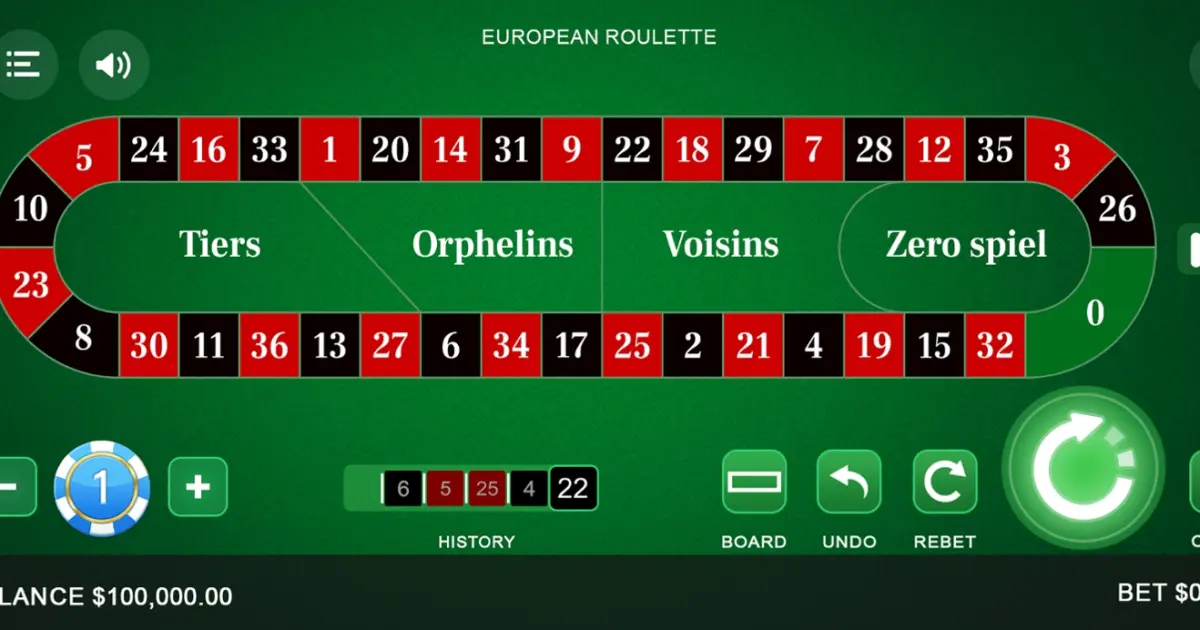
BeGames’ European Roulette lands exactly where the name promises: 97.3% RTP, which translates to a 2.70% house edge on every standard bet. That figure is the starting point for all single-zero roulette, and no betting pattern will move it. The question is whether this table offers anything beyond the baseline, or whether you should spend your time at a wheel with multipliers, French rules, or a stronger feature set.
The provider, BeGames, runs a two-game catalogue with an average RTP of 97.31%—slightly above the corpus average of 96.97%. This table sits at the 78.5th percentile for popularity, which suggests steady traffic without the brand weight of a Red Tiger or NetEnt release. Free demo play is available, so you can confirm the layout and speed before committing a bankroll.
How European Roulette (BeGames) plays
The wheel spins, the ball lands, and the payout follows the bet you placed. Inside bets—straight-up, split, street, corner, line—pay higher multiples but cover fewer pockets. Outside bets—red/black, odd/even, dozens, columns—pay lower multiples and cover more pockets. The structure is identical across every European table: 37 pockets numbered 0 through 36, with zero coloured green and the rest split evenly between red and black.
The layout accommodates all standard bet types. FACTS does not confirm whether this table includes a racetrack for call bets—neighbour wagers, tiers du cylindre, voisins du zéro, orphelins—so check the game’s own interface if you rely on those bets. The absence of detail here does not mean the feature is missing; it means you must verify it yourself before assuming it is present.
The pocket count is the whole story
A European wheel has 37 pockets. A straight-up bet on a single number pays 35:1. The true odds are 36:1. That single-pocket gap is the house edge, expressed across every bet on the table. A red/black bet wins 18 times out of 37 and loses 19 times, because zero is neither red nor black. The edge is 2.70% on every standard wager, regardless of how you distribute your chips.
An American wheel adds a second zero, raising the pocket count to 38 and the house edge to 5.26%. French rules—La Partage or En Prison—return half your stake on even-money bets when zero lands, cutting the edge on those bets to 1.35%, the best standard bet in the game. FACTS does not confirm whether this table applies French rules, so assume it does not unless the game’s rules screen states otherwise.
| Bet type | Payout | True odds (37 pockets) | House edge |
|---|---|---|---|
| Straight-up | 35:1 | 36:1 | 2.70% |
| Split | 17:1 | 17.5:1 | 2.70% |
| Street | 11:1 | 11.33:1 | 2.70% |
| Corner | 8:1 | 8.25:1 | 2.70% |
| Red/Black, Odd/Even | 1:1 | 1.056:1 | 2.70% |
| Dozen, Column | 2:1 | 2.08:1 | 2.70% |
Multiplier formats fund the boost by lowering the base
Lightning-style tables pay something other than 35:1 on base straight-up bets—often 29:1 or 30:1—and use the difference to fund multipliers on selected numbers. The effective RTP on straight bets differs from classic roulette, so read the paytable. This table’s name does not suggest a multiplier format, and FACTS does not list one, so treat this as a standard-payout wheel until the game proves otherwise. If you want a multiplier format from the same provider, Luxe Roulette Multipliers is the confirmed option.
Reading the 97.3% figure
RTP is the percentage of all wagers the game returns as winnings over a long sample. A 97.3% RTP means the house keeps 2.70% of every euro, pound, or dollar bet. That is the theoretical average; short sessions swing wide. You can win ten straight spins or lose twenty. The RTP describes what happens after tens of thousands of rounds, not what you see in an hour.
This RTP figure applies to every standard bet. The edge does not change whether you cover a single number or half the wheel. A straight-up bet carries higher variance—longer losing streaks punctuated by a 35:1 win—but the same 2.70% edge as a red/black wager. If FACTS had confirmed French rules, the even-money bets would carry a 1.35% edge and a 98.65% RTP. That is the only standard-rules deviation that changes the RTP on a European wheel.
Choosing bets for the session you want
Inside bets and outside bets do not differ in expected value; they differ in the shape of variance. A straight-up number hits once every 37 spins on average and pays 35:1 when it does. A red/black bet hits 18 times out of 37 and pays 1:1. Both lose 2.70% over time, but the straight-up bet produces longer stretches without a win, then delivers a payout large enough to recover many losses at once. The outside bet produces frequent small wins that bleed slowly against the edge.
If you want a short, volatile session with a chance at a balance spike, bet inside. If you want to extend play and smooth the ride, bet outside. Neither approach beats the house edge. The choice is about the experience, not the outcome.
Covering most of the wheel does not reduce risk
Placing chips on 32 numbers does not make the session safer. You win often, but you win less than you wagered across the layout, and the edge compounds on the total amount bet. Covering the board accelerates losses unless you hit the uncovered pockets disproportionately—a result indistinguishable from luck.
Martingale and friends: the honest answer
No progression system changes expected value. Martingale—doubling after every loss—does not beat the edge. Fibonacci, D’Alembert, and “wait for five reds then bet black” do not beat the edge. The spins are independent. The wheel has no memory. Previous results have no predictive value on an RNG table.
Martingale works until you hit a losing streak long enough to exceed the table limit or empty your bankroll. That streak will come. A sequence of eight losses on a near-even bet happens more often than intuition suggests, and the eighth double requires 128 units if you started at one. If the table caps bets at 100 units, the system fails. If your bankroll runs out first, the system fails. The house edge is still 2.70%, and you have amplified the risk without improving the return.
Progressions redistribute variance. They turn many small losses and occasional large losses into frequent small wins punctuated by a catastrophic loss that resets the account. If you enjoy the structure, play it in demo mode first and track the requirement over thirty or forty spins. The number grows faster than most players expect.
Bankroll and table limits
FACTS does not list the minimum or maximum bet for this table, so you must check the game’s own display before you sit. The minimum determines how many spins your bankroll can sustain; the maximum determines whether a progression system will hit the ceiling before recovering a streak. For a session of sixty spins on even-money bets, budget at least sixty times the minimum bet, and assume you will lose 2.70% of the total wagered if variance runs flat.
Set your budget before the first spin. Roulette is entertainment, not income. The house edge is a cost, the same way a concert ticket or a dinner out carries a cost. If you are playing to recover losses or fund something you cannot otherwise afford, the session has already failed. Only wager money you can lose without consequence, set a stop point in advance, and leave when you reach it. This is a game for adults who understand the price and choose to pay it anyway.
Demo play shows the interface, not your future results
Free demo mode lets you test the layout, speed, and bet controls without financial risk. It does not predict what will happen when you switch to real money. The RNG produces independent results regardless of mode, and a winning streak in demo play has zero bearing on the next session. Use the demo to confirm you like the interface and understand the bets, then treat the real-money session as an entirely separate event.
Verdict on European Roulette (BeGames)
This is a single-zero wheel with 97.3% RTP, which is the standard European figure and the second-best house edge in roulette after French-rules tables. BeGames does not add multipliers, side bets, or feature layers, so the result is a clean, by-the-book wheel that behaves exactly as the maths predicts. If you want that baseline with no elaboration, this table delivers it.
The absence of detail about table limits, racetrack availability, and French rules means you must verify those points in the game itself. If French rules were confirmed, the even-money edge would drop to 1.35%, and this would rank among the best standard wheels available. As it stands, the table is interchangeable with any other European wheel at 97.3%, which includes European Roulette (Red Tiger) and European Roulette Pro. The decision comes down to interface preference and whether the provider’s lobby is accessible from your region. The maths will not differ.
Frequently Asked Questions
Is there a free demo for European Roulette (BeGames)?
Yes, free demo play is available. Use it to test the interface, bet layout, and spin speed before committing a bankroll. Demo results do not predict real-money outcomes; the RNG produces independent results in every mode, so treat each session separately.
What is the RTP of European Roulette (BeGames)?
The RTP is 97.3%, which translates to a 2.70% house edge on every standard bet. That figure is the baseline for all single-zero European wheels, and it applies whether you bet inside, outside, or across the entire layout. No betting pattern changes it.
Does the Martingale system work on this table?
No. Martingale and all other progression systems leave the 2.70% house edge untouched. Doubling after losses redistributes variance but does not improve expected value. A long losing streak will eventually exceed the table limit or drain your bankroll, and that streak will come more often than intuition suggests.
Is this better than American roulette?
Yes. A European wheel has 37 pockets and a 2.70% house edge; an American wheel has 38 pockets and a 5.26% edge. The extra zero on the American wheel nearly doubles the cost of every bet. If both wheels are available, always choose the European or French variant unless the American table offers a feature worth paying double the edge for.
How does this compare to European Roulette (Red Tiger)?
Both tables run at 97.3% RTP with a 2.70% house edge on a single-zero wheel. The maths are identical. The difference is interface design, provider reputation, and lobby availability. Red Tiger carries more brand weight and a larger game catalogue; BeGames is a smaller provider with a two-game offering. Choose based on access and layout preference, not edge.




