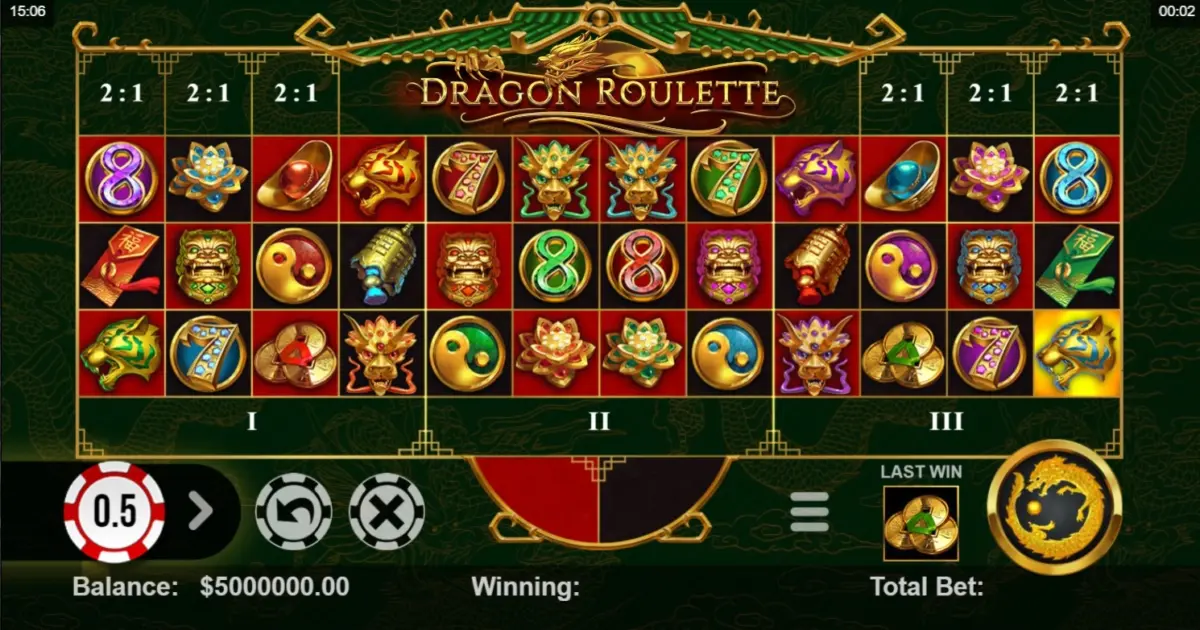
Dragon Roulette is worth a few minutes of your time if you play for entertainment and want a table whose published RTP sits a touch above the norm. At 97.4%, it beats the 96.97% average across the roulette games on this site, and the free demo is available right now, so you can check the rules screen and the feel of the table before you commit a single unit. What it is not, despite the name, is a way around the maths that governs every roulette wheel ever built. The sections below walk you through what is knowable, what is not, and how to read this game honestly.
Dragon Roulette at a glance
Dragon Roulette is a roulette title from Elysium Game Studio, and it is the only game from that provider listed in this catalogue — which means the provider’s average RTP of 97.4% is exactly this game’s figure. It sits at rank 216 of the roulette games tracked here, in the 3.6th popularity percentile, so it is not a table that most players are seeking out. That is neutral information, not a criticism: a niche table can still be a perfectly good one.
The distinguishing number is the RTP of 97.4%, which is 0.43 percentage points above the 96.97% corpus average. That is a real but small edge over the field. For context, the three related games this catalogue links against — European Roulette (Red Tiger) at 97.3%, European Roulette Pro at 97.3% and French Roulette (NetEnt) at 97.3% — all sit a hair lower. So on the published figure alone, Dragon Roulette is marginally ahead of each of them. The demo is free to play, and no download is required to open it.
Which wheel is this, and what it costs you
Here is the honest limit of what the catalogue tells us. The name “Dragon Roulette” points toward a single-zero family — that is, a European-style wheel with 37 pockets — but the name alone is not proof. You must confirm the pocket count on the game’s own rules screen before you bet real money, and the same goes for whether any French rules apply.
What you can lock in before you open the game is the cost structure of each wheel family. On a single-zero (European) wheel with 37 pockets, every standard bet carries a house edge of 2.70%. On a double-zero (American) wheel with 38 pockets, every standard bet carries a house edge of 5.26%, except the five-number basket bet, which is 7.89%. If the game uses French rules — La Partage or En Prison — half your stake is returned on even-money bets when zero lands, which cuts the even-money house edge to about 1.35%, the best standard bet in the game.
That range matters: whether this table costs you 2.70%, 5.26% or 1.35% per even-money spin is a difference of real money over hundreds of spins. Do not assume from the name. Open the demo, read the rules screen, and confirm the wheel type and any French rules for yourself.
What a 97.4% RTP means per spin
RTP is the long-run return over a very large number of spins, and it is the mirror image of the house edge. A 97.4% RTP means the house edge is 2.60%, which is slightly better than the 2.70% you would expect from a standard single-zero wheel. That gap is small but real, and it is the reason this table beats the 96.97% catalogue average.
Per spin, the number is not dramatic. On a €10 flat bet, a 2.60% house edge costs you about €0.26 per spin on average. That is the honest way to read it: not a promise of profit, but a slightly lower expected bleed than the average table on this site. Over 1,000 flat €10 spins, the expected loss is roughly €260, against about €270 on a standard 2.70%-edge wheel. The difference is €10 over a thousand spins — meaningful over the long run, invisible in any single session.
Two cautions. First, this figure is the publisher’s published RTP; verify it on the game’s information or paytable screen if you are staking real money, because a published figure can differ from the live configuration. Second, RTP describes the average over many spins, not your next ten. Short sessions can land anywhere.
Inside versus outside bets
Inside and outside bets change the shape of your variance, not your expected value. The house edge is the same on every standard bet on a given wheel, because the payout gap is proportional to the true odds. The table below shows the standard payouts and true odds on a single-zero (European) wheel — the most likely family for this title, to be confirmed in-game.
| Bet type | Payout | True odds (37 pockets) | House edge |
|---|---|---|---|
| Straight-up (single number) | 35:1 | 36:1 | 2.70% |
| Split (two numbers) | 17:1 | 17.5:1 | 2.70% |
| Street (three numbers) | 11:1 | 11.33:1 | 2.70% |
| Corner (four numbers) | 8:1 | 8.25:1 | 2.70% |
| Six line (six numbers) | 5:1 | 5.17:1 | 2.70% |
| Column / Dozen (12 numbers) | 2:1 | 2.08:1 | 2.70% |
| Even-money (red/black, odd/even, high/low) | 1:1 | 1.06:1 | 2.70% |
If the game turns out to be double-zero, every payout in that table stays the same but the true odds worsen, pushing the edge to 5.26% on all but the basket bet. If French rules apply, only the even-money row improves, to about 1.35%. So the single most useful thing you can do is confirm the wheel type, then decide whether you want frequent small wins (outside bets) or rare large ones (inside bets) — the cost per spin is the same either way.
Why no betting system changes the maths
No system changes the maths, and it is worth saying plainly because the internet is full of confident nonsense about it. Martingale, Fibonacci, D’Alembert, “wait for five reds then bet black” — none of them alters your expected value. Spins are independent. The wheel has no memory. A number, colour or sector is never “due”, “hot” or “cold”, and tracking previous results has no predictive value on an RNG wheel.
What progressions actually do is redistribute variance and accelerate table-limit risk. A Martingale — doubling after every loss — turns a run of losses into a steeply rising stake, and the moment you hit the table limit or run out of bankroll, the accumulated losses land in one hit. You are not fighting the house edge; you are borrowing variance from the future and paying for it with higher risk of a catastrophic single session.
The honest version: pick a bet you understand, stake an amount you can lose, and treat every spin as an independent event. The 97.4% RTP is the average the house edge allows over the long run — it is not a system waiting to be found.
Playing the Dragon Roulette demo
The free demo is available and requires no download — you can open it in your browser and play at your own pace. This is genuinely useful for two things. First, confirming the wheel type and any French rules on the rules screen, which resolves the biggest open question about this table. Second, getting a feel for the pace and the interface, so you know whether the table suits how you like to play.
What the demo cannot do is predict real-money results. Demo spins run on the same maths, but a short demo session tells you nothing about what you would win or lose at a real-money table — the two are not connected. Treat the demo as a way to learn the game, not as a rehearsal that forecasts outcomes.
If you do play for real money, the standard ground rules apply. You must be 18 or older. Set a budget in advance and do not exceed it. Treat the game as entertainment, not as income — the house edge is a certainty over time, and the only reliable way to keep it cheap is to decide your limit before you start.
Verdict
Dragon Roulette is a competent, slightly-above-average roulette table. The headline number is the 97.4% RTP, which beats the 96.97% catalogue average and each of the three related tables listed against it — European Roulette (Red Tiger), European Roulette Pro and French Roulette (NetEnt), all at 97.3%. If you want a comparable single-zero table with a similar published figure, European Roulette (Red Tiger) is a reasonable alternative to check.
The caveats are the usual ones. The wheel type is not confirmed by the name alone, so use the demo to verify it before staking. No betting system changes the maths, and the demo does not predict real-money results. If you want the lowest possible house edge on even-money bets, a French-rule table like French Roulette (NetEnt) is the one to compare against — its 1.35% even-money edge is the best standard bet in the game, if the rules screen confirms it. Dragon Roulette is worth a spin in demo form; just go in with the maths straight.
Frequently Asked Questions
Is there a Dragon Roulette free demo, and does it need a download?
Yes — the free demo is available and requires no download. You can open it directly in your browser. Use it to confirm the wheel type and any French rules on the game's rules screen, and to get a feel for the interface before you decide whether to stake real money.
What is the Dragon Roulette RTP figure?
The published RTP is 97.4%, which corresponds to a house edge of 2.60%. That is 0.43 percentage points above the 96.97% average across the roulette games in this catalogue. Verify the figure on the game's paytable screen before betting real money.
Which wheel is this, and what is the house edge?
The name points toward a single-zero (European) wheel with 37 pockets, but the name alone is not proof. On a single-zero wheel the edge is 2.70% on every standard bet; on a double-zero wheel it is 5.26%. Confirm the pocket count in-game before staking.
Does any betting system work on Dragon Roulette?
No. Martingale, Fibonacci and similar progressions do not change expected value, because spins are independent and the wheel has no memory. Progressions only redistribute variance and increase the risk of a large single loss when you hit the table limit or run out of bankroll.
Who makes Dragon Roulette, and how does it compare?
Dragon Roulette is from Elysium Game Studio, and it is the only game from that provider in this catalogue. At 97.4% RTP it sits slightly above European Roulette (Red Tiger) at 97.3%, European Roulette Pro at 97.3% and French Roulette (NetEnt) at 97.3%.




