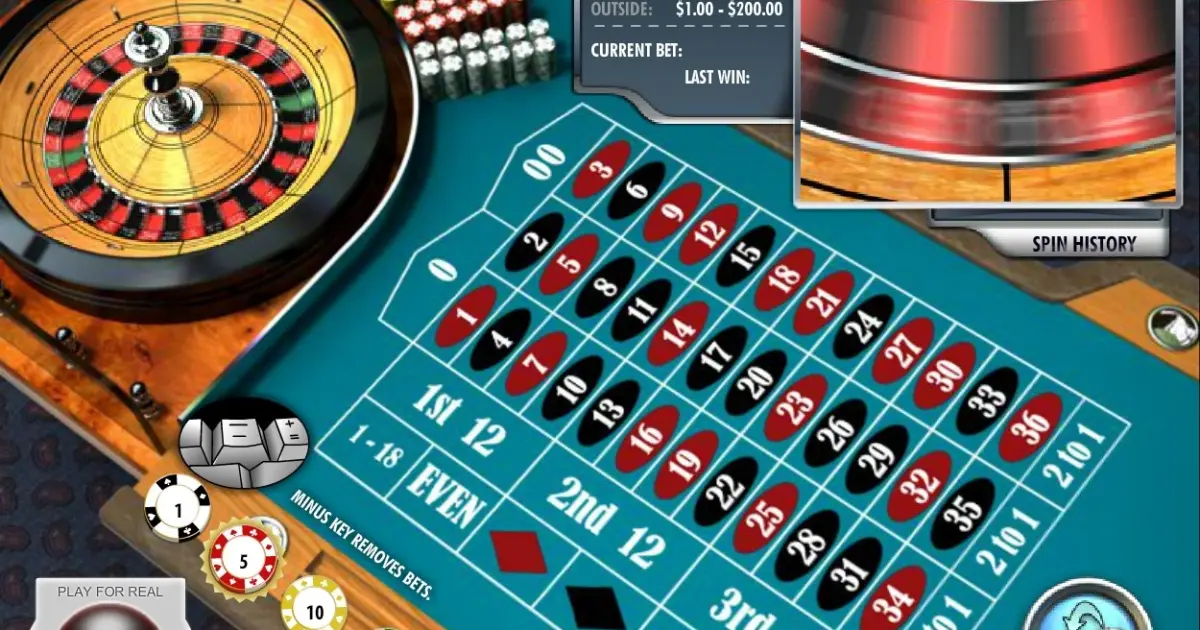
Is American Roulette (Rival) worth your time? That depends entirely on whether you value authenticity over mathematics. Rival has built a clean, no-frills double-zero wheel that returns exactly what the physics of 38 pockets dictate: nothing more. If you want the classic Las Vegas experience, this delivers it. If you want your money to stretch further, there are better options on this very site.
How American Roulette (Rival) plays
The format is the one you will recognise from any casino floor: a 38-pocket wheel carrying numbers 1 through 36 in alternating red and black, plus two separate zero pockets labelled 0 and 00. Rival has kept the presentation straightforward. You place chips on the felt layout, the ball is released, and the pocket it lands in determines every outcome. Inside bets cover individual numbers or small groups of two, three, four, five, or six. Outside bets cover colours, dozens, columns, high/low, and odd/even. The game is available as a free demo, so you can see the layout and spin mechanics before committing anything.
What distinguishes this from the European Roulette from the same provider is purely structural. One extra pocket changes the arithmetic for every single wager simultaneously.
The pocket count is the whole story
Every standard bet on American Roulette (Rival) faces 38 possible outcomes. The payouts, however, were set when the game carried only 37 pockets and nobody revised them. That gap is the house edge, and it applies uniformly across all bets except one.
On a European wheel with 37 pockets, a straight-up bet pays 35 to 1 against true odds of 36 to 1. The house keeps one pocket’s worth of edge: 2.70%. Add the 00 pocket, and the true odds shift to 37 to 1 while the payout stays at 35 to 1. The house edge climbs to 5.26%. This is not a marginal difference. Over ten thousand spins, that extra 2.56 percentage points compounds into a materially larger expected loss.
The one exception on this wheel is the five-number basket bet covering 0, 00, 1, 2, and 3. It pays 6 to 1 against true odds of approximately 7.6 to 1, producing a 7.89% house edge. This is the worst bet in roulette at any table, on any wheel, ever invented. Never place it.
Reading the 94.74% figure
The RTP of 94.74% is not a promotional number or a rounded estimate. It is the exact arithmetic complement of the 5.26% house edge that a 38-pocket wheel produces. For every $100 wagered across a session, the mathematical expectation is $94.74 returned. That single figure tells you everything about the table’s generosity: it is fixed, it is universal across all standard bets, and no sequence of outcomes can alter it.
Contextualising that number matters. The average RTP across all roulette games in this site’s catalogue sits around 96.97%, and Rival’s own portfolio averages 96.02%. This table falls approximately 2.23 percentage points below the site average, which is precisely the double-zero penalty expressed as a percentage. If you compare it to European Roulette (Red Tiger) at 97.3% RTP, the gap is 2.56 points — the cost of one extra pocket, measured in cents per dollar.
There are no French rules in play here. La Partage and En Prison return half your stake on even-money bets when zero lands, but they apply to single-zero wheels. Even if a table carried both rules on an American wheel — which no legitimate version does — the presence of 00 would still degrade the return.
Choosing bets for the session you want
The house edge on this table is 5.26% regardless of whether you bet a single number or a colour. What changes is variance, and variance shapes how your session feels.
| Bet type | Payout | True odds (38 pockets) | House edge |
|---|---|---|---|
| Straight up (1 number) | 35:1 | 37:1 | 5.26% |
| Split (2 numbers) | 17:1 | 18:1 | 5.26% |
| Street (3 numbers) | 11:1 | 35/3:1 | 5.26% |
| Corner (4 numbers) | 8:1 | 8.5:1 | 5.26% |
| Five-number basket | 6:1 | 33/5:1 | 7.89% |
| Line (6 numbers) | 5:1 | 16/3:1 | 5.26% |
| Dozen or Column (12) | 2:1 | 13/6:1 | 5.26% |
| Even money (red, odd, etc.) | 1:1 | 19/18:1 | 5.26% |
Inside bets produce long dry stretches punctuated by large wins. Outside bets grind steadily with frequent small resolutions. Neither choice makes the table friendlier — only the pocket count does that.
Martingale and friends: the honest answer
Each spin on this wheel is independent. The RNG selects from 38 pockets with equal probability regardless of what preceded it. No number is due. No colour is hot. No pattern in the history display carries predictive information.
Progression systems like the Martingale — doubling your stake after each loss on an even-money bet — do not alter the expected value of a single unit wagered. What they do is concentrate your risk. A sequence of seven consecutive losses on red, which occurs roughly once every 170 cycles, turns a nominal $5 session into a $640 exposure on the eighth spin alone. On a 5.26% edge, the system accelerates your approach to table limits and bankroll depletion without any compensating benefit. The Fibonacci and D’Alembert variants redistribute variance in slightly gentler shapes but change nothing about the long-run expectation. The edge is structural, not behavioural.
Bankroll and table limits
The FACTS for this table do not include published minimum or maximum stakes. That absence matters because table limits are where the theoretical edge meets practical play. A high maximum combined with a generous minimum lets aggressive inside-bet sessions run long; a tight spread forces shorter sessions. Without confirmed figures, assume typical double-zero limits in the $1 to $500 range but verify on the real-money version before planning anything.
Set a session budget before you open the game, decide the amount you are willing to lose, and treat it as the cost of entertainment rather than an investment. Play for fun, not income. If you are over 18 and gambling stops being enjoyable, stop.
Verdict on American Roulette (Rival)
Rival has produced an honest American wheel. The 94.74% RTP is neither padded nor obscured; it is exactly what the double-zero format guarantees. The presentation is clean, the free demo lets you confirm the layout, and the provider’s own European variant at 97.3% RTP sits one click away if mathematics persuades you.
Choose this table if you specifically want the 00 pocket, the five-number bet’s existence, and the slightly faster rhythm that comes with a wider wheel. If none of those features appeal, the extra pocket is simply an unforced tax on every spin you take. Rival roulettes include European Roulette Pro as another single-zero option with the same 97.3% return, making the comparison a simple two-click exercise on this site.
Frequently Asked Questions
Can I play American Roulette (Rival) free demo without an account?
Yes. Free demo access is available for this table, so you can spin the 38-pocket wheel, review the bet layout, and test your stake sizing without registering or depositing. The demo uses the same 94.74% mathematical structure but does not predict real-money outcomes, since each spin is independently random.
What is the RTP of American Roulette (Rival)?
The stated RTP is 94.74%, which is the exact complement of the 5.26% house edge inherent to a double-zero wheel. This figure is uniform across all standard bets except the five-number basket at 7.89% edge. It sits approximately 2.23 percentage points below the site-wide roulette average.
Why is the house edge higher than on European Roulette from the same provider?
The American wheel carries 38 pockets — 0 and 00 — while European Roulette (Rival) carries 37. Payouts are calibrated for 37 outcomes, so the extra pocket adds one full unit of house profit on every bet. Rival's European version returns 97.3% versus 94.74% here, a 2.56-point gap that equals the double-zero penalty exactly.
Does the Martingale system work on American Roulette (Rival)?
No. Each spin is independent with 38 equally weighted pockets, so no betting progression changes the 5.26% expected loss per unit wagered. The Martingale converts frequent small wins into rare large losses and accelerates your approach to table limits, particularly on even-money bets where the 5.26% edge persists unchanged.
Is this table suitable for low-budget sessions?
Without published table limits in the available data, you cannot confirm a low minimum. The 5.26% house edge also means a budget depletes faster than on any single-zero alternative. If you are gambling at a set entertainment budget, a 97.3% European wheel from the same provider will stretch the same amount roughly 2.5% further per dollar wagered.




