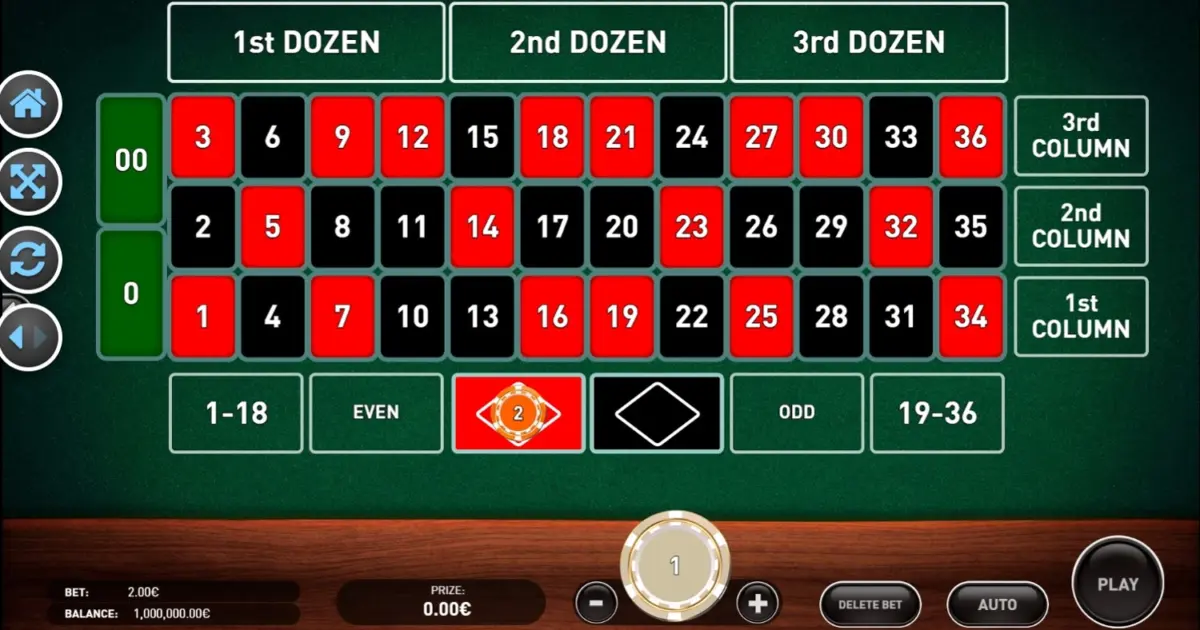
If you want the cheapest roulette maths available, a double-zero wheel is not where you find it. What american roulette (r. franco) does offer is a free demo, a listed RTP of 97.74%, and a straightforward table you can learn on without spending anything. Whether it earns real-money time depends on how much the extra pocket matters to you, and that is a decision you can make in about a minute.
How American Roulette (R. Franco) plays
This is a roulette table from RFranco Games, playable as a free demo with no download. The core loop is the same as every RNG roulette game: place chips on the layout, spin, the ball settles in one pocket, winning bets pay at fixed odds and everything else is collected.
FACTS does not tell us what this specific build includes beyond that. There is no confirmed information here about a racetrack for call bets, neighbour betting, a bet-saving or repeat function, statistics panels, or any side bet or multiplier layer. That absence matters in practice: if you rely on a racetrack to place voisins or tiers quickly, you cannot assume it is present, and you should open the demo and look before you commit a session to it.
RFranco Games has just one title in this collection, so there is no wider family of tables from the same studio to compare interface habits against. The demo is the only reliable way to check how the layout feels, how fast the spin resolves, and whether the chip denominations suit the stakes you had in mind.
The pocket count is the whole story
The title points to an American wheel, and on a standard American wheel the numbers are not in dispute. There are 38 pockets: 1 through 36, plus 0 and 00. Every standard bet on that wheel carries a house edge of 5.26%. The one exception is the five-number basket bet covering 0, 00, 1, 2 and 3, which is worse at 7.89% and is best left alone permanently.
Compare that with a single-zero European wheel: 37 pockets, and a house edge of 2.70% on every standard bet. Same game, same rhythm, roughly half the long-run cost. French rules go further still, returning half your stake on even-money bets when zero lands and pulling the even-money edge down to about 1.35%.
Where the edge actually comes from is simple arithmetic. A straight-up number on an American wheel pays 35:1, but the true odds against you are 37:1 because there are 37 pockets that are not yours. That two-pocket gap, repeated across every bet type, is the entire house advantage. Treat the American designation here as a strong hint from the name rather than a confirmed rule, and read the game’s own rules screen before betting real money.
Reading the 97.74% figure
The listed RTP for this table is 97.74%. That sits 0.77 percentage points above the 96.97% average across the roulette titles on this site, which makes it a comparatively generous listing among the double-zero group.
It also sits above the 94.74% you would expect from a textbook American wheel with no rule modifications, which is worth pausing on. A 97.74% figure implies something in this table’s rules softens the standard double-zero maths, or that the figure is calculated across a specific bet mix rather than a flat straight-up assumption. FACTS does not say which, and it would be guessing to fill that in. Practically, it means the rules screen is not optional reading here. Look for any zero-handling rule, any surrender or half-stake return on even-money bets, and any note about how the RTP was measured.
For context on where the single-zero field sits, European Roulette (Red Tiger) lists 97.3% on a 37-pocket wheel, so the two figures are close on paper while the underlying pocket counts are not.
Choosing bets for the session you want
Bet selection changes the shape of your results, not the price. Every standard bet on an American wheel returns the same 5.26% edge, so choosing red instead of a single number does not make the game cheaper. It makes it slower and smoother.
| Bet | Pockets covered | Payout | True odds (38 pockets) |
|---|---|---|---|
| Straight up | 1 | 35:1 | 37:1 |
| Split | 2 | 17:1 | 18:1 |
| Street | 3 | 11:1 | 11.67:1 |
| Corner | 4 | 8:1 | 8.5:1 |
| Basket (0, 00, 1, 2, 3) | 5 | 6:1 | 6.6:1 |
| Line | 6 | 5:1 | 5.33:1 |
| Dozen or column | 12 | 2:1 | 2.17:1 |
| Red, black, odd, even, high, low | 18 | 1:1 | 1.11:1 |
Even-money bets win close to 47.4% of spins, which stretches a small balance across more rounds. Straight-up numbers win about 2.6% of the time and produce long dry stretches punctuated by 36-unit returns. If you want a long session, bet outside. If you want the chance of a large single hit, bet inside and size stakes so a losing run does not end things early.
Martingale and friends: the honest answer
No betting system improves your expected result on this or any roulette wheel. Martingale, Fibonacci, D’Alembert, Labouchère, waiting for five reds before backing black — none of them change the 5.26% cost per unit staked on an American wheel.
The reason is that spins are independent. The RNG has no memory of the previous result, so no number, colour or sector is ever due, hot or cold, and tracking history has no predictive value. A wheel that has landed red eight times running is exactly as likely to land red on the ninth spin as it was on the first.
What progressions do is move variance around. Doubling after losses produces frequent small wins and rare very large losses, and each doubling step grows fast: eight consecutive losses on a one-unit start needs 256 units on the ninth bet. That is where table limits and bankrolls end runs, not where the system fails to work. It never worked. If you enjoy a progression as structure for your session, treat it as structure and nothing more.
Bankroll and table limits
FACTS does not list the minimum or maximum stakes for this table, and that gap matters. Limits determine how many units your balance actually covers and where any progression would hit a wall, so check them in the demo before you decide the stake size for real play.
A workable approach is to set the total you are willing to lose first, then divide it into at least 50 units for outside betting or 100 for inside betting. At 5.26%, the expected cost of 100 one-unit even-money spins is roughly five units, though real sessions swing well either side of that.
Roulette is 18+ entertainment, not income. Set a budget before you open the game, decide in advance how long you will play, and stop when either limit is reached rather than when the balance decides for you. Free demo results tell you nothing about how real-money play will go.
Verdict on American Roulette (R. Franco)
The case for this table rests entirely on the 97.74% listing, which beats the 96.97% site average and is unusually high for a wheel named American. If the rules screen confirms it, this is a genuinely competitive double-zero option. If the figure turns out to be a bet-mix calculation, you are looking at standard 5.26% maths.
The case against is the pocket count. A 38-pocket wheel is structurally more expensive than a 37-pocket one, and single-zero alternatives are easy to find. European Roulette Pro gives you the 2.70% edge, and French Roulette (NetEnt) takes even-money bets down near 1.35%.
Play the free demo to check the rules, the limits and whether a racetrack exists. Then decide, with the numbers in front of you, whether the extra pocket is a trade you want to make.
Frequently Asked Questions
Can I play American Roulette (R. Franco) free with no download?
Yes. This table is available as a free demo, so you can open it in a browser with no download and no deposit. The demo runs on the same rules as real play, which makes it the right place to check the layout, chip sizes and stake limits. Demo results do not predict real-money outcomes.
What is the American Roulette (R. Franco) RTP?
The listed RTP is 97.74%. That is 0.77 percentage points above the 96.97% average across roulette titles here. It is also higher than a textbook American wheel would produce, so check the game's rules screen for any zero-handling rule or note explaining how the figure was calculated before betting real money.
Which wheel is this and what is the house edge?
The name points to a 38-pocket American wheel with both 0 and 00, where every standard bet carries a 5.26% house edge and the five-number basket bet is worse at 7.89%. Treat that as a strong hint from the title, not a confirmed fact, and verify it on the rules screen.
Does the Martingale system work on this table?
No. Martingale does not change expected value on any roulette wheel, and neither does Fibonacci, D'Alembert or waiting for a run of one colour. Spins are independent, so no number or colour is ever due. Progressions only reshape variance, and doubling reaches table limits fast: nine straight losses needs 256 units.
How does it compare with European Roulette (Red Tiger)?
European Roulette (Red Tiger) lists 97.3% on a 37-pocket single-zero wheel, where the standard house edge is 2.70%. This RFranco Games table lists a slightly higher 97.74% but on a double-zero layout. The listed figures are close; the underlying pocket counts are not, which is why the rules screen matters.




