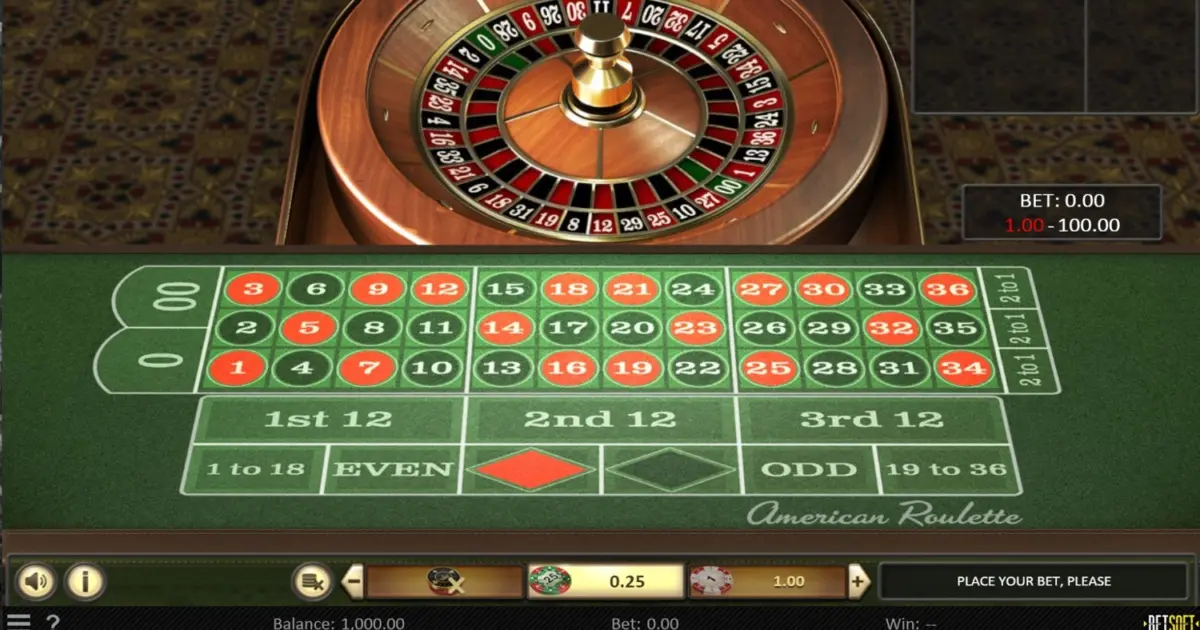
American Roulette (Betsoft) is a title worth a look only if you settle one question first: does this table actually use a double-zero wheel, or has Betsoft applied a single-zero layout under the “American” label? The stated RTP of 97.74% implies a house edge of just 2.26%, while the variant hint points to 38 pockets and a mathematical edge of 5.26%. Those numbers cannot both describe the same set of bets, so you owe it to yourself to open the in-game rules screen before depositing.
American Roulette (Betsoft) and the Betsoft gaming range
Betsoft Gaming is a provider with two roulette titles in our index, and this American version sits alongside Zoom Roulette (Betsoft), which carries a stated RTP of 97.30%. Betsoft’s roulette output is small compared to studios like Evolution or Pragmatic Play, so you are choosing from a narrow range rather than a broad catalogue. The average RTP across Betsoft’s roulette games is 97.52%, marginally below the corpus average of 96.97% plus the small bump this game’s 97.74% adds. If you want to compare provider depth, Betsoft is not where the variety lives, but the titles it does ship are competently built and playable in a free demo without a download.
The wheel, the pockets and the edge
Here is the core tension. An American roulette wheel has 38 pockets: numbers 1 through 36, a single zero, and a double zero. That extra pocket is the entire source of the house advantage, because payouts remain calibrated to a 37-pocket board. A straight-up number pays 35 to 1, but your true odds on a 38-pocket wheel are 37 to 1 against. The one-pocket gap produces a house edge of 5.26% on every standard bet. The five-number basket covering 0, 00, 1, 2 and 3 pays 6 to 1 against true odds of 6.6 to 1, yielding an edge of 7.89% — the worst bet in roulette on any wheel. None of this is disputed. What is disputed is whether Betsoft’s “American” layout actually contains 38 pockets or merely replicates the felt arrangement with a single zero. If it is genuinely 38 pockets, the game’s true RTP should be 94.74%, not the 97.74% listed in its metadata.
97.74% in practice
An RTP of 97.74% means the theoretical house edge is 2.26%, which is almost exactly what a single-zero European wheel produces (2.70% edge, 97.30% RTP). This proximity suggests Betsoft may be running a one-zero wheel behind the American table layout — a cosmetic choice some providers make to appeal to players who prefer the classic felt arrangement without accepting the worse mathematics. Alternatively, 97.74% could be a blended figure averaged across all bet types with some non-standard rule applied. You cannot know from the name alone. The European Roulette (Red Tiger) title publishes 97.30% RTP, matching the textbook European figure precisely. If Betsoft genuinely delivers 97.74% from an American-labelled table, it would outperform even a standard European wheel, which would require either a single zero or a rule like La Partage — neither of which the game’s metadata confirms. Treat the published RTP as unverified until you read the rules yourself.
Building a bet you understand
The table below shows the payout structure for a standard 38-pocket American wheel. Compare the “true odds” column with the “payout” column: the gap between them is where the house edge lives on every single bet.
| Bet type | Payout | Winning numbers | True odds against | House edge |
|---|---|---|---|---|
| Straight up (single number) | 35:1 | 1 of 38 | 37:1 | 5.26% |
| Split (two numbers) | 17:1 | 2 of 38 | 18:1 | 5.26% |
| Street (three numbers) | 11:1 | 3 of 38 | 12:1 | 5.26% |
| Corner (four numbers) | 8:1 | 4 of 38 | 9:1 | 5.26% |
| Line (six numbers) | 5:1 | 6 of 38 | 32:6 = 16:3 | 5.26% |
| Dozen or column | 2:1 | 12 of 38 | 26:12 = 13:6 | 5.26% |
| Even money (red, black, odd, even, high, low) | 1:1 | 18 of 38 | 20:18 = 10:9 | 5.26% |
| Five-number basket (0, 00, 1, 2, 3) | 6:1 | 5 of 38 | 33:5 = 6.6:1 | 7.89% |
Every bet except the basket carries the same 5.26% edge. Inside and outside bets differ only in how often you win and how much you win, not in expected value. The five-number bet is the one you should simply never place.
Systems, streaks and independent spins
You will find countless pages selling a method to beat the table — Martingale, Fibonacci, D’Alembert, “wait for the colour to balance.” None of them work. Spins are independent events generated by a random number generator; the wheel has no memory of what preceded this spin. A progression like doubling after a loss does not reduce expected value — it merely shifts the risk profile toward fewer but larger losses, and table limits guarantee that a losing run will eventually hit a ceiling you cannot double past. On a 5.26% edge, Martingale accelerates the rate at which your bankroll hits that ceiling. There is no sequence of previous results that tells you anything about the next spin. If you want a European Roulette Pro format instead, at least start from a lower base edge before you worry about progressions.
Free demo and staying in control
This table is available as an American Roulette (Betsoft) free demo, so you can see the wheel layout, read the rules screen, and confirm whether 0 and 00 both appear before risking a cent. Use that demo specifically to resolve the RTP discrepancy noted above. When you do play for real, treat it as entertainment with a fixed budget set before your first spin, not as an income stream or a way to recover previous losses. The house edge does not care about your session plan. If you find yourself chasing losses or playing to escape a mood, stop. You must be 18 or over, and if gambling is causing problems for you or someone you know, free support services are available in most jurisdictions.
Who should play American Roulette (Betsoft)
This game suits a specific player: someone who enjoys the visual arrangement of the double-zero felt but wants to verify whether the underlying mathematics matches the aesthetic. If you confirm the wheel truly has 38 pockets, you are accepting a 5.26% edge on every spin, which is nearly double what a single-zero table charges. At that point, the honest answer is that no amount of Betsoft polish compensates for the worse maths, and you would be better served by any single-zero game. If, however, the 97.74% RTP reflects a genuine one-zero wheel wearing an American layout, this becomes a reasonable pick within Betsoft’s small range. The free play American Roulette (Betsoft) route costs nothing to test and takes two minutes to verify. That verification is the whole point of this review.
Frequently Asked Questions
Is American Roulette (Betsoft) available to play for free?
Yes. Betsoft Gaming offers this table as a free demo with no download required. You can open the game in your browser, observe the wheel layout, and check the rules screen to confirm whether both 0 and 00 pockets appear before deciding whether to play for real money.
What is the RTP of American Roulette (Betsoft)?
The stated RTP is 97.74%, which implies a house edge of 2.26%. This is unusual because a genuine American wheel with 38 pockets produces a 5.26% edge and an RTP of only 94.74%. The published figure suggests a single-zero layout, but you should verify the rules in-game before relying on it.
Does a betting system help on this table?
No system changes expected value. Each spin is an independent event generated by a random number generator with no memory of previous results. Martingale, Fibonacci, and D'Alembert all redistribute when you experience losses rather than whether you experience them, and table limits eventually prevent doubling past a ceiling.
Which bet has the worst odds on American Roulette (Betsoft)?
The five-number basket bet covering 0, 00, 1, 2, and 3 carries a 7.89% house edge, worse than any other standard roulette wager. Every other bet on a genuine 38-pocket American wheel has a uniform 5.26% edge, so avoid the basket and choose based on your preferred variance instead.
How does this game compare to other Betsoft roulettes?
Betsoft has two roulette titles in our index. Zoom Roulette (Betsoft) lists 97.30% RTP, slightly below this game's 97.74%. Both are part of a small provider range with an average RTP of 97.52%, so your choice between them should come down to interface preference rather than any meaningful mathematical difference.




