This is a straightforward RNG baccarat table from Funky Games with a published return of 98.41%, and a free demo you can open without depositing. Whether it is worth your time depends less on the table than on which of the three bets you plan to make, because that choice moves your expected cost far more than the difference between one baccarat table and another. The one gap worth knowing about up front: Funky Games has not published a paytable for this game in the data available here, so the Tie payout and the commission terms are unconfirmed.
Virtual Baccarat in one minute
Funky Games lists Virtual Baccarat with a return to player of 98.41%. It sits in the baccarat subcategory, ranks 27th in that list, and lands in the 43.5th popularity percentile — mid-table interest rather than a headline game. The provider has five games in this corpus, averaging 98.67% RTP, so this table sits a little below its own stablemates.
A free demo is available, which matters more in baccarat than in most games because the demo lets you confirm the paytable at zero cost.
What is not published: the exact Tie payout, whether winning Banker bets carry the standard 5% commission or a commission-free rule, table limits, and whether any side bets are offered. Those are the things that actually change your cost per hand. The game’s name signals a virtual, RNG-dealt format rather than a live studio, but it says nothing about the paytable. Open the in-game rules screen and read it before you bet real money.
Return to player: 98.41%
98.41% RTP means that across a very large number of hands, the game is modelled to return 98.41 units for every 100 staked. The other 1.59 is the house margin. It is a long-run average, not a promise about your session, and short runs of hands can land anywhere.
Against the games on this site, which average 98.55%, this table is 0.14 percentage points lower. Against the Funky Games average of 98.67%, it is lower still. On 100 hands of 1 unit, a 0.14-point gap is about 0.14 units of expected difference — real but small.
The important caveat: a single blended RTP figure for a baccarat table is an average across the bets players actually make. Baccarat does not have one house edge; it has three, and they are far apart. A 98.41% headline number cannot tell you which bet you are getting, and a Tie-heavy session will run at a much worse rate than the headline implies. Treat the published figure as a rough label for the table and the individual bet edges below as the number that governs your session.
Banker vs Player vs Tie: picking a bet you understand
Baccarat has exactly three main bets and no decisions after you place one. Every third card is drawn by a fixed tableau, so the entire game is bet selection.
In a standard eight-deck Punto Banco shoe with 5% commission on winning Banker bets, the general figures are well established:
| Bet | Typical payout | Approximate house edge |
|---|---|---|
| Banker | 1:1 less 5% commission | About 1.06% |
| Player | 1:1 | About 1.24% |
| Tie | 8:1 or 9:1 | Roughly 14.36% (varies with payout) |
These are the general Punto Banco numbers, not confirmed figures for this table, because no paytable has been published for it.
Banker is the best standard bet in the casino at roughly 1.06%, and it stays best even after the commission, because the drawing rules hand the Banker side a structural advantage the commission only partly recovers. Player at about 1.24% costs you a little more per hand and saves you the arithmetic of the commission. Tie, at roughly 14.36%, is the worst-value standard bet in the game by a wide margin and the highest variance. If the paytable here pays 8:1 rather than 9:1, that edge is worse again — another reason to read it first.
Live, multiplayer or RNG — what the format changes and what it doesn’t
The name points to a virtual, RNG-dealt table rather than a live studio with a camera and a human dealer. That changes what you see and how fast you play. It does not change the odds of Punto Banco.
A digital baccarat game draws from a freshly shuffled virtual shoe for every round. There is no physical shoe running down, no cut card approaching, no depleted deck composition to exploit. That has a direct consequence: scoreboards, bead plates and streak charts have no predictive value on a fresh RNG shoe. Whatever the last twenty hands did, the next hand is dealt from a full, reshuffled set.
Live-dealer and multiplayer formats do the reverse — they change the presentation substantially, with a shared table and a real dealer on video, while leaving the underlying edges exactly where the table above puts them. So the format is a comfort and pacing choice. Pick the one you enjoy sitting at, and understand that RNG tables tend to run faster, which means more hands per hour and therefore more total exposure to the house edge in the same amount of time.
Common baccarat mistakes
Chasing the Tie. The 8:1 or 9:1 payout looks like the reason to be at the table, and the roughly 14.36% edge is why it is not. Betting Tie costs you something in the order of ten times as much per unit staked as betting Banker. Occasional Tie bets for entertainment are your call; building a session around them is the single most expensive habit in the game.
Ignoring the commission. On a standard table, a winning Banker bet pays even money less 5%, so a 10-unit win returns 9.5. That deduction is already inside the 1.06% figure — Banker is still the best bet with it applied. What matters is not being surprised by it, and not assuming this table is commission-free. Commission-free variants exist and typically pay a winning Banker hand on a six at 1:2 instead of even money, which shifts the edge. Nothing published about this game confirms which version it runs.
Reading patterns. Related to the RNG point above: a run of Banker results tells you nothing about the next hand. No staking pattern changes it either. Martingale, flat progression and streak-betting redistribute when your wins and losses arrive; none of them alters a fixed house edge.
Trying the demo first
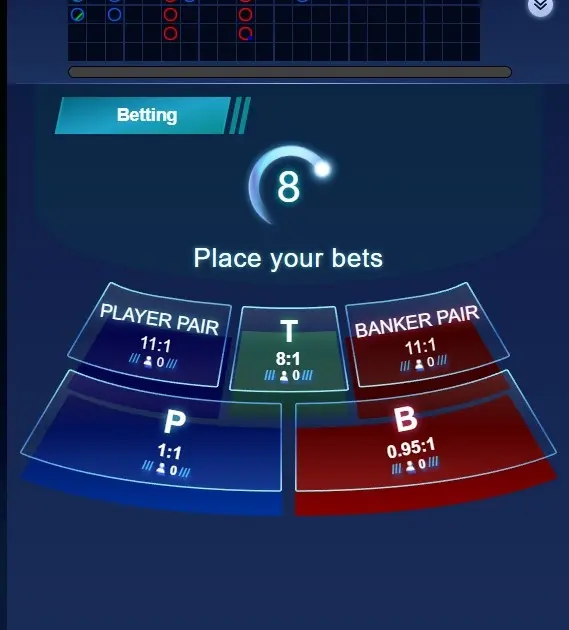
A free demo is available for this table, and there is a specific job for it here: confirm what the data does not say. Open the rules and paytable screen and check the Tie payout, whether winning Banker bets carry commission, and whether any side bets are offered. Side bets like Player Pair, Banker Pair or Dragon Bonus carry their own, considerably worse edges, so knowing whether they are on the felt is worth two minutes. You can also see the table limits and the pace of the dealing.
What the demo cannot do is forecast your real-money results. Demo hands are not a sample that predicts anything about a funded session.
Baccarat is 18+. Decide what the session is worth to you before you open the table, and treat that figure as entertainment you have paid for rather than money you expect back. If you want to try the same provider’s take on a side-bet table, Virtual Dragon Bonus Baccarat makes the Dragon Bonus part of the offering, so its rules screen is a useful comparison point.
Who should play Virtual Baccarat
This suits a player who wants a fast, low-decision card game and intends to bet Banker or Player most of the time. If that is you, the 98.41% figure is close enough to the 98.55% site average that the table is a reasonable place to sit, and the free demo removes the cost of checking the rules first.
It suits you less if you specifically want a confirmed commission-free rule or a stated Tie payout before you deposit, because neither is published here. It also suits you less if you were hoping to read scoreboards, since a reshuffled virtual shoe gives that nothing to work with.
If RTP is your deciding factor, Baccarat Babes publishes 98.94% and is the higher figure among the Funky Games baccarat games listed here. And if you want a break from card-counting-free card games entirely, Virtual Domino QQ is the same studio in a different format.
Frequently Asked Questions
Can I play Virtual Baccarat for free without downloading anything?
Yes. A free demo is available for Virtual Baccarat, so you can open the table in a browser and play without depositing or installing software. Use it to read the in-game paytable and rules screen, which is where the Tie payout and commission terms are confirmed — those details are not published in the game data listed here.
What does the 98.41% RTP for Virtual Baccarat actually mean?
It means the game is modelled to return 98.41 units per 100 staked over a very large number of hands, leaving a 1.59% house margin. That is a long-run average, not a session forecast. It is also a blend across bet types, so a Tie-heavy session will run far worse than the headline suggests.
Which bet gives the best value at this table?
Banker, on the standard Punto Banco figures — roughly 1.06% house edge, against about 1.24% for Player and roughly 14.36% for Tie. Banker holds that advantage even with 5% commission deducted from wins, because the fixed drawing rules favour the Banker hand. Funky Games has not published this table's specific paytable, so verify it in-game.
Does tracking previous results or using a betting system help here?
No. This is an RNG table that draws from a freshly shuffled virtual shoe every round, so scoreboards, bead plates and streak charts have nothing to predict from. Staking systems such as Martingale or flat progression change when wins and losses arrive but leave the fixed house edge on each bet unchanged.
How does it compare with Virtual Dragon Bonus Baccarat from the same provider?
Both are Funky Games titles, but no RTP is published for Virtual Dragon Bonus Baccarat, while this table lists 98.41%. The other game's name signals a Dragon Bonus side bet, and side bets like that carry considerably worse house edges than Banker or Player. Check each game's own rules screen for payouts.