Baccarat (Section8) is a straightforward Punto Banco table with a published RTP of 98.94%, and it is playable as a free demo, so there is no cost to checking it against the tables you already use. The number sits marginally above the 98.55% average for baccarat titles in this corpus, which is a small edge on paper and worth almost nothing in a short session. What actually decides your results here is which of the three bets you back, and that is a decision the maths of baccarat (section8) already answers for you.
This review covers what the table gives you, what Section8 has not published, and where you need to open the rules screen yourself.
How Baccarat (Section8) plays
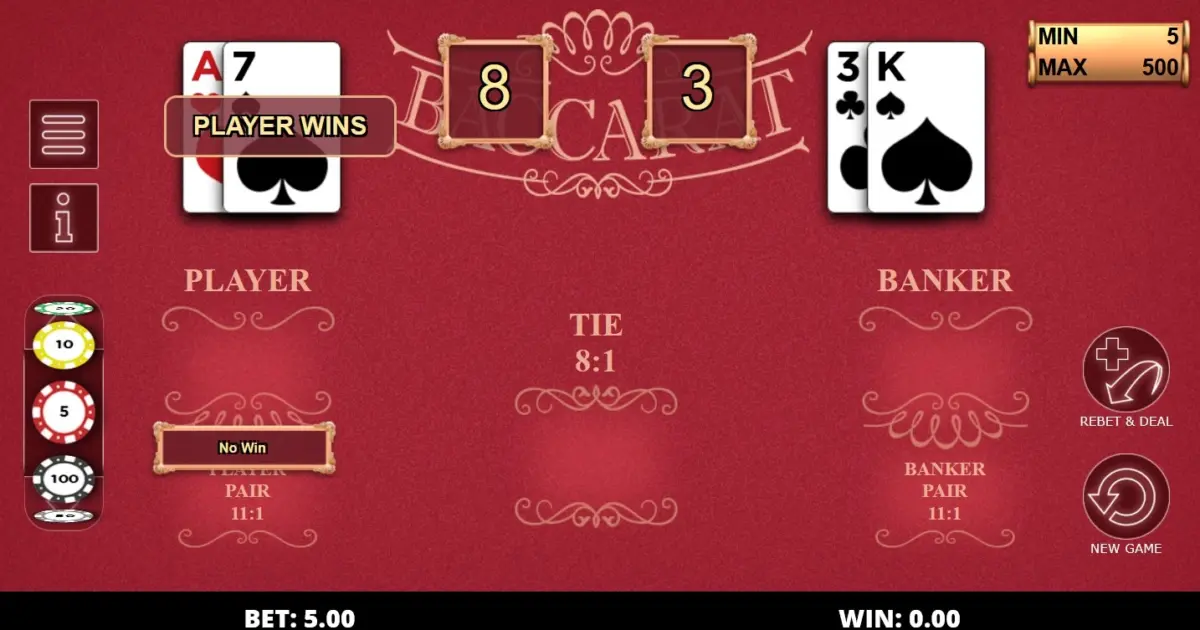
Baccarat has exactly three bets on the main layout: Banker, Player and Tie. You choose one, the cards are dealt, and every third-card decision follows a fixed tableau written into the rules of the game. You never choose to draw or stand. That is the whole point of the format and the reason it takes about thirty seconds to learn.
Two hands are dealt two cards each. Tens and picture cards count zero, aces count one, and only the last digit of the total matters, so a seven and a six make three rather than thirteen. Whichever hand lands closer to nine wins, and if a hand shows eight or nine on the first two cards it stands immediately. Everything else is resolved by the drawing table, which is identical at every legitimate Punto Banco table anywhere.
Because there are no decisions after the bet, there is no strategy in the blackjack sense. Skill in baccarat means bet selection and stake size, nothing else. Section8 has not published whether this table runs a standard eight-deck shoe or a shorter one, and it has not published table limits, so if minimum stake matters to your bankroll you will need to read that off the table itself in the demo.
| Provider | Section8 |
|---|---|
| RTP | 98.94% |
| Free demo | Yes |
| Site-wide average RTP | 98.55% |
Section8 and this table
Section8 lists a single game in this corpus, and this is it. That gives you very little to compare against internally, since the provider average RTP of 98.94% is simply this one table’s figure repeated. There is no back catalogue here to tell you whether the studio typically publishes generous paytables or thin ones, and no track record of side-bet design to judge.
Practically, that means you should weigh this table against other studios’ baccarat rather than against Section8’s other work. Baccarat – Punto Banco is the closest comparison in this list at 98.77%, close enough that the difference is noise over any session you are likely to play. Baccarat Supreme sits noticeably lower at 95.65%, which is the kind of gap that does matter, and it is worth checking what rules change there to explain it. Baccarat (Habanero) has no published return figure at all, which is its own answer about how much you can verify before betting.
The table ranks 19th here and sits around the 61st popularity percentile, so it gets a reasonable amount of traffic without being a headline release.
Reading the 98.94% figure
A quoted RTP for a baccarat table is a blended average across the bets available, weighted by an assumed pattern of play. It is not the return on the bet you personally place. Back Banker every hand and your expected return is roughly 98.94%; back Tie every hand and it is nowhere near that, whatever the headline says.
The universal figures for a standard eight-deck shoe with 5% commission on winning Banker bets are a house edge of about 1.06% on Banker, about 1.24% on Player, and somewhere around 14.36% on Tie depending on whether the payout is 8:1 or 9:1. Those are properties of the game’s drawing rules, not of Section8’s build, so they hold here unless the rules screen shows a variant.
Notice that a 1.06% edge is the mirror image of a 98.94% return. That is a strong hint that the published number describes flat Banker play, and it is the most useful reading of the figure. It also means the table is not offering you anything unusual: it is offering you standard baccarat maths, honestly stated.
Treat 98.94% as a long-run average across many thousands of hands. Over an evening, variance dominates entirely.
Tie bets, side bets and what they really cost you
Tie is the worst standard bet in baccarat by a wide margin, and it is worth saying plainly. An edge in the region of 14.36% means the bet is roughly thirteen times more expensive than Banker per unit staked. The 8:1 or 9:1 payout looks tempting because ties do happen often enough to feel reachable, but the payout does not come close to covering the true odds against.
Section8 has not published the Tie payout for this table. That is not a trivial gap: the difference between 8:1 and 9:1 moves the house edge by several percentage points, so the paytable is the first thing to check in the demo if you intend to bet Tie at all.
The same caution applies to side bets. Player Pair, Banker Pair, Perfect Pair and Dragon Bonus style wagers all carry house edges far worse than the main three, typically well into double figures. FACTS does not confirm that this table offers any of them, so do not assume they are there, and do not assume they are priced kindly if they are. Read the paytable, work out what each side bet actually pays, and understand that adding them to your betting pattern drags your effective return below the published 98.94%.
Commission, and how commission-free tables change the maths
The Banker hand wins slightly more often than Player because the drawing rules favour it. Casinos correct for that with a 5% commission on winning Banker bets, which claws back most but not all of the advantage. That is why Banker still ends up with the lowest house edge in the game, and why flat Banker betting is the cheapest way to sit at a baccarat table.
Commission-free variants exist and work differently. Instead of taking 5% on every Banker win, they usually pay a winning Banker hand that totals six at 1:2, keeping every other Banker win at even money. That single change is what funds the removal of commission, and it produces a different edge, not automatically a better one.
Nothing in the name Baccarat (Section8) or in the published data says this is a commission-free table, so assume standard 5% commission until the rules screen tells you otherwise. If you open it and find a reduced payout on a Banker six, you are on a commission-free variant and should recalculate accordingly.
One thing neither format changes: no staking pattern alters expected value. Martingale, flat progression and betting with or against a run all leave the house edge exactly where it was.
Free play before real money
A Baccarat (Section8) free demo is available, and it is genuinely the right first step here given how much this table leaves unpublished. Use it to read the paytable, confirm the Tie payout, check whether commission applies to Banker wins, note the table limits and see whether any side bets sit on the layout. Those five checks take a couple of minutes and they tell you more than any review can.
What the demo cannot do is predict real-money results. The hands you see in free play carry no information about the hands you will see later, and a good or bad demo run means nothing beyond itself. Digital baccarat draws from a freshly shuffled virtual shoe every round, so there is no physical shoe to track and no scoreboard pattern that says anything about the next hand.
Play only if you are 18 or over, decide your budget before you open the table rather than during a session, and treat the money as the price of entertainment. Baccarat is not income, and a 1.06% edge on the best bet in the house is still an edge against you.
Final take on Baccarat (Section8)
This is a competent, plain baccarat table. The published 98.94% return is a shade above the 98.55% corpus average and consistent with flat Banker play at standard commission, which is exactly what you would hope to see and no more. Nothing here is a trap, and nothing here is a bargain.
The reservation is transparency rather than value. With no published Tie payout, no confirmed side-bet list and no stated limits, you are relying on the in-game rules screen for the details that actually move your return. Section8’s single-title catalogue gives you no wider record to lean on either.
Back Banker, skip Tie, ignore side bets until you have priced them, and this table treats you about as well as baccarat can. If you want a directly comparable alternative with a published figure, Baccarat – Punto Banco at 98.77% is effectively the same proposition.
Frequently Asked Questions
Can I play Baccarat (Section8) for free?
Yes, a free demo is available, and it is worth using here. Section8 has not published the Tie payout, the table limits or a side-bet list, so the demo is where you confirm all of that. Demo hands carry no information about later real-money results, though.
What does the 98.94% RTP on Baccarat (Section8) actually mean?
It is a blended long-run average, and 98.94% is the mirror of a 1.06% house edge, which matches flat Banker play at standard 5% commission. It is not the return on Tie or on side bets. Over one session, variance matters far more than the published figure.
Which bet is the best value at this table?
Banker, at roughly 1.06% house edge, against about 1.24% for Player and around 14.36% for Tie. The drawing rules give Banker a built-in advantage that the 5% commission only partly removes. Backing Banker flat is the cheapest way to play any standard baccarat table.
Does tracking the scoreboard or using a betting system help?
No. Digital baccarat reshuffles a virtual shoe every round, so previous results tell you nothing about the next hand and no scoreboard pattern is predictive. Martingale, flat progression and streak betting change how your stakes are distributed, never the fixed house edge on each bet.
How does it compare to Baccarat - Punto Banco?
Baccarat - Punto Banco publishes 98.77% against this table's 98.94%, a difference small enough to ignore in practice. Both are standard three-bet Punto Banco layouts. Baccarat Supreme sits much lower at 95.65%, which is a gap worth investigating in that game's rules screen.