Baccarat (OneTouch) is a clean, no-frills Punto Banco table that delivers the standard three-bet format without side bets, roadmaps, or extra decision points. With a published RTP of 95.65%, it sits below the corpus average of 98.55%, so while the rules are familiar, the long-run cost per unit wagered is higher than many competing tables. If you want a straightforward baccarat experience with a free demo, this OneTouch release is worth a look — but it pays to understand exactly where that RTP comes from before you commit real money.
What kind of baccarat is Baccarat (OneTouch)?
This is a digital RNG baccarat table running standard Punto Banco rules. There is no live dealer — every hand is dealt from a freshly shuffled virtual shoe, which means each round is independent of the last. You will not find roadmap scoreboards, bead plates, or any of the pattern-tracking tools common in live-dealer lobbies, because on an RNG shoe they offer zero predictive value anyway.
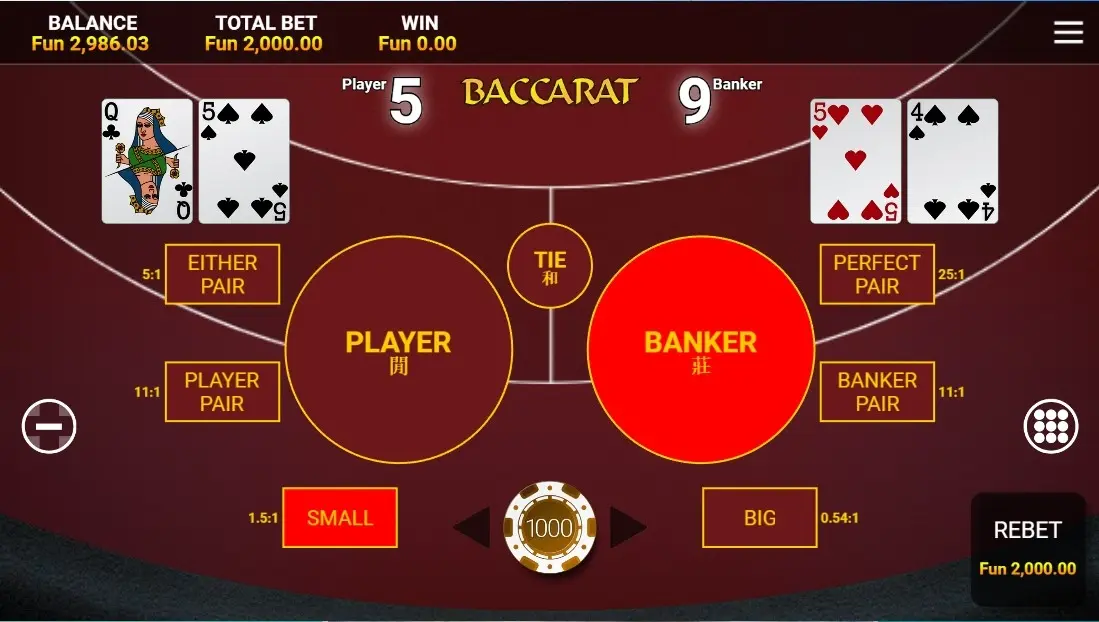
The game presents three betting options: Banker, Player, and Tie. You place your wager before the cards are dealt, and from that point the hand plays out automatically according to the fixed third-card drawing tableau. There are no player decisions mid-hand — no standing, hitting, or doubling — which is exactly what makes baccarat mechanically simple. OneTouch has not published details of side bets such as Player Pair or Banker Pair for this table, so assume the standard three bets only unless the game’s own rules screen says otherwise.
The presentation is compact and mobile-first, consistent with OneTouch’s design philosophy. The interface is stripped back to the essentials: chip selection, bet placement, and a clear view of the dealt cards and result. If you have played any digital Punto Banco before, the layout will feel immediately familiar.
| Provider | OneTouch |
|---|---|
| RTP | 95.65% |
| Free demo | Yes |
| Site-wide average RTP | 98.55% |
The maths of a single hand
In every baccarat hand, two two-card hands are dealt — one to the Banker position and one to the Player position. The hand closest to a total of nine wins. Cards two through nine count at face value, aces count as one, and tens plus picture cards count as zero. If either hand totals more than nine, only the last digit matters: a seven and a six making thirteen counts as three.
The Banker hand wins approximately 45.86% of hands, the Player hand wins about 44.62%, and ties occur roughly 9.52% of the time. These are long-run frequencies baked into the fixed drawing rules — they do not change from table to table or shoe to shoe. The third-card rules give the Banker a structural advantage because the Banker acts after seeing the Player’s third card, allowing a more informed draw. This is why the Banker bet carries a commission in most baccarat formats: without it, the Banker bet would have a clear edge over the player.
When a tie occurs, both the Banker and Player bets are returned. This sounds fair, but it means the effective win rate for either side bet is lower than the raw percentage suggests — you win less often than the headline number implies because ties cancel out. Understanding this is key to evaluating the actual cost of each bet over time.
Where the 95.65% comes from
RTP in baccarat is a weighted average across all three bets, but in practice most players concentrate their volume on Banker or Player. The 95.65% figure published for Baccarat (OneTouch) represents the combined expected return across all bets at standard stakes and a standard commission structure. It sits 2.9 percentage points below the corpus average of 98.55% for baccarat tables on this site, meaning a higher long-run house take.
In a standard 8-deck shoe with a 5% commission on winning Banker bets, the house edge on Banker is roughly 1.06% and on Player roughly 1.24%. The Tie bet, typically paying 8:1, carries an edge of about 14.36% — though this swings by several points depending on whether the payout is 8:1 or 9:1. OneTouch has not published the specific Tie payout for this table, so check the paytable in-game before wagering on it.
The gap between this table’s 95.65% and the theoretical optimum near 98.5% likely reflects a combination of the exact commission structure, the Tie payout offered, and how the provider calculates the weighted average. The lower RTP does not change the odds on any individual hand — the Banker bet is still the best standard wager — but it does mean you lose more per unit wagered over thousands of hands compared to a higher-RTP table.
Commission, payout and the Tie trap
The standard commission on Banker bets in Punto Banco is 5% of the profit on a winning hand. Bet 10 units on Banker, win, and you receive 9.5 units of profit instead of 10. This commission is what keeps the Banker bet profitable for the house despite its structural edge in the drawing rules. It is not optional or negotiable — it is baked into the game’s maths.
The Player bet pays even money with no commission. It is slightly simpler in that respect, but the trade-off is a higher house edge of roughly 1.24% compared to about 1.06% on Banker. Over a long session, that difference adds up: on every 100 units wagered, you expect to lose about 1.06 on Banker versus 1.24 on Player.
The Tie bet is the real trap. It typically pays 8:1 (or occasionally 9:1), and it looks tempting because of the large payout relative to the stake. But ties occur less than 10% of the time, and the house edge on this bet is enormous — roughly 14.36% at 8:1 — making it by far the worst-value standard bet in baccarat. If you wager 100 units on Tie repeatedly, you can expect to lose about 14 units on average. No streak-tracking or scoreboard pattern changes this maths. The Tie bet is high variance and low value; the numbers are unambiguous.
How Baccarat (OneTouch) compares to other tables
At 95.65% RTP, Baccarat (OneTouch) sits at the lower end of the baccarat spectrum on this site. For context, Baccarat Supreme shares the same 95.65% RTP but may offer a different presentation or feature set worth comparing if you are deciding between the two. On the other hand, Baccarat Triple Treat posts a significantly higher RTP of 98.94%, which translates to a much lower long-run cost per unit wagered — a meaningful difference if volume matters to you.
If you want to explore a commission-free format, No Commission Baccarat removes the standard 5% Banker commission but typically compensates by paying only half on a winning Banker six. The overall house edge in commission-free variants is often comparable to or slightly worse than standard baccarat, but the experience feels different because your Banker wins land at even money more often. It is worth trying in demo to see whether the altered payout pattern suits your preferences.
OneTouch’s provider average RTP across their baccarat catalogue is 96.47%, so this specific table falls below even the studio’s own average. That does not make it a bad game — the rules are fair and the maths are transparent — but it does mean there are higher-return options both within OneTouch’s range and across the broader baccarat category.
Free demo and staying in control
A free demo is available for Baccarat (OneTouch), and it is the best way to evaluate the table without spending anything. The demo uses the same RNG engine and the same rules as the real-money version, so the maths are identical — but the outcomes carry no financial consequence, which makes it useful for understanding bet sizing, payout mechanics, and how the commission works in practice.
If you move to real money, set a budget before you start and stick to it. Baccarat’s low house edge on Banker and Player means neither bet is a fast drain, but the cost is real over time, and the Tie bet’s edge is severe enough to erode a bankroll quickly. Treat every session as entertainment you pay for, not a source of income. You must be 18 or older to play. If gambling stops being fun, stop playing — help is available from responsible-gambling organizations in your region.
The no-download format means you can play directly in your browser on mobile or desktop without installing software. This also makes it easy to try the demo for a few hands, assess the interface and pace, and walk away without commitment.
Final verdict
Baccarat (OneTouch) is a competent, stripped-back Punto Banco table that does exactly what it promises: three bets, fixed drawing rules, no distractions. The 95.65% RTP is below average for baccarat, which means the long-run cost of playing here is higher than at tables like Baccarat Triple Treat at 98.94%. If RTP is your primary concern, there are better options.
That said, the game is mechanically sound, the free demo works without download, and the mobile-first interface is clean. If you are looking for a simple baccarat table to learn the bet mechanics or just prefer OneTouch’s design style, this delivers. Just go in with eyes open on the RTP, stick to Banker or Player for the best value, and treat the Tie bet as the mathematical trap it is.
Frequently Asked Questions
Can I play Baccarat (OneTouch) for free without downloading anything?
Yes. A free demo is available directly in your browser with no download required. The demo uses the same RNG engine and rules as the real-money version, so the maths are identical — it is the best way to evaluate the table before committing real funds.
What is the RTP of Baccarat (OneTouch) and what does that number mean?
The published RTP is 95.65%, which means that over a very large number of hands, the game returns about 95.65 units for every 100 units wagered on average. This is below the corpus average of 98.55% for baccarat tables, so the long-run house take is higher than at many competing tables.
Which bet — Banker, Player, or Tie — offers the best value?
Banker is the best-value standard bet in baccarat, with a house edge of roughly 1.06% after the 5% commission. Player is close behind at about 1.24%. The Tie bet, by contrast, carries an edge of approximately 14.36% at 8:1 payout, making it the worst-value bet by a wide margin.
Does tracking patterns on scoreboards or streaks help in this game?
No. Baccarat (OneTouch) is an RNG table that shuffles a fresh virtual shoe for every hand. Previous outcomes have no mathematical influence on the next deal, so scoreboard patterns and streak-tracking cannot improve your results. Each hand is an independent event.
How does Baccarat (OneTouch) compare to Baccarat Triple Treat?
Both are digital Punto Banco tables, but Baccarat Triple Treat posts a significantly higher RTP of 98.94% compared to Baccarat (OneTouch)'s 95.65%. That difference translates to a lower long-run cost per unit wagered at Baccarat Triple Treat, making it the stronger choice if return percentage is your priority.