Baccarat (KA Gaming) is a standard three-bet Punto Banco implementation from a provider that currently lists only one title in this catalogue. With no published paytable or commission detail from the developer, the practical question is not whether the presentation is engaging — it never was going to be — but whether you understand the fixed mathematical cost of every wager you place.
How Baccarat (KA Gaming) plays
You choose one of three bets: Banker, Player, or Tie. Two cards go to each side, and a third is dealt to either hand according to a fixed tableau that neither you nor the dealer controls. If the Banker or Player hand totals 8 or 9 on the first two cards, both stand immediately (a “natural”). Below that, the drawing rules are mechanical — Player hits on 0-5 and stands on 6-7; Banker’s decision depends on both its own total and whether Player drew a third card.
Because no decision point exists after you stake, there is no “strategy” in the way blackjack has strategy. The only variable you control is which of the three bets you choose, and the maths below shows how badly that choice can go. If you want to see how other studios frame the same fixed-rule game with different presentation layers, Baccarat – Punto Banco publishes a confirmed 98.77% figure that maps directly onto the standard Banker bet at 5% commission.
Ka Gaming and this table
Ka Gaming is a small provider: this is its only baccarat title in the current catalogue and its only entry here at all. That means there is no sister table to compare it against for house-edge consistency, no track record of commission-free experiments, and no documented side-bet history to cross-reference.
When a provider offers a single table with no published rules page, you should treat every number in this review as a universal baccarat figure rather than a confirmed table-specific value. Ka Gaming may operate identically to any other 8-deck Punto Banco implementation, or it may differ in shoe penetration, commission handling, or Tie payout — none of which is visible from the outside without the rules screen.
Reading the RTP figure
This catalogue lists an average RTP of 98.55% across baccarat titles generally. For a standard 8-deck Punto Banco game with 5% Banker commission, that figure corresponds to the Banker bet’s house edge of roughly 1.06% (equating to 98.94% RTP). The Player bet sits at about 1.24% house edge, or 98.76% RTP.
Ka Gaming has not confirmed whether this table follows that exact model. The 98.55% corpus average is a reasonable expectation for a game that mirrors standard commission, but it is not a promise. If you need a verified number, Baccarat Supreme at 95.65% demonstrates how far below the universal Banker edge a game can fall once high-cost side bets or altered paytables are involved — the published figure is an overall blend that includes those wagers.
Until Ka Gaming publishes a rules page, treat 98.55% as a directional hint, not a guarantee.
Tie bets, side bets and what they really cost you
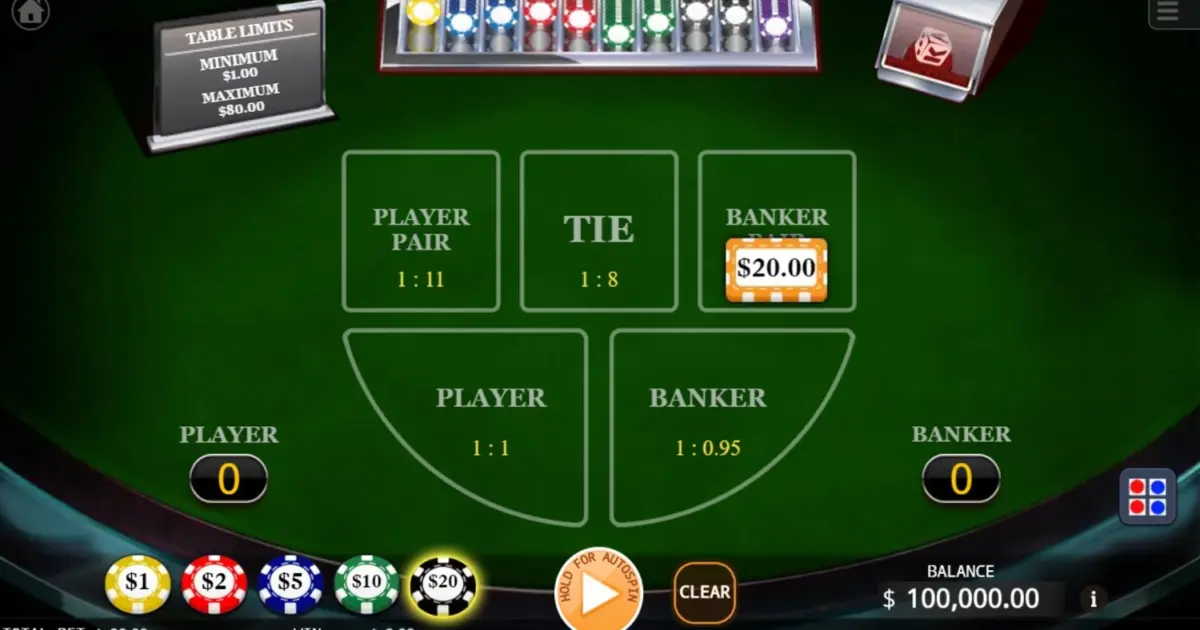
The Tie bet pays 8:1 or 9:1 depending on the paytable. At 9:1, the house edge is approximately 14.36%. At 8:1, it rises to roughly 15.75%. Neither figure is confirmed for this table, but both are catastrophic compared to the main wagers. Ka Gaming has not listed side bets for this title, so Player Pair, Banker Pair, Perfect Pair and Dragon Bonus may not exist here at all.
Where those side bets do appear on other tables, their individual house edges typically range from about 5% (Player/Banker Pair at 11:1) to over 20% (Dragon Bonus variants). If a paytable screen shows any of them on this game, you are looking at additional negative expectation layered onto an already fixed-rule wager. The table below summarises what is universal:
| Bet type | Standard payout | Approx. house edge |
|---|---|---|
| Banker (5% commission) | 0.95:1 | ~1.06% |
| Player | 1:1 | ~1.24% |
| Tie (9:1) | 9:1 | ~14.36% |
Commission, and how commission-free tables change the maths
The standard model charges 5% on winning Banker bets — stake 100, collect 195 net. This commission exists because the fixed drawing rules give the Banker position a structural advantage over Player; without it, Banker would carry roughly a 1.46% edge in the player’s favour.
Commission-free variants exist and usually replace the 5% fee with a conditional payout: a winning Banker hand that lands on exactly 6 pays at 1:2 (half your stake) instead of even money. That single alteration shifts the Banker edge back to approximately 1.46% — worse than the standard commission model despite the marketing language.
Nothing in Ka Gaming’s naming or description signals a commission-free structure for this table. The safest assumption is standard 5% commission, but check the in-game rules screen to confirm before staking.
Free play before real money
A free demo is available for this title, and it is the correct first step given the missing data. In demo mode you can verify three things in under two minutes: whether the Banker commission is 5% or zero, whether a Tie pays 8:1 or 9:1, and whether any side bets appear on the felt. All three directly affect your long-run cost.
Because the game draws from an RNG shoe (or a fixed rule sequence in any digital implementation), scoreboards, bead plates, and “road” patterns have no predictive power. A streak of ten Banker wins does not make a Player win “due.” The next hand’s probability is set by the shoe composition, not the history you can see on screen.
Baccarat is a fixed-edge product: the house advantage is locked in your choice of bet before the first card moves. Set a budget you are comfortable losing before playing with real money, treat the session as paid entertainment, and stop when that budget is reached — this is gambling, not income. You must be 18 or over to play for money in your jurisdiction.
Final take on this table
Baccarat (KA Gaming) is a minimal-provider entry with no published rules page, no confirmed paytable, and no documented differences from standard Punto Banco. If it is indeed a standard 8-deck, 5%-commission implementation, then Banker is the best-value bet at roughly 1.06% house edge and Tie is the worst by an enormous margin. Until Ka Gaming confirms those parameters, the free demo is the only way to check. For comparison with a fully documented table, Baccarat (Habanero) sits in the same catalogue at similar rank — worth exploring if you want a provider that publishes its commission structure.
Frequently Asked Questions
Can I play Baccarat (KA Gaming) for free?
Yes. A free demo is available through this catalogue, and it is the recommended way to verify the commission structure, Tie payout and whether any side bets are active before staking real money.
What is the RTP of Baccarat (KA Gaming)?
Ka Gaming has not published a specific RTP for this table. The catalogue lists a baccarat genre average of 98.55%, which aligns with the standard Banker bet house edge of about 1.06% at 5% commission. Treat this as directional rather than confirmed.
Which bet should I choose in Baccarat (KA Gaming)?
Banker carries the lowest house edge at approximately 1.06% under standard 5% commission rules, compared to about 1.24% on Player and roughly 14% or more on Tie. No decision-making after betting changes this ranking.
Do scoreboards or betting patterns work on this table?
No. The game operates on a fixed rule set with no player decisions after the initial wager. Past results have no mathematical influence on the next hand's outcome, and no staking pattern changes the fixed house edge of any bet type.
How does Baccarat (KA Gaming) compare to Baccarat - Punto Banco?
Baccarat - Punto Banco publishes a confirmed 98.77% RTP consistent with standard 5% commission rules. Baccarat (KA Gaming) has no published figure, so while the maths are likely similar, you cannot verify the commission or Tie payout without checking the in-game rules screen yourself.