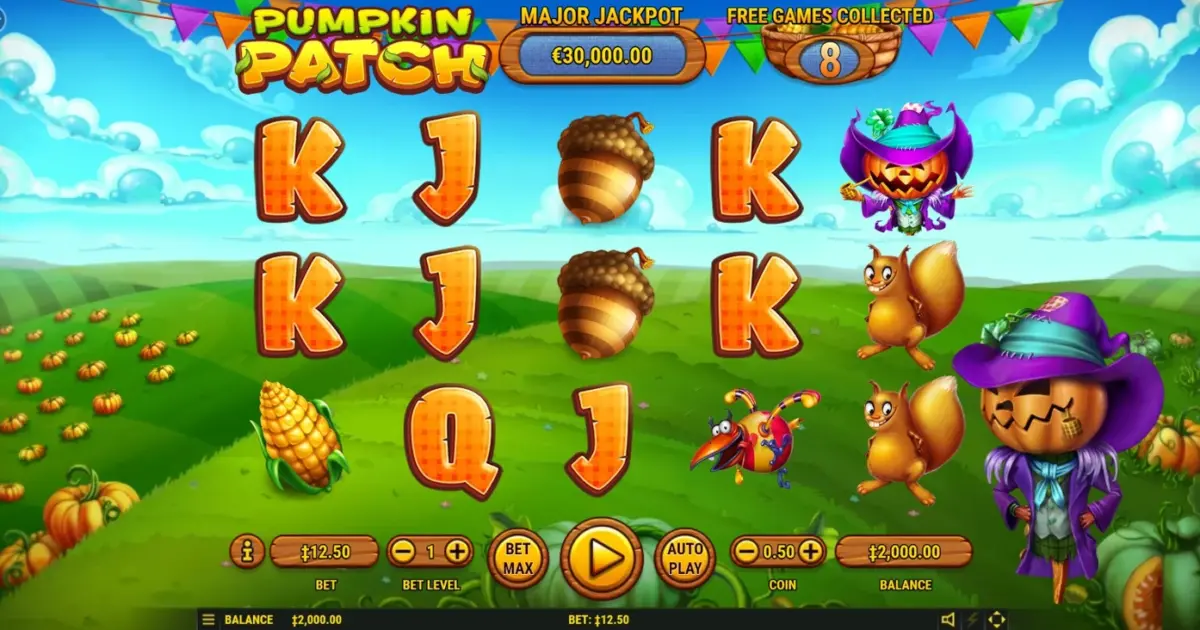
Pumpkin Patch is worth a look if long-run value matters to you — its 98.18% RTP is unusually high and well above the average slot. The game uses a familiar 5-reel layout with a Halloween theme and a free demo is available, so you can compare it without risk. This pumpkin patch slot review sticks to the published numbers and what they mean for your session planning.
Pumpkin Patch versus the average slot
The single most useful number for comparison is how far Pumpkin Patch sits above the norm. Across the corpus tracked for this site, the average RTP is 95.71%. Pumpkin Patch is published at 98.18%, which is 2.47 percentage points above that average.
In practical terms, that gap compounds over volume. A 95.71% game returns £95.71 per £100 wagered on average across a very large sample, while a 98.18% game returns £98.18 per £100. Over 10,000 spins at £1 a spin, the expected cost at the corpus average is about £429, versus about £182 for Pumpkin Patch — a difference of roughly £247 in expected loss, though individual sessions will vary widely and short-term results can be far from the average.
Rank and popularity also help frame it. Pumpkin Patch sits at rank 2456 in the catalogue. It falls around the 87.7th percentile for popularity, which means it gets more attention than most titles ranked below it, but it is not among the small group of top-traffic games. Popularity does not change the maths; it only tells you what other players are sampling.
There are 147 Halloween-themed games in the library, so this is a crowded niche. An RTP 2.47 points above average is a clear differentiator inside that set, where many alternatives cluster closer to 94%–96%.
RTP breakdown: 98.18% in context
RTP — return to player — is a long-run statistical average, not a promise for any single session. A 98.18% RTP means that for every £100 wagered, the game is designed to return £98.18 to players collectively over millions of spins. The remaining £1.82 is the theoretical house edge over that same huge sample.
What that does not mean is that you will get £98.18 back from £100 in an evening. Each spin is independent, and variance ensures that one player can finish well ahead while another finishes well behind the average in the same time window. Over a small sample — say 200 spins at £0.50 (£100 staked) — the expected return is £98.18, but the actual result will often land £20 or more either side of that expectation depending on volatility and hit frequency.
Over a larger sample the average becomes more meaningful. Over 5,000 spins at £0.40 (£2,000 staked), the expected return is £1,963.60 with an expected cost of £36.40. At a 95.71% average slot, the same £2,000 staked would have an expected return of £1,914.20 and an expected cost of £85.80. The higher RTP narrows the long-run cost per spin, but it does not remove swings and it does not change the fact that the expected value remains negative for the player.
No max win figure, hit frequency, or buy-feature price has been published in the FACTS for this title, so treat any such numbers you see elsewhere with caution and rely on the verified 98.18% figure for comparison.
Volatility profile
Volatility describes how returns are distributed around the RTP average. Low volatility generally means more frequent but smaller wins, longer sessions on a fixed bankroll, and smaller bankroll swings. High volatility generally means rarer wins, shorter average sessions on the same bankroll, larger swings, and a greater need for a buffer to ride out dry spells. Medium sits between the two.
For Pumpkin Patch, no volatility rating has been provided in the FACTS block. That absence matters for planning. Without a published low/medium/high label, you cannot assume how choppy the ride will be or how large a bankroll you should set aside for a given stake and session length.
In this situation the free demo is the most honest way to get a feel for cadence. Use it to note how often any win lands and how stable your balance feels over 300–500 spins at a stake that mirrors what you would use for real, remembering that demo play does not predict real-money results. Every spin remains independent once you switch modes.
Until Habanero publishes a volatility figure, frame your expectations around the RTP alone: over a very large sample the game keeps less per £100 than average, but without volatility you cannot estimate the size of interim peaks and troughs.
Habanero as a studio
Habanero has 176 games in the catalogue tracked here, which makes it a mid-to-large established studio rather than a boutique newcomer. Across those titles the provider average RTP is 96.40%, noticeably above the site-wide corpus average of 95.71%.
Pumpkin Patch at 98.18% sits well above its own studio average — about 1.78 points higher than Habanero’s mean. That suggests this title is positioned at the generous end of the studio’s range for long-run theoretical return, rather than being representative of the studio as a whole. It also means that comparing Pumpkin Patch only to the studio mean understates how strong its RTP is; the gap to the wider market is even larger.
If you want to stay inside the same provider for comparison, Hot Hot Fruit is published at 96.84% RTP, much closer to the studio mean and 1.34 points below Pumpkin Patch. Mystic Fortune Deluxe at 96.71% tells a similar story — solid and above the corpus average, but still well under the 98.18% on offer here. Both use familiar 5-reel formats, so the mechanical difference for you is mainly the expected long-run cost per £100 staked, not a shift from reels to ways.
The third related Habanero title, Wealth Inn, has no RTP published in FACTS, which is itself useful information: you cannot make a like-for-like value comparison on that one until the figure is provided. Among Habanero slots as a group, Pumpkin Patch stands out on the single metric that is verified.
Three Halloween alternatives worth comparing
With 147 Halloween games available, it pays to check how Pumpkin Patch lines up against direct theme alternatives on the numbers you can verify. RTP is the only comparable figure provided for these alternatives, so use it as the filter.
Trickstar Spins is listed at 94.00% RTP. That is 4.18 points below Pumpkin Patch and 1.71 points below the corpus average. Over £1,000 staked, the expected return gap is about £41.80 in favour of Pumpkin Patch across a large sample, though again short-term variance will dominate any single session.
Book of Shadows is closer at 96.01% RTP, which is still 2.17 points below Pumpkin Patch but 0.30 points above the corpus average. It represents a middle ground within the theme: not as strong as Pumpkin Patch on long-run value, but not as far below average as Trickstar Spins.
Halloween Crystals has no RTP listed in FACTS, so you cannot rank it on value. That lack of data does not mean the game is better or worse; it simply means you would be choosing it on theme or mechanics rather than on a verified return figure. When you want a like-for-like value decision, stick to titles where the RTP is published.
If you like the Halloween label but want to see how different studios handle the same seasonal brief, run the Pumpkin Patch free demo alongside one of the alternatives above for the same number of spins and the same notional stake. You will see differences in pacing even when the theme overlaps, and you keep the comparison grounded in figures you can verify.
Getting the most out of the free demo
Pumpkin Patch free demo play is available, which lets you explore without staking. The demo uses the same published 98.18% RTP as the real-money version, but demo credits have no cash value and the experience is for learning, not for predicting profit. Use it to check practical points: how quickly 100 spins pass at your usual stake, how your balance moves, and whether the 5-reel layout and Halloween presentation suit you.
A simple structure helps. Set a notional bankroll and stake that matches what you would actually use — for example, 200 notional units at 0.5 units per spin gives you 400 spins of runway before a theoretical refill. Run at least 300 spins so you see more than a brief streak, and note the starting and ending balance rather than chasing a feeling of being “up” or “due”. Every spin remains independent; previous outcomes do not change the odds of the next one.
Because volatility, hit frequency, paytable, and bonus details have not been supplied in FACTS, avoid drawing conclusions about features that are not verified. If you later see claims about specific free-spin counts, multipliers, or max wins for this title, ask where the publisher confirmed them.
Set a budget before you move from demo to any real-money play, and treat the spend as the cost of entertainment. Only stake what you can afford to lose, take regular breaks, and use deposit or time limits if you find yourself chasing losses. You must be 18+ to gamble. If you need support, speak to a recognised responsible-gambling organisation in your jurisdiction.
Should you play Pumpkin Patch?
Choose Pumpkin Patch if verified long-run value is your priority within Halloween slots. The 98.18% RTP is the clearest reason to try it, sitting 2.47 points above the corpus average and comfortably above both the Habanero studio average and the two theme alternatives where an RTP is published. The 5-reel structure is familiar, and the free demo lets you check pacing without commitment.
Hold back if you need a published volatility rating or a detailed paytable to plan bankroll precisely. Those figures have not been provided here, so you cannot yet estimate swing size or session length with confidence. Likewise, there is no published stake range, max win, or feature list in FACTS, so any decision that depends on those specifics should wait until the data is available.
| Item | Detail |
|---|---|
| Game | Pumpkin Patch (Pumpkin Patch Slot) |
| Provider | Habanero |
| RTP | 98.18% |
| Reels | 5 |
| Themes | Halloween, 5-Reels |
| Provider games | 176 (provider average RTP 96.40%) |
| Corpus average RTP | 95.71% (Pumpkin Patch +2.47) |
| Rank / Percentile | 2456 / 87.7th percentile |
| Free demo | Available |
On the numbers alone, Pumpkin Patch compares favourably. Use the demo to confirm you enjoy the session feel, then decide with the maths — not marketing — in view.
More from Habanero
- Soju Bomb — 96.64% RTP
Frequently Asked Questions
Can I play Pumpkin Patch as a free demo without downloading?
Free demo play for Pumpkin Patch is listed as available, so you can try the game in demo mode where offered. Pumpkin Patch no download options depend on the site hosting the demo, but browser-based demos typically load without an install. Demo credits have no cash value and do not predict real-money outcomes.
What is the RTP of Pumpkin Patch and what does it mean?
Pumpkin Patch has a published RTP of 98.18%, which is 2.47 points above the corpus average of 95.71%. That means over millions of spins the game is designed to return £98.18 per £100 wagered on average. Short-term sessions will vary, and every spin remains independent.
What is the volatility of Pumpkin Patch?
No volatility rating is included in the FACTS for Pumpkin Patch, so its risk profile as low, medium or high has not been verified. Without that label you cannot estimate session length or swing size from the rating alone. Use the free demo to observe win cadence, while remembering volatility and RTP are separate concepts.
Who makes Pumpkin Patch and what else do they offer?
Pumpkin Patch is made by Habanero, a studio with 176 games tracked here and a provider average RTP of 96.40%. Related Habanero slots include Hot Hot Fruit at 96.84% and Mystic Fortune Deluxe at 96.71%, both above the corpus average but below Pumpkin Patch on published return.
How does Pumpkin Patch compare to Book of Shadows?
Book of Shadows, a Halloween alternative, is published at 96.01% RTP, which is 2.17 points below Pumpkin Patch at 98.18% and much closer to the site average. Over a large sample that gap raises the expected cost per £100 staked versus Pumpkin Patch, though individual sessions will still vary due to randomness.