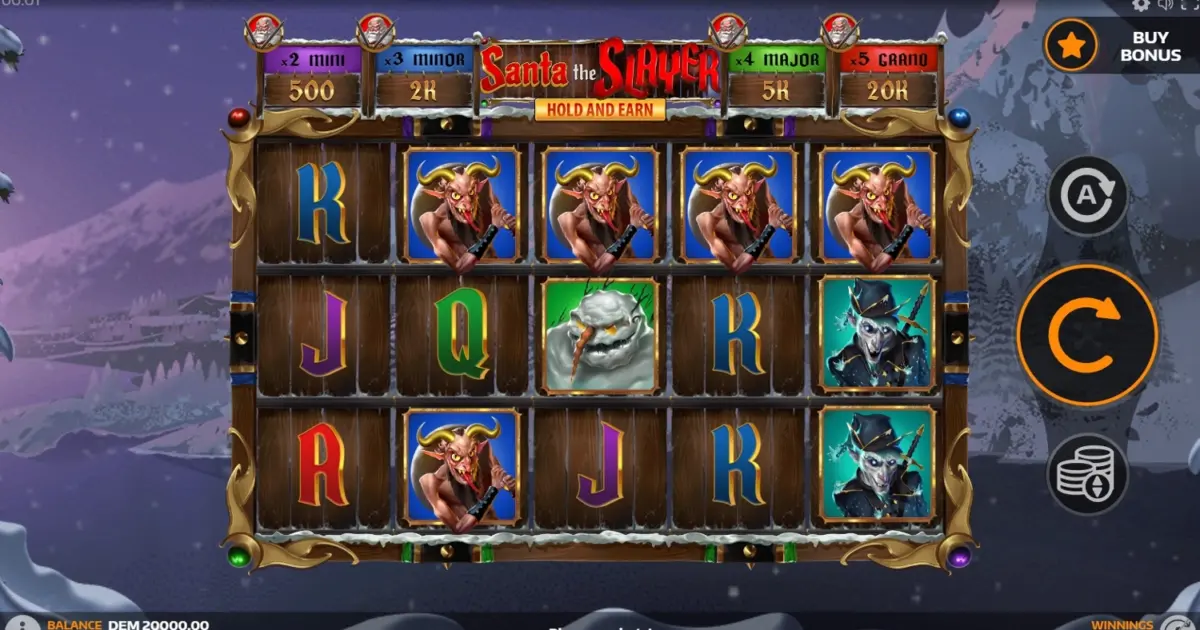
Santa the Slayer is a 5-reel Winter slot from Mancala Gaming with a 95.0% RTP, so your decision comes down to how you feel about a slightly below-average return paired with an undetailed volatility profile. If you want a free-demo comparison game before you commit bankroll, the value here is in testing session length rather than chasing a headline feature. The santa the slayer slot works best as a measured, entertainment-first spin.
The 5-reel grid explained
A 5-reel grid is the most common layout in modern video slots, and Santa the Slayer uses that format. In general terms, five vertical reels spin independently and then stop to display a matrix of symbols, usually with three or four rows visible per reel. That structure does not by itself determine how the game pays; paylines or ways mechanics do. It does determine how much information you see per spin and how combinations can form across the screen.
What you can take from the 5-reel label is familiarity. Most 5-reel games are designed around left-to-right evaluations, with wins assessed across adjacent reels. Without published row counts, payline counts or ways numbers for this title, you cannot assume a specific number of winning routes. The sensible approach is to treat the grid as standard until you load the free demo and check the paytable in-game, where reel height, symbol distribution and evaluation rules are displayed.
From a session-planning view, reel count alone tells you little about hit frequency or variance. Two 5-reel games can behave very differently depending on their maths model. For this reason, the grid explained here is best understood as a container. The RTP, paytable and volatility settings — where published — are what shape results over time. In this case Mancala Gaming has published the RTP at 95.0% but has not published volatility, hit frequency, stake range or a max win figure, so those gaps should guide how cautiously you trial the game.
Paylines, ways and how Santa the Slayer pays
No payline count, ways count or symbol paytable has been published for Santa the Slayer in the data supplied for this review. That absence matters, because paylines and ways define exactly how combinations are counted. Rather than guess, this section sets out the general mechanics you will see across many slots, so you can check which one this game uses once you open its information screen.
Many slots use fixed paylines: a set number of predefined routes across the reels, with wins paid left-to-right when matching symbols land on one or more of those lines. A win on a single line can occur even if the same symbols appear elsewhere off-line. Other games use ways-to-win, where any matching symbols on adjacent reels count, regardless of their row position. Ways games often quote totals like 243 or 1,024 ways, reflecting the number of possible adjacent-reel routes. Both systems still pay according to the paytable values assigned to each symbol combination.
Many slots also include concepts such as wild symbols that substitute for regular symbols, and scatter symbols that may pay or trigger features regardless of paylines. How wilds and scatters behave — if they appear at all — is specific to each title. Because Santa the Slayer has no published detail on these points, you should verify in the demo whether wilds substitute, whether scatters exist, and whether wins pay left-to-right, both ways or via clusters. Treat any third-party description of line counts or feature triggers with caution until you see it in the built-in help pages.
95.0% RTP put in context for santa the slayer slot
Return to Player is a long-run statistical average, not a promise for a single session. A 95.0% RTP means that, across a very large sample, the game is designed to return £95.00 for every £100.00 wagered, with the remaining £5.00 representing the house edge in that model. Every spin remains independent; past results do not change the expected return of the next spin.
In context, 95.0% sits below the broader corpus average of 95.71% by 0.71 percentage points, and it is essentially in line with Mancala Gaming’s own average of 95.01% across 90 games in the data set. The difference versus the corpus is small in percentage terms but meaningful if you compare many titles over many spins. Over 10,000 spins at £1 a stake, total wagers equal £10,000. At 95.0% the theoretical return is £9,500 and the theoretical cost is £500. At 95.71% the theoretical return would be £9,571 and the cost £429, a £71 difference in expected cost across that sample. In shorter samples of a few hundred spins, actual results will be dominated by variance, not by that 0.71-point gap.
Comparisons inside the same themes help. Among related Winter games, Mammoth Tundra is published at 95.4% RTP, 0.4 points above Santa the Slayer, while Barragan en Laponia sits at 95.0%, level with it. Those are the only direct RTP figures available from the related sets where Cash Chalet has no published RTP. Use these head-to-head numbers rather than adjectives when you decide which demo to try first.
| Figure | Value |
|---|---|
| Game | Santa the Slayer |
| Provider | Mancala Gaming |
| RTP | 95.0% |
| Reels | 5 |
| Themes | Winter, Christmas, 5-Reels |
| Primary theme | Winter |
| Popularity rank | 2458 |
| Provider average RTP (90 games) | 95.01% |
| Corpus average RTP | 95.71% |
Volatility and hit patterns
No volatility classification has been published for Santa the Slayer, and no hit frequency figure is available in the data supplied. That absence is itself information: you cannot plan bankroll around a low, medium or high label for this game without seeing more from the provider. Volatility, where published, describes the shape of returns over time — how often wins tend to occur and how large the swings can be — not whether the game is more or less likely to be profitable overall, which is governed by RTP and randomness.
In general terms, low-volatility slots tend to produce more frequent but smaller wins, which can extend session length on a fixed budget but rarely produce large departures from the average in a single session. High-volatility slots tend to produce fewer wins with larger gaps between them, which can exhaust a budget quickly and also produce larger single-win spikes relative to stake. Medium volatility sits between those patterns. Many modern games disclose this label alongside the RTP so you can match the profile to your preference for steadier play versus larger swings.
Without a published hit frequency, you also lack the complementary figure that would say, on average, what share of spins produce any win. Some providers quote overall hit frequency, some quote feature hit frequency, and many quote neither. For Santa the Slayer, neither is available here. The practical implication is to treat early demo sessions as exploratory: set a spin count rather than a target, observe how often the balance ticks upward versus drains, and do not infer a stable hit pattern from a few dozen spins. Because spins are independent, even a long run of wins or losses does not make the opposite outcome more likely next.
Choosing a stake between published limits
Mancala Gaming has not published a minimum or maximum stake, a default bet or a max win figure for Santa the Slayer in the data supplied for this review. This section therefore deals with what the absence of stake limits means for planning, rather than recommending a specific coin size that cannot be verified. When limits are unpublished in an overview, they are typically displayed inside the game client itself, in the bet configuration panel and the help file.
In general, stake choice interacts with bankroll and session length in a straightforward mathematical way. Total cost for a session, before variance, is stake multiplied by number of spins. At £0.20 a spin, 500 spins represent £100 wagered; at £1.00 a spin, the same 500 spins represent £500 wagered. The expected theoretical return scales with that total, but the short-term swing around the expectation grows when stake size grows relative to your budget. That is why two players can have very different experiences on the same RTP game if their stakes and spin counts differ.
Until you can see the actual minimum and maximum in the demo, the most useful check is to open the bet panel and note three things: the lowest selectable stake, the increments between stakes, and any max-bet behavior on autoplay. If you are comparing games, note that neither Mustang Rush nor the other provider-matched titles have distinct stake limits disclosed in this data set, so Santa the Slayer is not an outlier in that regard. Once you have the real limits, set a total budget for the session, divide it by the stake you intend to use to get a rough spin count, and treat that count as your entertainment plan rather than a path to a target.
Demo play versus real money
Free demo play is available for Santa the Slayer, which is the most useful way to inspect what the overview data does not cover. In demo mode you can confirm the row count, paytable values, payline or ways count, help-file rules and the actual stake limits without spending. The maths model in a reputable demo is intended to mirror the real-money version at the same RTP setting, but demo credits have no cash value and demo outcomes do not predict real-money results. A strong or weak run in free play does not make the next real-money session more or less likely to behave the same way.
Playing for real money introduces financial risk that demo play does not. Set a budget before you start, treat that amount as the price of entertainment, and use deposit and time limits if you have access to them. Keep stakes proportionate to the budget so that a normal losing streak does not end the session in a handful of spins. This is adult entertainment for over-18s, and it should remain paid entertainment with a firm stop point. If you need to pause or get support, use your jurisdiction’s responsible-gambling tools and consider taking a break.
Because this review site focuses on comparative numbers, the practical difference between the two modes is clarity. Demo play gives you the missing specifics — paytable, lines or ways, bet range, help-file RTP confirmation — while real-money play adds cost and variance. Use the demo to decide whether the game’s pace and paytable suit you, and do not interpret demo hit patterns as evidence that the game is hot or cold. Each spin is random and independent, regardless of mode.
Verdict on Santa the Slayer
Santa the Slayer is a straightforward proposition based on what is actually published: a 5-reel Mancala Gaming slot in the Winter and Christmas grouping, with a 95.0% RTP and a popularity rank of 2458, placing it in the 87.7th percentile for visibility in a catalogue of 365 Winter-themed games. The RTP is marginally below the corpus average of 95.71% and almost exactly on the provider average of 95.01%, so the maths alone does not make it a standout value or a poor value versus Mancala Gaming’s own range.
The gaps are the main story. Without published volatility, hit frequency, paylines or ways, stake limits or a max win figure, you cannot fully model session length or swing size from this overview alone. That does not make the game unworthy of a try; it makes the free demo the sensible next step if the theme appeals. Load the demo, check the help file for the missing details, and compare the in-game RTP confirmation to the 95.0% published here. If you prefer numbers you can verify before you spin for real, that quick check will tell you more than any adjective.
For comparison, consider trialling a thematically adjacent title with a slightly higher published RTP, or stay within the provider’s 95.0% group to keep the maths level and compare by paytable and pacing. In either case, keep sessions budget-led and treat the spin as independent entertainment. Santa the Slayer does not publish enough to earn a strong buy or avoid on the figures alone, but it is well suited to a short, structured demo comparison before you decide.
Frequently Asked Questions
Can I play Santa the Slayer for free before wagering?
Free demo play is listed as available for Santa the Slayer, so you can load the demo to inspect the paytable, reel layout and bet panel without spending. Demo credits have no cash value and outcomes in demo do not predict what will happen in real-money sessions, as each spin is independent.
What is the RTP of Santa the Slayer and what does it mean in practice?
The published RTP is 95.0%, which means the game is designed to return £95.00 for every £100.00 wagered across a very large sample, leaving a 5.00% house edge. That is 0.71 points below the corpus average of 95.71% and on Mancala Gaming's average of 95.01%. Short sessions will vary widely around that average.
What volatility is Santa the Slayer?
No volatility rating or hit frequency has been published for Santa the Slayer in the data supplied, so you cannot assume low, medium or high behaviour. In general, low volatility tends to give more frequent smaller wins and longer sessions, while high volatility gives larger, less frequent swings. Check the in-game help file in the demo for any disclosure.
Who makes Santa the Slayer and what else do they offer?
Santa the Slayer is made by Mancala Gaming, credited with 90 games at an average RTP of 95.01% in the data set. Other titles from the same provider at 95.0% include Mustang Rush, Book of Wealth III and Majestic Wolf. The theme count for Winter slots overall is 365, so there are many direct comparisons.
Does Santa the Slayer pay real money in demo mode?
Demo play does not pay real money; it uses play credits with no cash value and is for learning the rules and paytable. To have the chance of real returns and the risk of real losses, you must play the real-money version with a funded balance, within a budget you set beforehand as entertainment spending.