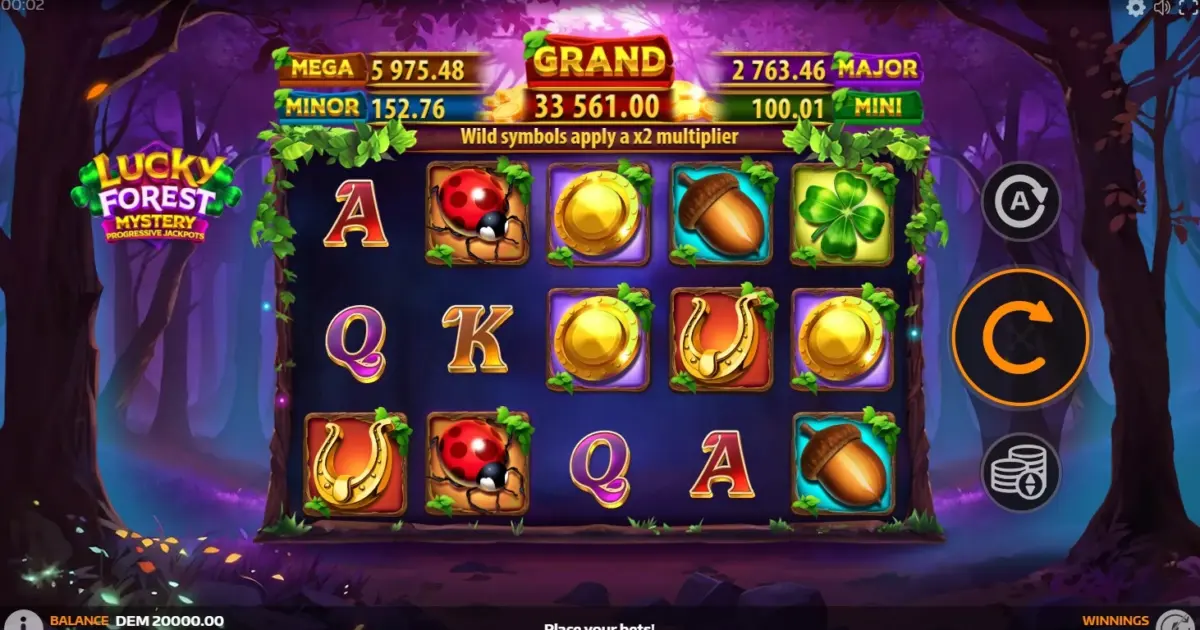
If you want one number to decide on, it is 95%. That is the published return to player for this Mancala Gaming release, and it sits below the average across the games we track. Everything else about the game — layout aside — is either unpublished or generic, so this review works the maths and tells you plainly where the gaps are.
The good news: a free demo exists, so you can see how the lucky forest slot actually behaves without committing money to a return figure you might not like.
Lucky Forest slot at a glance
Here are the figures Mancala Gaming and our database supply. Rows that do not appear below are rows where no data exists — no published volatility rating, no paytable detail, no stake range, no maximum win multiplier.
| Field | Value |
|---|---|
| Provider | Mancala Gaming |
| RTP | 95.0% |
| Reels | 5 |
| Type | Slot Machine |
| Themes | Animals, Nature, 5-Reels |
| Popularity rank | 2,424 (87.9th percentile) |
| Provider average RTP | 95.01% across 90 games |
| Database average RTP | 95.71% |
| Free demo | Available |
Who does that suit? Someone who already likes Mancala Gaming’s output and is not shopping purely on return percentage. Someone comparing dozens of animal-themed games will find 1,788 alternatives in that category alone, and several of them publish higher figures. The 87.9th popularity percentile says a reasonable number of people do open this one, but popularity is a measure of traffic, not of value.
What a 95% RTP actually returns
RTP is a long-run statistical average, calculated across millions of simulated spins. A 95% figure means the game is modelled to return £95 for every £100 wagered over that very large sample. The remaining £5 is the house edge. It is not a promise about your session, your day or your month — it is the number the maths settles on given enough spins, and no individual player ever plays enough spins to reach it.
Work it through. Suppose you staked £0.20 per spin for 1,000 spins — Mancala Gaming has not published the stake range for this title, so treat that figure purely as an illustration. You would wager £200. The modelled return is £190, so the expected cost of that session is £10. Stake £1 instead and you wager £1,000, with an expected cost of £50.
Against the database average of 95.71%, this game gives up 0.71 percentage points. On £1,000 of total wagering that difference is about £7.10 in extra expected cost. Small per spin, visible over a long run. Notably, the provider average is 95.01%, so this is not an outlier for Mancala Gaming — it is their standard setting.
Volatility is unpublished, so judge the session yourself
There is no volatility or variance rating for this game in the data available, and Mancala Gaming has not published one. If you see a slot review confidently calling it “medium volatility”, ask where that came from.
The absence matters, because volatility is what you actually feel. Low-volatility games pay small amounts often; your balance drifts down gently and sessions last a long time on a modest budget. High-volatility games pay rarely and larger; long dry stretches are normal, swings are wide, and the same budget can disappear in a fraction of the spins. Two games with identical 95% RTP can produce completely different experiences depending on where they sit on that scale.
Since the rating is missing, the demo is your measuring instrument. Play a few hundred spins and watch two things: how often any win lands at all, and how big the largest win is relative to your stake. Frequent small returns point one way; long gaps punctuated by occasional larger hits point the other. That tells you more than any label would.
One thing to hold onto regardless: every spin is an independent event. Previous results do not change the odds of the next one.
The 5-reel layout and how wins are counted
Five reels is the standard modern layout, and it is the one piece of structural information confirmed here. What is not confirmed is how wins are evaluated across those reels, because no payline or ways count is published for this title.
That gap is worth understanding rather than guessing at. Across the industry, five-reel games usually resolve wins in one of three ways. Fixed paylines define set patterns, typically 10, 20 or 25, and symbols must land on those exact positions. Ways or “all ways” systems pay for matching symbols in any position on consecutive reels, which usually means more frequent small returns. Cluster and Megaways mechanics change the count dynamically from spin to spin. Apex Strike Megaways is a straightforward example of that last approach if you want to compare mechanics side by side, and it publishes a 96.13% RTP.
Many slots also include wilds, scatters and free-spin rounds, and some sell a bonus entry outright. None of those are confirmed features of this game. The demo paytable will tell you in under a minute what the marketing material does not.
Stake range and sizing a bankroll
No minimum or maximum stake is published for this release, so check the bet controls in the demo or at whatever operator you are looking at before you plan anything. Limits also vary between operators for the same game.
The sizing logic does not depend on the specific numbers. Decide your session budget first, then divide by the number of spins you want it to cover, and let that dictate your stake. A £40 budget spread over 400 spins means £0.10 a spin. The same £40 at £1 a spin buys you 40 spins, and with an unknown volatility profile those 40 spins could easily produce nothing at all.
Two things that do not help: no stake pattern, progression or timing changes the expected value of a slot, and no amount of bet sizing alters the 95% figure. Raising your stake after losses increases the money at risk, nothing more. Stake size controls how long your budget lasts and how large the swings feel, and that is the full extent of its power. Set it once and leave it.
Playing the Lucky Forest demo before you commit
A free demo is available, which is genuinely useful given how much is unpublished. In demo mode you play with virtual credits, the same maths engine runs underneath, and you can check the paytable, the bet range and the general rhythm of the game at no cost. Most sites offer it with no download and no account.
The Lucky Forest free demo will not, however, predict your real-money results. Demo sessions are short, outcomes are random, and a lucky or dismal run of a few hundred spins tells you nothing about the next few hundred. Use it to answer questions about mechanics, not about profit.
If you do move to real stakes: this is for adults 18 and over, set a budget before you open the game, and treat the money as the price of entertainment rather than an investment you expect back. Walk away when the budget is gone. That is the whole of it.
Verdict: who should play Lucky Forest
This is a middling proposition on paper. The 95% return is 0.71 points under the database average, the volatility rating is missing, and the paytable structure is undocumented — so you are buying partly on trust and partly on whether the demo appeals to you.
It makes sense if you specifically like this studio’s games. Mancala Gaming slots average 95.01% RTP across 90 titles, so this is representative rather than a weak entry in their range. Majestic Wolf is the closest comparison from the same provider at the same 95% return if you want another animal-themed option from them.
If return percentage is what you are optimising for, look elsewhere. Strength of Hercules publishes 96.31%, which is 1.31 points better and cuts roughly £13 off the expected cost of every £1,000 wagered. Over a long run that is the more meaningful difference. Try the demo here, enjoy it if it clicks, but go in knowing exactly what the numbers say.
Frequently Asked Questions
Can I play Lucky Forest for free?
A free demo is available for this Mancala Gaming title, and most review sites host it with no download and no registration. You play with virtual credits against the same 95% RTP maths engine, which makes it a sensible way to check the paytable and bet controls before risking anything.
What is the RTP of Lucky Forest?
The published return to player is 95.0%, meaning the game is modelled to return £95 per £100 wagered across a very large sample. That is 0.71 percentage points below the 95.71% average across our database, so expect roughly £7 more in long-run cost per £1,000 staked.
How volatile is Lucky Forest?
No volatility rating has been published for this game, so any site quoting one is guessing. Play several hundred demo spins and watch win frequency and the size of the biggest hit relative to your stake. Frequent small returns suggest lower variance; long gaps suggest higher.
Who is Mancala Gaming and what else do they make?
Mancala Gaming is the studio behind this release, with 90 titles in our database averaging 95.01% RTP. That average tells you their house style sits around the 95% mark. Mustang Rush, Book of Wealth III and Majestic Wolf all share the same 95.0% figure as this game.
How does Lucky Forest compare to Strength of Hercules?
Strength of Hercules publishes a 96.31% RTP against 95.0% here, a 1.31 point advantage that works out to about £13 less expected cost per £1,000 wagered. Both are five-reel games. If return percentage is your deciding factor, the Hercules title is the stronger pick on paper.