The single most decision-relevant fact about the emerald fantasy slot is its 94.91% RTP, which sits 0.8 percentage points under the 95.71% average across the games catalogued on this site and 0.63 points under the 95.54% average of FlipLuck Games’ own 71 titles. That is a real, measurable cost per unit staked over a long sample. A free demo is available, so you can look at the reels without spending anything, and there are higher-return alternatives from the same studio if the figure bothers you.
| Detail | Value |
|---|---|
| Game | Emerald Fantasy |
| Provider | FlipLuck Games |
| RTP | 94.91% |
| Reels | 5 |
| Category | Slot Machine |
| Theme label | 5-Reels |
| Popularity rank | 2278 (88.6th percentile) |
| Provider average RTP | 95.54% across 71 games |
| Site average RTP | 95.71% |
| Free demo | Available |
The 5-reel grid explained
Five reels is the default shape of the modern online slot, and it is the one confirmed structural fact here. A five-reel layout gives the maths more room than the three-reel classics: more reel positions means more possible symbol combinations, which lets a designer spread prizes across a wider range of sizes rather than concentrating everything in one rare jackpot line.
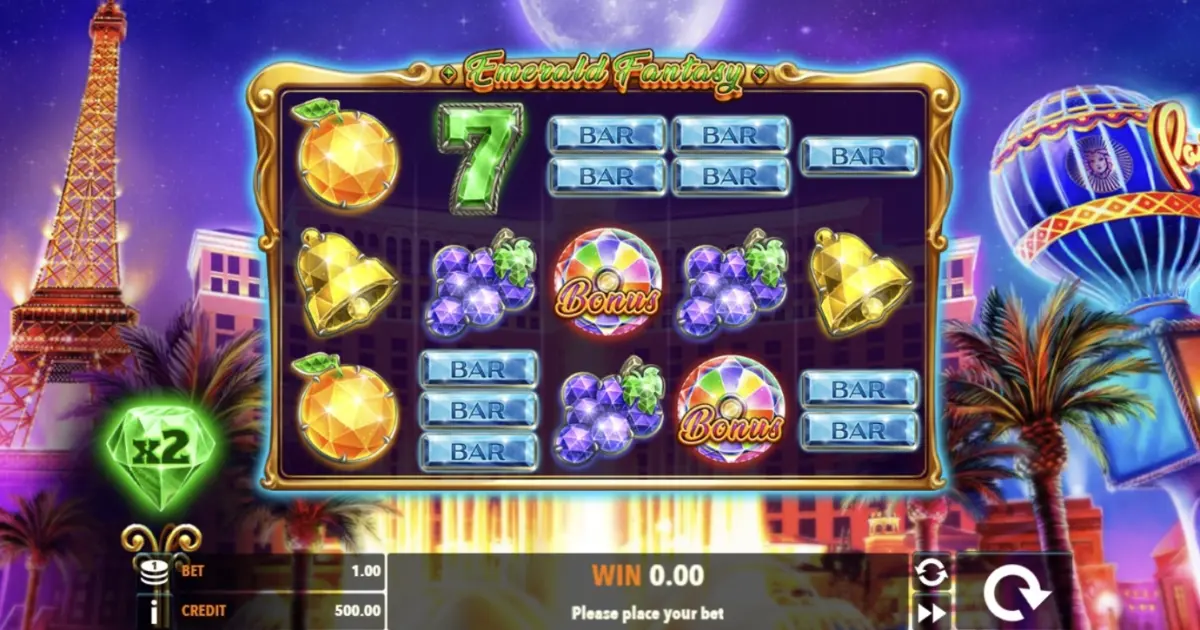
What FACTS does not tell you is the row count. Five reels with three rows gives 15 visible positions; five with four rows gives 20; a 5×5 grid gives 25. Those are different games in practice, because the number of positions drives how often symbols can cluster and how many win patterns a designer can define. Since that detail is not published in the data available here, the demo is the fastest way to see the grid for yourself.
Treat the “5-Reels” theme label the same way. It describes the layout, not a setting, a story or an art direction. There is no theme information here beyond that, so anyone describing the visuals in detail is describing something they have seen in the game itself rather than anything documented.
Paylines, ways and how Emerald Fantasy pays
No payline or ways count is published for this title, so the honest answer is that the win-evaluation method is unknown until you open the game. That is worth knowing rather than glossing over, because it is one of the details that changes how a session feels.
In general terms, five-reel slots resolve wins in one of three ways. Fixed paylines check specific patterned routes across the reels, so a win depends on symbols landing in defined positions. “Ways” or “all ways” systems ignore position within a reel and pay when matching symbols appear anywhere on consecutive reels, which is how counts like 243 or 1,024 ways arise. Cluster and scatter-pays systems drop lines entirely and count total matching symbols on screen.
Many slots also layer on wilds that substitute for other symbols, scatters that trigger free spins, and occasionally a paid feature entry. Those are common industry conventions, not documented features of this game. Assume nothing about which of them applies here; the demo answers the question in a minute or two.
94.91% RTP put in context
RTP is a long-run average, not a session promise. At 94.91%, the theoretical return is £94.91 per £100 staked across a very large number of spins, leaving a house edge of 5.09%. Stake £1 a spin for 1,000 spins and you have wagered £1,000, with a theoretical return of £949 and a modelled cost of about £51. Actual results over 1,000 spins will scatter widely around that line, and nothing you do changes the expected value, because every spin is settled independently of the last.
The comparison is where this figure earns attention. Against the 95.71% site average, the gap of 0.8 points is roughly £8 more theoretical cost per £1,000 wagered. Against FlipLuck Games’ own 95.54% average, this title is one of the studio’s weaker returns rather than a typical one.
Within the same catalogue, King’s Alchemist is set at 96.35%, a 1.44-point improvement that works out at about £14 less theoretical cost per £1,000 staked. Lucky Ladies at 95.71% lands exactly on the site average. If return figures drive your choice, both are stronger starting points.
Volatility and hit patterns
FlipLuck Games has not published a volatility rating or a hit frequency for this game, so treat any figure quoted elsewhere with caution. Volatility and RTP are separate dials: two games can both return 94.91% in theory while feeling nothing alike.
Low volatility means frequent small wins, shallower swings and a bankroll that drains slowly and predictably. High volatility means long dry stretches punctuated by rarer, larger payouts, which demands a bigger bankroll relative to your stake and produces short sessions that look nothing like the theoretical return. Medium sits between the two. None of these patterns is better or worse mathematically; they are different distributions around the same average.
Because the rating is unknown here, the practical move is to play the demo for a few hundred spins and watch the shape of the results: how often something lands, how deep the gaps run. That tells you about the distribution, though it never tells you what the next spin will do. No slot is ever due, hot or cold.
Choosing a stake between the game’s minimum and maximum
The bet limits are not listed in the data available here, which means you will see the actual minimum and maximum in the game’s own stake selector. The reasoning still works without the numbers.
Start from the budget, not the stake. Decide the total you are willing to spend on the session, then divide it by the number of spins you want it to last. A £40 budget stretched over 400 spins points to 10p a spin; the same £40 over 100 spins points to 40p. At 94.91% RTP, that 400-spin session at 10p wagers £40 with a theoretical return of about £37.96.
Stake size does not change the house edge. Doubling the stake doubles both the swing and the expected cost per spin, nothing more. Raising or lowering bets according to recent results changes neither the odds nor the expected value, since outcomes are independent. If the minimum stake is higher than your budget comfortably supports, that is a reason to pick a different game rather than to shorten the session.
Demo play versus real money
The Emerald Fantasy free demo runs on the same random outcome engine as the paid version, so it is an accurate way to learn the grid, the pay method and the pace before any money moves. What it cannot do is indicate what real-money play will return. A lucky demo run and an unlucky one carry exactly the same information about the future: none. Demo credits also cannot be converted into withdrawable money.
Use the demo for the things it genuinely answers. How many rows does the grid show? Does it pay on lines, ways or clusters? How long do the quiet stretches run at your intended stake? Those are the questions worth a few hundred free spins.
Slots are 18+ and priced entertainment, not a way to make money. Set a budget before you start, treat it as spent the moment you sit down, and stop when it is gone rather than topping it up.
Verdict on the Emerald Fantasy slot
This is a five-reel game from a studio with 71 titles on record, well known enough to sit in the 88.6th popularity percentile at rank 2278, and priced at a return below both its studio average and the wider average here. The 94.91% figure is the sticking point: a 5.09% house edge is a real long-run cost, and FlipLuck Games has published stronger numbers elsewhere.
The gaps in the published data matter too. With no volatility rating, no payline count, no row count and no stake range documented, there is little to judge from a spec sheet alone. The demo closes those gaps at no cost, which is the sensible first step.
If you want a higher return from the same studio, Dog House Bonanza at 95.00% is a marginal improvement and King’s Alchemist at 96.35% a clear one. Play this one in demo mode first, and let the mechanics you find there decide whether the 0.8-point RTP shortfall is worth accepting.
Frequently Asked Questions
Can I play Emerald Fantasy for free?
A free demo is available for this title, so you can spin the five-reel game without staking anything. The demo uses the same outcome engine as the paid version, making it a fair way to see the grid layout and pay method. Demo credits have no cash value and cannot be withdrawn.
What is the RTP of Emerald Fantasy and is it good?
The RTP is 94.91%, meaning a theoretical return of £94.91 per £100 staked across a very large sample and a 5.09% house edge. That is below the 95.71% average across games listed here and below FlipLuck Games' own 95.54% average, so it is a weaker return rather than a competitive one.
How volatile is Emerald Fantasy?
No volatility rating or hit frequency has been published for this game, so any number you see quoted elsewhere is unverified. Volatility is separate from the 94.91% RTP: it describes how results scatter around that average, not the average itself. Running a few hundred demo spins is the practical way to gauge the swing pattern.
Who makes Emerald Fantasy and what else do they produce?
FlipLuck Games developed it, a studio with 71 titles catalogued here at an average RTP of 95.54%. Their range includes King's Alchemist at 96.35%, Lucky Ladies at 95.71% and Dog House Bonanza at 95.00%. All three carry a higher published return than this game's 94.91%.
How much should I bet per spin on Emerald Fantasy?
The stake range is not published in the data available here, so check the in-game selector. Work backwards from your budget instead: a £40 session intended to last 400 spins points to 10p a spin. Stake size never changes the 5.09% house edge, only the size of the swings.