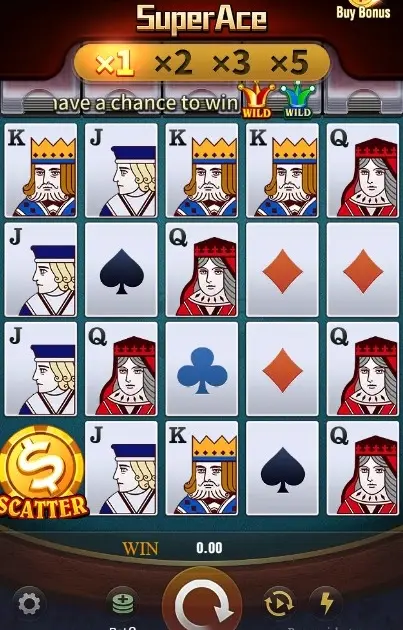
Super Ace slot draws players with a card-deck visual language and a 5-reel layout that feels familiar to anyone who has played video poker hybrids. The catch that shapes every decision below: TaDa Gaming has never released a theoretical return-to-player figure for this title, so the single most important number for evaluating any slot is absent.
The 5-reel grid explained
Super Ace uses a 5-reel layout, which places it in the most common structural category in online slots. Five reels give developers enough columns to build overlapping winning combinations without the visual clutter that appears on 7-reel or 10-reel games. For you as a player, the practical consequence is that the game reads quickly — you can track what lands on each reel without scanning a wall of symbols.
The card theme means the reel faces are populated with playing-card ranks and suits rather than fruit icons or ancient artefacts. This is a cosmetic choice, not a mechanical one. A 5-reel game with card symbols behaves identically to a 5-reel game with Egyptian symbols in terms of how wins are calculated. The theme affects engagement and readability; the mathematics lives elsewhere.
TaDa Gaming has built 118 titles to date, and Super Ace sits at popularity rank 148 overall with a 99.3 percentile ranking — meaning it outperforms 99.3% of games in the library by engagement volume. That tells you players find the format compelling. It does not tell you anything about the return.
Paylines, ways and how Super Ace pays
Facts available to this review do not specify whether Super Ace uses fixed paylines, selectable paylines, a “ways” mechanic or cluster pays. Many 5-reel slots with a card theme deploy between 10 and 25 fixed paylines, because card symbols pair well with horizontal and diagonal line wins that mimic poker hands. That is a general observation about the subgenre, not a confirmed specification for this game.
What matters for your bankroll planning is this: if the game uses fixed paylines, every spin costs the same regardless of how many symbols land. If it uses a ways mechanic (243 or 1024 ways, say), the number of potential winning combinations per spin is much larger, which tends to produce more frequent but smaller individual payouts. You can check which applies by loading the free demo and reviewing the paytable — no registration required.
The absence of this detail in published materials is itself a small signal. Providers that market aggressive ways-mechanic games typically lead with that number in promotional copy. Super Ace’s silence here may indicate a conventional payline structure, but that is inference, not confirmation.
RTP put in context
TaDa Gaming has not published an RTP for Super Ace. You will not find a percentage on the provider’s site, and no third-party audit report we can reference attaches one to this title. Where you see a figure quoted on other review sites, treat it as unverified.
The table below places what is available alongside what you would want to know.
| Metric | Super Ace | TaDa Gaming average | All-games corpus average |
|---|---|---|---|
| RTP | Not published | 96.79% | 95.71% |
| Volatility | Medium | — | — |
| Min stake | $0.05 | — | — |
| Max stake | $100.00 | — | — |
TaDa Gaming’s provider-wide average RTP of 96.79% is above the all-games corpus average of 95.71%. If Super Ace tracks that provider average — and there is no reason it must — you would expect roughly $96.79 returned per $100 wagered across a very large sample. Fortune Gems, another TaDa title, carries a published 97.0%, showing the provider can and does hit near that mark elsewhere.
The gap between 96.79% and 95.71% sounds small. Over 10,000 spins at $1 per spin, it represents a $108 difference in total return. Over a casual session of 500 spins, the expected difference narrows to roughly $5.40, but the variance in either direction swamps that figure entirely.
Volatility and hit patterns
Super Ace is classified as medium volatility. In practical terms, medium volatility means you should expect neither the long dry stretches of a high-variance title nor the constant small nudges of a low-variance game. Winning spins arrive at a moderate cadence, and the payouts when they land tend to cluster around 1× to 5× your stake rather than spiking to 50× or more.
For your bankroll, medium volatility is the least punishing category to plan around. You do not need the large starting balance that high-variance games demand, and you will not feel the flat tedium that can make low-variance sessions drag. A budget that covers roughly 80 to 150 spins at your chosen stake is a reasonable baseline for a single session in this volatility band.
No hit-frequency figure is published for Super Ace. Hit frequency tells you what percentage of spins return any amount above zero. Medium-volatility games in the broader market typically sit between 20% and 35%. That means you can expect roughly one win every three to five spins. This is a market-wide observation, not a game-specific statistic.
Choosing a stake between $0.05 and $100.00
The stake range spans three orders of magnitude — from five cents to one hundred dollars per spin. That breadth means the game caters to penny-pinners and high rollers within the same title, but the strategy differs completely between the two extremes.
At the $0.05 floor, a $50 bankroll covers 1,000 spins. At medium volatility, that is enough sample size to see the game’s rhythm play out without an early bust. This is the sensible starting point for anyone evaluating the title with real money for the first time.
At the $100 ceiling, a $500 bankroll covers only 5 spins. Even at medium volatility, that is razor-thin. A realistic session budget at maximum stake would need to start around $2,000–$5,000 to survive a normal swing without depleting. Queenie, a card-themed alternative at 96.51% published RTP, offers a narrower stake range that may suit players who prefer to stay in the $1–$5 zone where session math is more forgiving.
Demo play versus real money
Super Ace is available as a free demo. The demo runs the same random number generator as the real-money version, so the sequence of outcomes is structurally identical. What is not identical is your relationship to those outcomes. In a demo, a 40-spin cold streak costs you nothing. In real money, that same streak drains your balance and can trigger chasing behaviour that no statistical model accounts for.
Never treat demo results as predictive of real-money performance. The RNG does not care whether you are wagering play credits or dollars. A hot demo session does not mean the real version will behave differently, and a cold demo does not mean you are owed a recovery.
Use the demo for two purposes only: to learn the paytable structure and to confirm you enjoy the visual pacing. Once you have done that, the demo has served its function. Set a budget before switching to real play, treat the entire session as paid entertainment rather than an investment, and stop when the budget is spent regardless of outcomes. You must be 18 or older to play for money in any jurisdiction that regulates this game.
Verdict on the Super Ace Slot
Super Ace is a well-constructed card-themed slot with a broad stake range and medium volatility that makes it easy to plan a session around. Its 99.3 popularity percentile confirms that players respond to the format. Money Coming, another TaDa release, shows the provider experimenting across different visual languages while maintaining the same structural backbone.
The missing RTP is a genuine gap, not a nitpick. Without a published return figure, you cannot calculate your expected loss rate over a given number of spins, which is the single most useful number a slot reviewer can provide. If the provider average of 96.79% holds here, the game is competitive. If it does not, you will not know until you have spent money.
Our recommendation: play the demo first. If you move to real money, start at the $0.05–$0.50 range where a $50 bankroll gives you 100–1,000 spins — enough volume to feel whether the pacing suits you, with limited downside while the RTP question remains open. The card theme and medium volatility make this a comfortable casual option; the missing data make it a questionable long-term value proposition until TaDa Gaming publishes the number.
Frequently Asked Questions
Is there a free demo of Super Ace slot available?
Yes, TaDa Gaming offers a free demo of Super Ace that you can play without registration or deposit. The demo uses the same random number generator as the real-money version, so the outcome structure is identical. It is useful for learning the paytable and judging whether the medium-volatility pacing suits your preference before risking funds.
What is the RTP for Super Ace slot?
TaDa Gaming has not published an RTP figure for Super Ace, so no verified percentage exists for this specific title. The provider's average RTP across its 118 games is 96.79%, and the all-games corpus average is 95.71%. Any RTP number you see quoted elsewhere for Super Ace is unverified and should be treated with caution.
Is Super Ace high or low volatility?
Super Ace is classified as medium volatility by TaDa Gaming. This means you can expect a moderate cadence of wins without the extreme dry spells found in high-variance titles or the repetitive micro-payouts of low-variance games. A reasonable session budget at medium volatility covers roughly 80 to 150 spins at your chosen stake.
Who makes Super Ace slot and what else do they produce?
Super Ace is developed by TaDa Gaming, a studio with 118 titles in its catalogue. Their average RTP across all games is 96.79%, which is above the all-games corpus average of 95.71%. Other TaDa releases include Fortune Gems at 97.0% RTP, Money Coming, and Boxing King, spanning various themes and mechanics.
What are the minimum and maximum bets on Super Ace?
Super Ace accepts stakes from $0.05 to $100.00 per spin, a range spanning three orders of magnitude. At the minimum, a $50 budget covers 1,000 spins. At the maximum, a $500 budget covers only 5 spins. The wide range lets the same game serve casual players and high rollers, but the bankroll planning differs dramatically between the extremes.