The single most decision-relevant fact about the eye of horus megaways slot is its return to player: 95.45%. That is marginally below the 95.5% average across Reel Time Gaming’s eleven titles and 0.26 percentage points below the 95.71% average of the games catalogued here. It is also popular, ranked 2218 and sitting in the 88.9th percentile for traffic, so plenty of people are playing it despite the maths. A free demo is available, which is the cheapest way to find out whether the pace suits you.
The reel grid explained
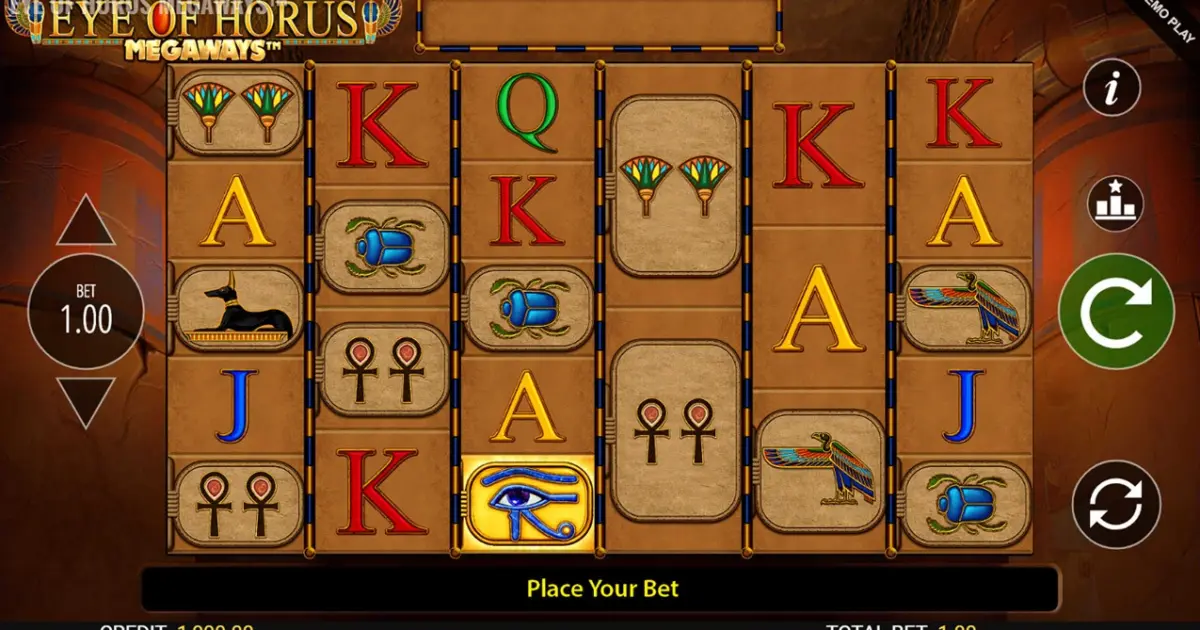
Reel Time Gaming has not published a grid size for this title, and no reel or row count appears in the data available here. That absence matters more than it looks. Grid dimensions are the first thing that tells you how a slot will behave: a compact three-reel layout produces short, blunt outcomes, while a six-reel layout with variable row heights produces long stretches of small returns punctuated by rarer, larger ones.
Games carrying the Megaways name are licensed to use a mechanic where the number of symbols on each reel changes from spin to spin, which in turn changes the number of ways to win on that spin. That is a description of the licensed mechanic in general, not a claim about how this specific release implements it. Since the numbers are not published, the demo is the only reliable way to see the grid in motion. Load it, watch twenty spins, and count the rows yourself. Treat any grid specification quoted on other sites as unverified until the provider confirms it.
| Provider | Reel Time Gaming |
|---|---|
| RTP | 95.45% |
| Free demo | Yes |
| Site-wide average RTP | 95.71% |
Paylines, ways and how Eye of Horus Megaways pays
No payline or ways figure is recorded for this game, so anyone quoting a precise maximum ways count is going beyond the published information. Here is what the terminology means in general so you can read the paytable yourself when you open it.
A payline slot pays when matching symbols land on a fixed, pre-drawn path across the reels. A ways slot drops fixed paths entirely and pays for matching symbols appearing anywhere on consecutive reels, left to right, with the total number of combinations calculated per spin. More ways does not mean better value. The total return is set by the paytable and the symbol distribution, and providers routinely reduce individual symbol payouts as the number of ways rises. Two games can advertise wildly different ways counts and return exactly the same percentage.
Many slots in this space also include wilds, scatters and free-spin rounds, and some sell a bonus entry directly. None of those features is confirmed for this title in the information available, so check the in-game paytable before you assume any of them are present. The paytable is the contract; marketing copy is not.
95.45% RTP put in context
Return to player is a long-run statistical average, not a promise about your session. A 95.45% figure means the game is modelled to return £95.45 for every £100 wagered across a sample far larger than any individual will ever play, with the remaining £4.55 forming the house edge. Over a short run, results scatter widely around that line in both directions.
Put it in spins. At £1 a spin, 500 spins means £500 wagered and a modelled return of roughly £477, an expected cost of about £23 for the session. At £0.20 a spin, the same 500 spins cost you about £4.55 in expectation. The percentage is fixed; what you control is the total amount wagered.
The comparison is where this game loses ground. The original Eye of Horus is recorded at 96.31%, nearly nine tenths of a percentage point better, which on £1,000 wagered is a difference of about £8.60 in expected cost. Two other Reel Time Gaming titles also sit higher: Fishin’ Frenzy at 96.12% and El Torero at 96.08%. If the house edge is your deciding factor, those are the stronger picks from the same studio.
Volatility and hit patterns
No volatility rating and no hit frequency figure are published for this game, so the honest answer is that its risk profile is unverified. What follows is how the categories behave in general, so you can classify it yourself from the demo.
Low volatility means frequent small returns, a slowly draining balance and long sessions from a modest bankroll. High volatility means most spins return nothing, with the game’s total return concentrated into rare larger outcomes, which requires a much bigger bankroll to survive the dry stretches. Medium sits between the two.
You can estimate the profile yourself: run a few hundred demo spins at a fixed stake and note how often anything pays at all, and how large the biggest single return is relative to your stake. Frequent small hits point low; long blanks with occasional spikes point high. One point worth being blunt about: every spin is independent of the last. A run of blanks does not make a payout more likely, and no slot is ever due, hot or cold.
Choosing a stake when no limits are published
Minimum and maximum bet figures are not recorded for this title, so you will need to read the stake selector in the game itself. The planning method does not change regardless of what those limits turn out to be.
Work backwards from a budget you have already decided you can afford to lose. Divide it by the number of spins you want the session to last, and that quotient is your stake. A £40 budget stretched across 400 spins means £0.10 per spin. If the game’s minimum is higher than the stake your budget implies, that is a straightforward signal the game is priced above your session and you should pick a different one rather than shortening the session.
Bear the 95.45% figure in mind while you do this arithmetic, because stake size multiplies it. Ten pounds a spin across 300 spins is £3,000 wagered and roughly £136 in expected cost. The same 300 spins at £0.20 costs about £2.73. No staking pattern, progression or timing alters the percentage: raising stakes after losses, lowering them after wins, or waiting for a particular moment all leave expected value exactly where it was.
Demo play versus real money
An Eye of Horus Megaways free demo is available, and it is worth using first. The demo shows you the grid, the paytable, the speed of play and how the game feels over a few hundred spins, all at no cost. Those are exactly the things the published data does not tell you here.
What the demo cannot do is forecast real-money results. Demo credits carry no value, so the emotional weight of a losing run is absent, and any sequence you see in free play says nothing about what the next real session will do. The 95.45% figure applies across enormous samples in either mode, and a lucky or dismal demo run is simply variance.
Slots are paid entertainment, not income, and they are for adults aged 18 and over only. Decide your budget before you start, use money you would otherwise spend on something else you enjoy, and stop when it is gone rather than topping it up. If tracking what you have spent has become uncomfortable, the deposit limits and time-out tools at any licensed operator exist for that reason.
Verdict on Eye of Horus Megaways
The case against this one is the number. At 95.45% it returns less than the Reel Time Gaming house average of 95.5% and less than the 95.71% catalogue average, and it is beaten by three of the studio’s own titles, most notably the original Eye of Horus at 96.31%. On top of that, the grid size, ways count, volatility rating and stake limits are all unpublished, which leaves you buying a game you cannot fully specify in advance.
The case for it is that it is genuinely well played. A rank of 2218 and an 88.9th percentile popularity score mean a large number of people keep coming back, which usually reflects pace and presentation rather than mathematics. If you already like the Egyptian-mythology framing that the name points to and you want the variable-ways version of it, the demo costs nothing to try.
Play it free first, and if the house edge is what you optimise for, take the 96.31% version instead. The difference is small per spin and meaningful across a few thousand of them.
Frequently Asked Questions
Can I play Eye of Horus Megaways for free?
Free play is available for this title, so you can run it in demo mode without wagering anything. That is the practical way to check the grid layout, paytable and pace, since Reel Time Gaming has not published the reel count, ways figure or volatility rating for this release.
What is the RTP of Eye of Horus Megaways?
The recorded return to player is 95.45%, meaning £95.45 returned per £100 wagered across a very large sample, with a £4.55 house edge. That sits slightly below Reel Time Gaming's 95.5% average and 0.26 points under the 95.71% catalogue average. Short sessions will scatter widely around that figure.
Is Eye of Horus Megaways high or low volatility?
No volatility rating is published for this game, so its risk profile is unverified. You can estimate it from a few hundred demo spins: frequent small returns suggest a lower-variance design, while long blank stretches broken by rare larger payouts suggest higher variance and a bigger bankroll requirement.
How does it compare to the original Eye of Horus?
On return to player the original wins. Eye of Horus is recorded at 96.31% against 95.45% here, a gap of 0.86 percentage points, which works out to roughly £8.60 less expected cost per £1,000 wagered. The Megaways version differs mainly in its variable-ways mechanic.
Who is Reel Time Gaming and what else do they make?
Reel Time Gaming is the studio behind this title, with eleven games catalogued here and an average return to player of 95.5%. Other Reel Time Gaming slots include Eye of Horus at 96.31%, Fishin' Frenzy at 96.12% and El Torero at 96.08%, all three above this game's figure.