Trinity Starlight is a Magic-themed slot from Fantasma Games that puts a 6-reel layout behind a 96.19% RTP, slightly above both the studio and wider market averages. If you compare games on numbers first, that combination makes the trinity starlight slot worth a shortlist spot, but the lack of published volatility and stake details means you should test expectations in demo before setting a budget.
Trinity Starlight at a glance
This is a 6-reel entry in the Magic and Fantasy space, categorised as a Slot Machine. Fantasma Games has released 49 titles, and this one sits at rank 2196 with a popularity percentile of 89.0, which places it outside the most-played tier but still within the tracked population where player data is available.
What matters for a quick decision is the headline maths and what is not disclosed. The published return is 96.19% RTP, the reel count is six, and the primary theme is Magic. Fantasma Games has not published volatility, hit frequency, max win, or stake range for this title in the data supplied here, so any third-party claim about those figures should be treated as unverified until the provider lists them.
For context, that 96.19% sits 0.25 points above Fantasma Games’ average of 95.94% across its 49 games and 0.48 points above the corpus average of 95.71%. It is not an outlier, but it is on the better side of average, which is useful when you are choosing between similar themes.
| Item | Detail |
|---|---|
| Game | Trinity Starlight (Fantasma Games) |
| RTP | 96.19% |
| Reels | 6 |
| Themes | Magic, 6-Reels, Fantasy (Primary: Magic) |
| Provider average RTP | 95.94% (49 games) |
| Corpus average RTP | 95.71% |
| Popularity rank | 2196 (89.0th percentile) |
| Free demo | Available |
If you like Magic themes but want to see how the same provider handles a different volatility or structure, Maze Escape Megaways at 96.15% offers a direct studio comparison without leaving Fantasma Games. For a theme-adjacent alternative with a higher published return, Madame Destiny Megaways at 96.56% keeps the Magic feel while lifting the long-run percentage.
What a 96.19% RTP actually returns
RTP is a long-run statistical average, not a promise for a single session. A 96.19% figure means that, across many millions of spins, the game is modelled to return £96.19 for every £100 wagered, keeping £3.81 as the house edge. Your 100 or 1,000 spins are a tiny sample inside that distribution, and results in that sample can sit well above or below the average.
To make the figure concrete, take a simple stake assumption you can scale. If you spun 1,000 times at £1 per spin, you would have wagered £1,000 in total. At exactly the theoretical return, the model would pay back £961.90 and retain £38.10. That does not mean you will see £961.90 back; it means that is the centre point around which short-term results vary. You could finish higher or lower, because each spin is independent and random.
Compared with the wider market, Trinity Starlight’s 96.19% is 0.48 percentage points above the corpus average of 95.71%. Over the same £1,000 wagered, the corpus average would return about £957.10 versus £961.90 here, a difference of £4.80 per £1,000 wagered in the long run. The gap is small per session but it is directionally favourable and it also beats the provider’s own average of 95.94% by £2.50 per £1,000 wagered.
RTP does not describe how often you win, how large wins are, or how long a bankroll lasts. Two games can share 96.19% and feel completely different if one pays small amounts often and the other pays rarely but larger. That behaviour is captured by volatility and hit frequency, which are not published for this title, so treat the RTP as a long-run pricing input rather than a forecast for tonight.
Volatility and what your session will feel like
No volatility classification has been published for Trinity Starlight in the data provided, so there is no official low, medium or high label to anchor expectations. That absence itself is information: you cannot size a bankroll on an assumed risk profile and you should not rely on community labels that are not sourced from the provider.
In general terms, volatility describes the spread of results. Low volatility tends to produce more frequent but smaller returns, which can extend session length on a fixed budget but rarely creates large balance swings. High volatility tends to produce less frequent returns with larger potential swings, which can deplete a budget faster between hits and requires a larger buffer for the same number of spins. Medium volatility sits between those patterns, with moderate swing size and moderate hit cadence.
Without a published figure, the practical approach is to observe rather than assume. In demo, note how many spins pass between any return, how often the balance moves at all, and how far it moves when it does. Those observations do not predict real-money results, because each spin remains independent, but they give you a feel for the distribution shape the provider has chosen. If you prefer predictable session length, many players choose to risk less per spin until they have seen that shape; if you prefer larger swings, the same uncertainty means you should allow for longer dry periods.
Because volatility is unpublished, also avoid inferring it from the theme, reel count, or popularity rank. A Magic theme or a six-reel grid does not determine risk on its own, and a rank of 2196 tells you about relative play volume, not about maths. Until Fantasma Games lists a volatility, treat risk as unknown and plan accordingly.
The 6-reel layout and how wins are counted
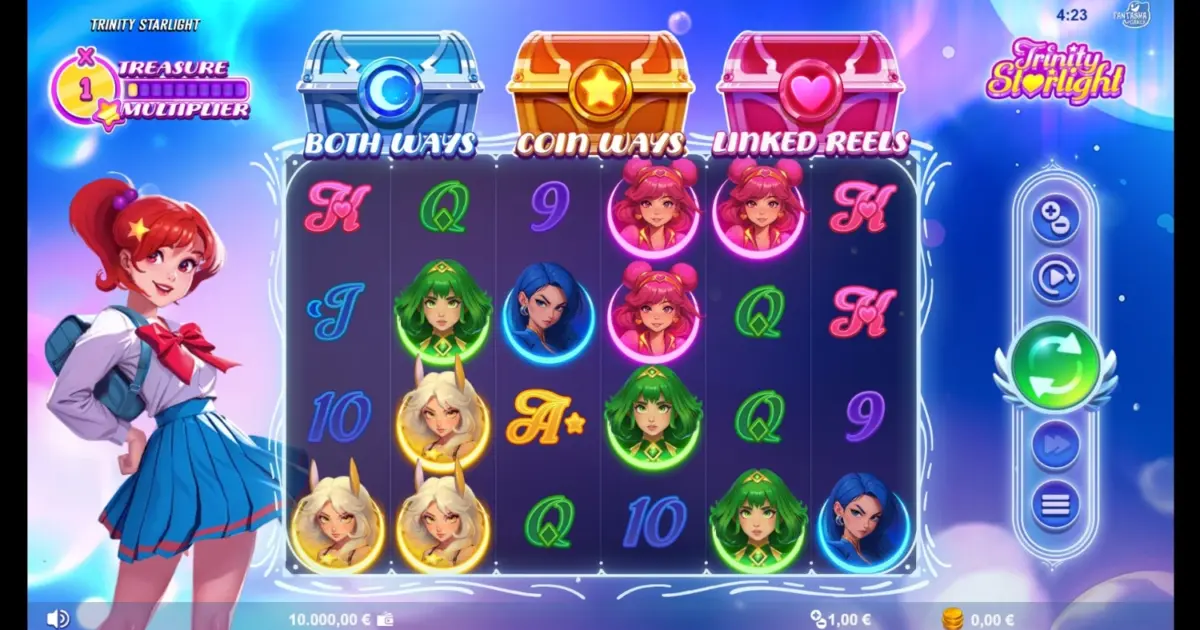
Trinity Starlight uses six reels, which is one more than the classic five-reel structure that dominates the market. In general, adding a reel expands the symbol matrix and can change how many positions are evaluated for wins, but the exact implication depends on whether the game uses fixed paylines, cluster pays, or a ways mechanic. That payline or ways count has not been published for this title, so you should check the in-game paytable rather than assume a number.
On a typical 6-reel game, if wins are counted on paylines, a win requires matching symbols on consecutive reels along a defined line from the leftmost reel, with the number of active lines shaping hit coverage and cost per spin. If the game uses ways, wins are usually counted for matching symbols on consecutive reels regardless of row, with the total ways calculated from the symbols per reel. Both systems still pay according to the paytable for symbol combinations, and six reels often means longer combinations are possible compared with five reels.
For session planning, the reel count alone does not tell you cost or frequency. A six-reel game with many ways can evaluate more combinations per spin, but that does not make returns more frequent or larger by itself; it simply defines how the game checks for wins. Without the published line or ways figure, focus on what is certain: six positions across, Magic as the primary theme, and 96.19% as the long-run return. Anything about specific symbols, wild behaviour, or scatter triggers would need to come from the provider’s paytable, which is not in the facts here.
Stake range and sizing a bankroll
No minimum stake, maximum stake, or default coin range has been published for Trinity Starlight in the data supplied. Without those numbers, you cannot calculate a precise spins-per-budget figure from this review alone, and you should verify the limits inside the game lobby before allocating funds.
Stake range matters because it sets the feasible session length. The general relationship is simple: your number of spins equals your session budget divided by your stake per spin, before any returns are considered. A smaller stake per spin extends the number of decisions you can make; a larger stake shortens it and magnifies both upswings and downswings. Because every spin is independent, changing stake size does not change the expected return percentage, it only changes exposure per decision.
Until you see the actual limits, a cautious way to frame a test session is to decide how many spins you want to observe and then work backwards from a budget you are comfortable treating as entertainment cost. For example, if you want to see 200 decisions and the lobby shows a £0.20 minimum, a £40 budget would cover those spins without accounting for returns; if the minimum were £0.10, the same £40 would cover 400 decisions. Adjust the figures to your own comfort, and remember that wins during the session will extend or shorten the count unpredictably.
Comparing within the studio can also help while the range remains unpublished. Prometheus Titan of Fire at 94.26% sits lower on return than Trinity Starlight, so if you are choosing between Fantasma Games titles on maths alone, the latter holds the percentage edge. Always confirm the stake options in-game, since providers sometimes offer different ranges by jurisdiction or operator.
Playing the trinity starlight slot demo before you commit
The free demo for Trinity Starlight is available, which lets you open the paytable, see the six-reel structure in practice, and get a sense of pace and presentation without wagering. Demo is the right place to check what this review cannot confirm from facts: the exact stake buttons, how the game counts wins, and any information screens about features. Use that view to decide if the tempo suits you, not to predict real-money outcomes.
Treat demo as a pricing and interface check, not a forecast. The random number generator does not remember demo results, and switching to real money does not make a game more or less likely to pay. A short demo run that looks generous or stingy is still a small sample inside a long-run model.
If you go on to play with real money, keep it as paid entertainment for adults. Set a budget before you start, use deposit or time limits where available, and stop when that budget is spent. If you need support, speak to a recognised help organisation in your country. You must be 18+ to gamble, and the expectation over time is a net cost of £3.81 per £100 wagered at this RTP, with wide variation in any single sitting.
Because the provider has not published volatility or max win for this title, demo is also where you can see whether the information screens address those points. If they remain absent there as well, assume they are undisclosed and size your play for uncertainty rather than for a specific swing size.
Verdict: who should play Trinity Starlight
Trinity Starlight suits players who prioritise a slightly above-average RTP in a Magic-themed, 6-reel format and who are comfortable with some unknowns. The 96.19% return is modestly ahead of both the corpus average and Fantasma Games’ own average, which is a clean, maths-based reason to prefer it over lower-return alternatives when theme is equal.
It is less suited to players who need a fully specified risk profile before committing. Without published volatility, stake range, or max win, you cannot model session length or swing size precisely, so you are buying into the return percentage and the reel count rather than a complete risk description. If that matters to you, compare with a title that does publish those details or keep stakes conservative until you have observed the game.
On theme, with 361 Magic titles in the tracked set, choice is abundant. If you want to stay in Magic but sample a different provider treatment, the related list gives you branching points without straying far from the brief. For a pure numbers comparison inside the same studio, the slightly lower 96.15% on Maze Escape Megaways keeps you close on return, while Prometheus Titan of Fire at 94.26% shows what a lower return looks like in the same catalogue.
Try the free demo first, confirm the paytable and stake limits in the lobby, and decide on a fixed entertainment budget. If the six-reel presentation and the 96.19% pricing appeal to you and you can tolerate undisclosed volatility, this is a reasonable addition to a Magic shortlist; if you need full disclosure on risk, keep it on the watchlist until Fantasma Games publishes more.
Frequently Asked Questions
Can I play Trinity Starlight for free without downloading anything?
Yes, the free demo for Trinity Starlight is listed as available, so you can load it in your browser to see the six-reel layout and paytable. Demo uses virtual credits and no download is indicated. Results in demo do not predict real-money play, because each spin is random and independent.
What is the RTP of Trinity Starlight and what does it mean for my session?
Trinity Starlight has a published RTP of 96.19%, which models a return of £96.19 per £100 wagered over many millions of spins. Over 1,000 spins at £1, that centres on £961.90 returned. Your short-term session can finish well above or below that average due to natural variation.
What is the volatility of Trinity Starlight?
No volatility rating has been published for Trinity Starlight in the supplied data, so there is no official low, medium or high classification to rely on. In general, low volatility favours smaller frequent returns and high volatility favours larger rare swings. Treat risk as undisclosed and size stakes cautiously.
Who makes Trinity Starlight and what else do they offer?
Trinity Starlight is made by Fantasma Games, a studio with 49 tracked titles averaging 95.94% RTP. Its catalogue includes titles like Maze Escape Megaways at 96.15% and Prometheus Titan of Fire at 94.26%, giving you nearby comparisons with published returns above and below this game's 96.19%.
What stake range does Trinity Starlight offer and how should I plan a bankroll?
The minimum and maximum stake for Trinity Starlight have not been published in the facts provided, so check the in-game lobby for the exact limits. As a guide, divide your session budget by your chosen stake to estimate spins, remembering that wins will vary. Every spin is independent, so stake size does not change the 96.19% expected return.