The numbers you can verify on the santa’s downfall slot are short but useful: GameArt, three reels, a return to player of 96.27%, and a free demo you can load without depositing. That RTP sits above the average of the games tracked here and above GameArt’s own house average, which makes it worth a look if you judge slots on published maths rather than presentation.
Santa’s Downfall at a glance
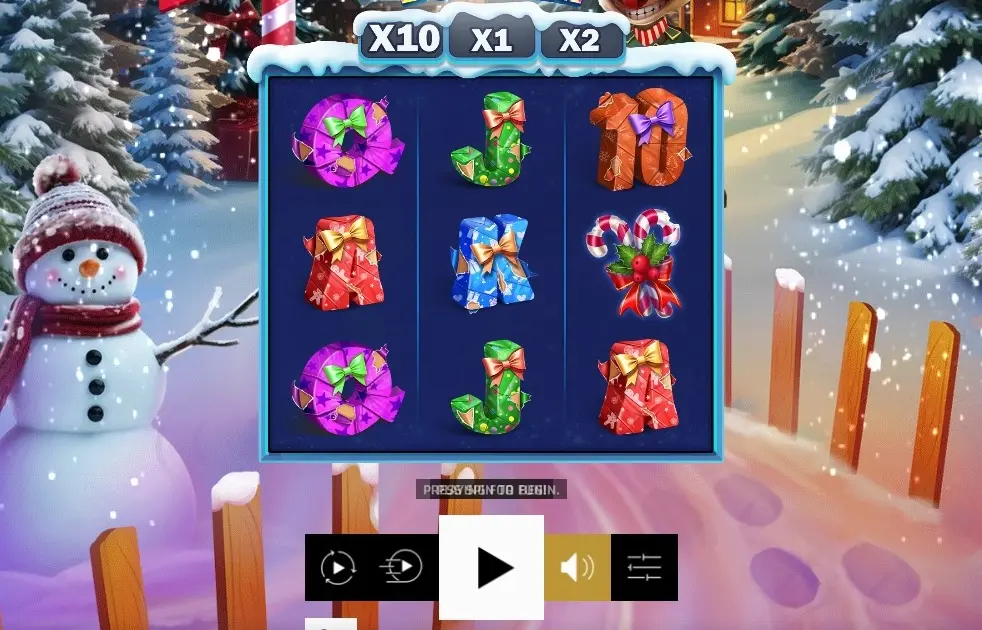
This is a winter-themed release from GameArt, a studio with 178 titles in our database. The theme labels attached to it are Winter, Christmas and 3-Reels, which tells you the setting and the cabinet shape and nothing more — GameArt has not published symbol details, bonus mechanics or a maximum win multiplier for this game, so treat any such figure you see quoted elsewhere as unverified.
| Figure | Value |
|---|---|
| Provider | GameArt |
| RTP | 96.27% |
| Reels | 3 |
| Primary theme | Winter |
| Category | Slot Machine |
| Popularity rank | 2,160 (89.2nd percentile) |
| Provider average RTP | 96.08% |
| Site average RTP | 95.71% |
| Free demo | Available |
It suits players who like short reel sets and a clear return figure. If you want a documented feature list before committing money, the missing paytable data is a genuine drawback, and the demo is the only way to fill that gap yourself.
What a 96.27% RTP actually returns
RTP is a long-run statistical average, not a session forecast. 96.27% means the game is modelled to return £96.27 for every £100 wagered across a very large number of spins — millions, not thousands. The 3.73% house edge is the part that does not come back.
Work it through. Wager £1 per spin for 1,000 spins and you have staked £1,000; the theoretical return on that turnover is £962.70, an expected cost of £37.30. Your actual result at that sample size will land well away from that figure in either direction, because 1,000 spins is statistically tiny. Ten thousand spins narrows the spread; it does not remove it.
Against the 95.71% average across the games catalogued here, this title runs 0.56 percentage points better — about £5.60 less expected cost per £1,000 staked. Against GameArt’s own 96.08% average across 178 games it is 0.19 points better. Both gaps are real but small. For comparison, Sweet FTN from the same studio publishes 96.55%, which is the higher figure if RTP is your only filter.
Unpublished volatility and what your session will feel like
GameArt has not published a volatility rating for this game, and no rating appears in our data. That absence matters, because volatility, not RTP, is what determines how a session feels. Two slots can both return 96.27% over the long run and deliver completely different experiences.
Low volatility means frequent small wins, a bankroll that drains slowly, and fewer long dry stretches — comfortable for long sessions at small stakes. High volatility means the same theoretical return arrives in fewer, larger payouts, so most spins return nothing and the swings between them are wide. High-variance games need a deeper bankroll relative to your stake simply to survive the gaps.
Without a published figure you cannot plan for either. The practical workaround is to run the demo for a few hundred spins and watch the pattern: how often anything lands, and how big the outliers are. That gives you a rough read on the shape of the game. It is a rough read only — a few hundred spins cannot pin down variance, and it tells you nothing about what your own real-money session will do.
The 3-reel layout and how wins are counted
Three reels is the classic cabinet shape. Fewer reels means fewer symbol positions, which means fewer possible combinations, which usually means a paytable built around a small number of lines rather than dozens. GameArt has not published the payline or ways count for this title, so the exact win-evaluation method is not something anyone can state from public data.
What holds generally: on a three-reel machine, wins are typically read left to right across one or more fixed lines, and the short reel set concentrates the return into fewer outcomes. Many three-reel games skip the expanded feature sets common on five-reel releases; some include wilds or a modest bonus mechanic. None of that can be asserted here, because the paytable is not documented in our data.
If you prefer knowing the structure in advance, the five-reel end of the winter category is generally better documented. Mammoth Tundra is another cold-weather title, though its 95.4% return is 0.87 points below this one — a difference of roughly £8.70 per £1,000 staked in expected cost.
Stake range and sizing a bankroll
No minimum or maximum stake is published for this game in our data, so check the range in the game client before you plan anything around it. Bet limits vary by operator as well as by title, so the figure you see may not match another site’s.
The sizing logic is the same whatever the range turns out to be. Decide your session budget first, then divide it by the number of spins you want the session to last. A £40 budget stretched across 400 spins puts you at £0.10 a spin; the same £40 at £1 a spin is a 40-spin session before variance is even considered. Neither is better — they are different products bought with the same money.
Two things worth stating plainly. Every spin is independent, so no stake pattern, timing or progression changes the 3.73% house edge; raising bets after losses increases how much you stake, nothing else. And the 96.27% figure applies to turnover, not to deposits, so a small budget recycled through many spins is exposed to the edge repeatedly.
Playing the Santa’s Downfall slot demo before you commit
A free demo is available, which is the most practical thing in this whole review given how much of the paytable is undocumented. Loading it costs nothing and requires no deposit, and it is the fastest way to see the symbol set, the feature set if there is one, and the bet range for yourself rather than taking a review’s word for it.
What the demo cannot do is predict money outcomes. Demo results have no bearing on what a real-money session produces — the maths is identical, the sample is short, and a good or bad run in play money is simply a short run. Treat it as a specification sheet you operate by hand, not as a test.
Slots are 18+ and priced entertainment, not a way to make money. Set a budget you are content to spend before you open the game, stop when it is gone, and keep gambling money separate from money you need. If it stops feeling like entertainment, close it.
Verdict: who should play Santa’s Downfall
This works for players who want a short reel set with a seasonal wrapper and a return figure that is modestly better than average. At 96.27% it beats the 95.71% site average and GameArt’s 96.08% house figure, and it ranks in the 89.2nd percentile for popularity here, so it is not an obscure release.
The case against is what is missing rather than what is there: no volatility rating, no published stake range, no documented paytable or max win. If you build session plans around those numbers, you will be working blind until you open the demo. That is a real limitation and not one a review can talk around.
Among winter titles, Barragan en Laponia publishes 95.0%, a full 1.27 points lower, so this remains the stronger of the two on return alone. Load the demo, check the bet range and paytable yourself, then decide — with this much data unpublished, that is the only sensible order.
Frequently Asked Questions
Can I play Santa’s Downfall for free?
A free demo is available, so you can load the game and spin with play credits without depositing. That matters more here than usual, because GameArt has not published the paytable, volatility rating or stake range for this title — the demo is the only way to see those details yourself before risking money.
What is the RTP of Santa’s Downfall?
The published RTP is 96.27%, meaning the game is modelled to return £96.27 per £100 wagered across a very large sample of spins. That leaves a 3.73% house edge. It runs 0.56 percentage points above the 95.71% average across the games tracked here and 0.19 above GameArt's 96.08% house average.
How volatile is Santa’s Downfall?
No volatility rating has been published for this game, so there is no verified answer. Volatility determines whether the 96.27% return arrives as frequent small wins or rare larger ones, and it drives how deep a bankroll you need. Running a few hundred demo spins gives a rough read, though not a reliable measurement.
Who makes Santa’s Downfall?
GameArt developed it. The studio has 178 titles in our database, averaging 96.08% RTP, so this release sits slightly above their own norm. Their other games include Sweet FTN at 96.55%, Kukulkan's Queen at 96.06%, and Dynamite Fruits Deluxe, for which no RTP figure is published in our data.
How does Santa’s Downfall compare to Mammoth Tundra?
On published return it is the stronger of the two: 96.27% against 95.4% for Mammoth Tundra, a gap of 0.87 percentage points or roughly £8.70 in expected cost per £1,000 staked. Both carry winter themes. Neither has a published volatility rating, so risk profiles cannot be compared on data.