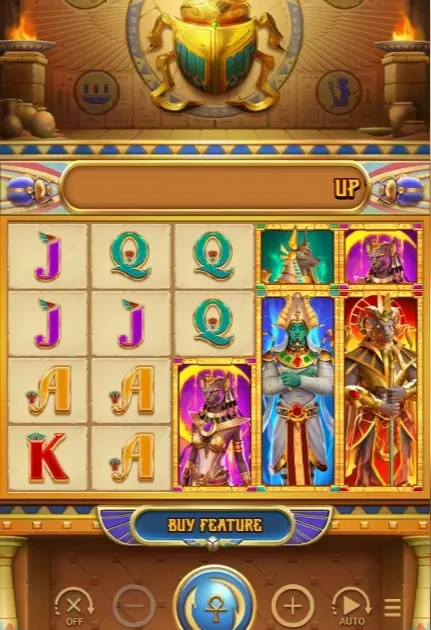
Temple of Gods is a mythology-themed slot from Naga Games with a 96.5% RTP and a 5-reel layout. That return sits a touch above the broader market average and almost exactly on the provider’s own average, so your session will live or die on variance rather than a notably generous or tight paytable. If you want a measured, demo-first comparison rather than promises, the temple of gods slot gives you a clean numbers-led starting point.
First look at Temple of Gods slot
Naga Games has built a catalogue of 35 titles, and Temple of Gods falls within the largest theme group in the data — Mythology, which includes 801 games in this corpus. Its primary theme is listed as Mythology, with secondary tags of Egypt and 5-Reels, which tells you the broad inspiration without pinning down specific characters, art style, or soundtrack — none of which are supplied in the facts for this title.
What is supplied is more useful for comparison. The game uses 5 reels, is classified under Slot Machine, and ranks at position 2119 in the popularity data supplied, placing it in the 89.4th percentile. That rank suggests it is not among the handful of most-played blockbusters, but it is far from obscure. Naga Games has not published additional specifics for this title in the facts block — there is no disclosed volatility level, no listed payline or ways count, no stake range, and no stated max win figure. Missing data is itself a signal: treat any claim about those figures that you encounter elsewhere as unverified until you see it in the paytable or help file inside the game client.
The value in a first look, then, is to anchor expectations. You know the provider, the reel count, the theme family, and two comparator averages: Naga Games averages 96.61% RTP across its 35 games, and the wider corpus averages 95.71%. Temple of Gods at 96.5% sits 0.11 points below its provider average and 0.79 points above the corpus average. Those margins are small, but they frame the rest of the review accurately.
How a round plays out
The only concrete mechanic disclosed for Temple of Gods is that it plays on 5 reels. That tells you the grid has five vertical columns that spin independently and then stop to display symbols. How those symbols pay — whether via fixed paylines, selectable lines, or a ways system where matching symbols on consecutive reels suffice — is not disclosed in the facts, so no specific number can be stated here. If the in-game help screen lists a payline count or ways figure, use that as the definitive source.
Beyond that single fact, it helps to think in general slot terms without attributing them to this game. Many modern 5-reel slots use wild symbols that substitute for regular symbols, and scatter symbols that pay or trigger features regardless of line position. Many allocate a free-spins feature, sometimes with modifiers, and some offer a buy-option to enter that feature at a cost. Those are common concepts, not claims about Temple of Gods. Because the facts for this title do not list any such features, the honest approach is to open the demo, check the paytable and rules pages, and confirm what actually exists before you factor any bonus into your decision.
Stake handling is also left to the game client here. The facts do not list a minimum stake, maximum stake, or coin-denomination range, so session planning should start in demo mode: locate the bet controls, see the allowed range, and note whether the game lets you adjust lines, ways, or coin value. Each spin is independent — the reels have no memory of previous results — so understanding the controls and pay rules up front prevents mismatched expectations later.
Reading the 96.5% return figure
96.5% RTP means £96.50 is returned per £100 wagered across a very large sample, not in your session. Return to player is a long-run statistical average calculated over millions of spins. In a short sample of a few hundred or even a few thousand spins, your actual return can sit well above or below that figure because wins and losses cluster randomly.
To make the figure tangible, scale it. At 96.5%, the theoretical loss — the house edge — is 3.5%. If you wager £1 per spin, £100 of total wagers has a theoretical return of £96.50 and a theoretical loss of £3.50 over an enormous sample. At 500 spins at £1, you will have wagered £500; the long-run expectation is £482.50 back and £17.50 retained by the house. At 1,000 spins at £0.50, you still wager £500, so the same expectation applies. The maths is linear with total amount wagered, not with time spent or number of bonus triggers.
Context matters. Temple of Gods at 96.5% is 0.79 points above the corpus average of 95.71%, which is a modest uplift — about £0.79 extra per £100 wagered in the long run versus the average game in this data set. Against Naga Games’ own average of 96.61%, it is 0.11 points lower, essentially on par. Small differences compound over volume, but they do not override variance in a single sitting. A useful way to separate the two ideas is: RTP sets the long-run centre point, volatility sets how wildly individual sessions swing around that centre.
| Figure | Value |
|---|---|
| Provider | Naga Games (35 games, avg RTP 96.61%) |
| RTP | 96.5% |
| Reels | 5 |
| Themes | Mythology (primary), Egypt, 5-Reels |
| Corpus average RTP | 95.71% (+0.79 vs this game) |
| Popularity rank | 2119 (89.4th percentile) |
| Free demo | Available |
Because volatility is not disclosed for this title, the RTP figure should be read as the only firm maths anchor you have before seeing the paytable in-game. Check whether the provider publishes a volatility rating or hit-frequency note inside the help file; if not, use the demo to observe pay distribution conceptually, without treating any short demo sample as predictive of real-money results.
Why volatility changes your bankroll maths
Volatility — sometimes labelled variance — describes the shape of the pay distribution, not the average return. A low-volatility game tends to produce more frequent, smaller wins that keep your balance ticking over and often stretch session length. A high-volatility game tends to produce longer dry spells punctuated by larger individual wins, which can shorten sessions unless your bankroll is sized to absorb the gaps. Medium volatility sits between those two patterns.
For Temple of Gods, the facts do not include a volatility rating, so no low, medium, or high label can be assigned here. That absence changes how you should plan. Without a stated level, you cannot reliably estimate how many spins a given bankroll will support or how large a downswing to allow for. The responsible way to fill the gap is to treat volatility as unknown and adopt a conservative planning stance: decide on a total budget for the entertainment session, divide it into a number of spins you are comfortable with at a modest stake, and be prepared to stop if variance goes against you, because every spin is independent and there is no point at which a win becomes due.
In general terms, bankroll maths is simple division with a variance caveat. Your number of spins equals your session budget divided by your stake per spin, assuming you re-bet wins or not. Volatility then determines how bumpy that path is likely to be. Because this title does not disclose that shape, avoid any system that raises stakes after losses or wins to chase a target; no progression changes the 3.5% long-run house edge implied by the 96.5% RTP, and each spin’s outcome remains random.
Bet sizing and stake planning
No minimum stake, maximum stake, or coin range is listed for Temple of Gods in the facts supplied, so the precise bet sizing cannot be described here. That means any planning has to start from general principles and be completed in the demo client where the actual controls are displayed. Missing stake information is common in third-party data feeds; the in-game settings and paytable are the authoritative source.
The general principle is straightforward: total wagered equals stake per spin multiplied by number of spins. If you set a session budget of £30 and choose £0.30 per spin, you have 100 spins if you ignore returns that recycle into the balance; with returns, you may get more spins, but you should never count on that to extend a session. If the game later shows a wide stake range — for example, from £0.10 to £100 — your personal range should still be set by your entertainment budget, not by the limits the game allows.
Because reel count alone does not determine cost per spin, the 5-reel layout does not imply a specific stake. Some 5-reel games tie stake to a fixed number of paylines or ways; others let you adjust coin value or bet level. Until you see which model this game uses, the most reliable step is to launch the free demo available for this title and confirm the smallest increment the plus and minus controls will allow, how line or ways selection — if any — affects total bet, and whether an autoplay limit helps you stick to your spin budget.
Where Temple of Gods sits among Mythology slots
Mythology is a crowded category with 801 games in this corpus, so direct RTP comparisons are a quick way to sort options. Temple of Gods at 96.5% matches one well-known peer and sits above another while trailing the provider’s own higher-RTP alternative.
Among mythology-themed games in the related set, Gates of Olympus also carries 96.5% RTP, making the two equal on long-run return alone; any preference between them would come down to pay distribution, presentation, and whether you prefer the specific mechanics disclosed in each game’s help files. By contrast, 9 Arrows of Odysseus at 94.0% RTP sits 2.5 points lower, which translates to £2.50 less per £100 wagered over a very large sample compared with Temple of Gods. That is a material gap if you play volume, though volatility differences can outweigh it in any single session.
Within the provider’s own catalogue, Amazing Circus from Naga Games lists 97.19% RTP, 0.69 points above Temple of Gods, while Vault of Riches at 96.29% sits 0.21 points below it. Those figures illustrate that Naga Games clusters around the mid-96% band; Temple of Gods is representative rather than an outlier. If your shortlist is built purely on return, the higher-RTP provider sibling is the logical demo to run side by side, but if you are choosing by theme, mythology comparisons should weigh the full paytable and stated volatility — where disclosed — rather than RTP alone.
The honest verdict
Temple of Gods is a straightforward proposition on the numbers you can verify: 5 reels, Mythology-led theme, 96.5% RTP that sits just above the market average and almost exactly on Naga Games’ house average. The facts do not disclose volatility, paylines or ways, stake limits, or a max win figure, so any verdict that leans on those elements would be guesswork. On what is known, the return figure is competitive without being exceptional, and the theme places it in a large, well-served category where side-by-side demos are easy to arrange.
The sensible way to try it is as a free demo first. Confirm the paytable, the line or ways structure, the real stake range, and whether a volatility descriptor appears in the help file. Treat the demo as a way to learn the rules and see if the presentation suits you, not as a predictor of real-money results — demo credits and real-money outcomes come from the same random process per spin, but short samples in either mode do not forecast the next session.
Set a budget before you play, stick to it, and treat slots as paid entertainment, not a way to make money. You must be 18+ to play. Use deposit or loss limits where available, take regular breaks, and step away if it stops being fun. If gambling becomes a concern, seek support from a recognised responsible-gambling organisation in your jurisdiction and use self-exclusion tools if needed. No bet size, timing, or system changes the underlying maths, and each spin is independent.
Frequently Asked Questions
Can I try Temple of Gods as a free demo without downloading?
A free demo is listed as available for Temple of Gods, so you can learn the paytable and controls without wagering. Demo play uses the same random spin process but does not pay real money and does not predict real-money results. Use it to confirm reel behaviour and stake options before deciding.
What does the 96.5% RTP on Temple of Gods actually mean for my session?
The 96.5% return to player is a long-run average over millions of spins, not a promise for one sitting. It implies about £96.50 returned per £100 wagered across a huge sample, with a 3.5% house edge. Short sessions will vary widely above or below that average due to randomness.
What volatility does Temple of Gods have and how would it affect my bankroll?
No volatility rating is disclosed for Temple of Gods in the facts supplied, so a low, medium or high label cannot be assigned. Without that, size your bankroll conservatively and plan your number of spins from your budget divided by stake. Remember each spin is independent and volatility only describes swing size.
Who makes Temple of Gods and what else do they offer?
Temple of Gods is made by Naga Games, which has 35 titles in this data set with an average RTP of 96.61%. That puts Temple of Gods at 96.5% almost exactly on the provider average. Naga Games also offers titles such as Amazing Circus at 97.19% and Vault of Riches at 96.29%.
How does Temple of Gods compare to Gates of Olympus on return?
Temple of Gods and Gates of Olympus both list 96.5% RTP, so their long-run return centre is identical on that metric alone. The difference in experience would come from undisclosed factors like volatility, paytable structure and presentation. Try both demos and compare their help files before choosing where to spend your budget.